
The Environment
- Microsoft 365 environment for email, collaboration, and document workflows
- Shared client file repositories with sensitive accounting and tax records
- Multiple workstations used by partners, staff accountants, and administrative users
- Existing backup platform with limited recovery visibility
- No documented recovery procedures for business-critical data
- High-pressure peak periods during tax season and audit preparation
What ITAD4Me Did
- Reviewed backup configuration, retention policies, and protected data sources
- Verified coverage across systems, users, shared data, and business-critical files
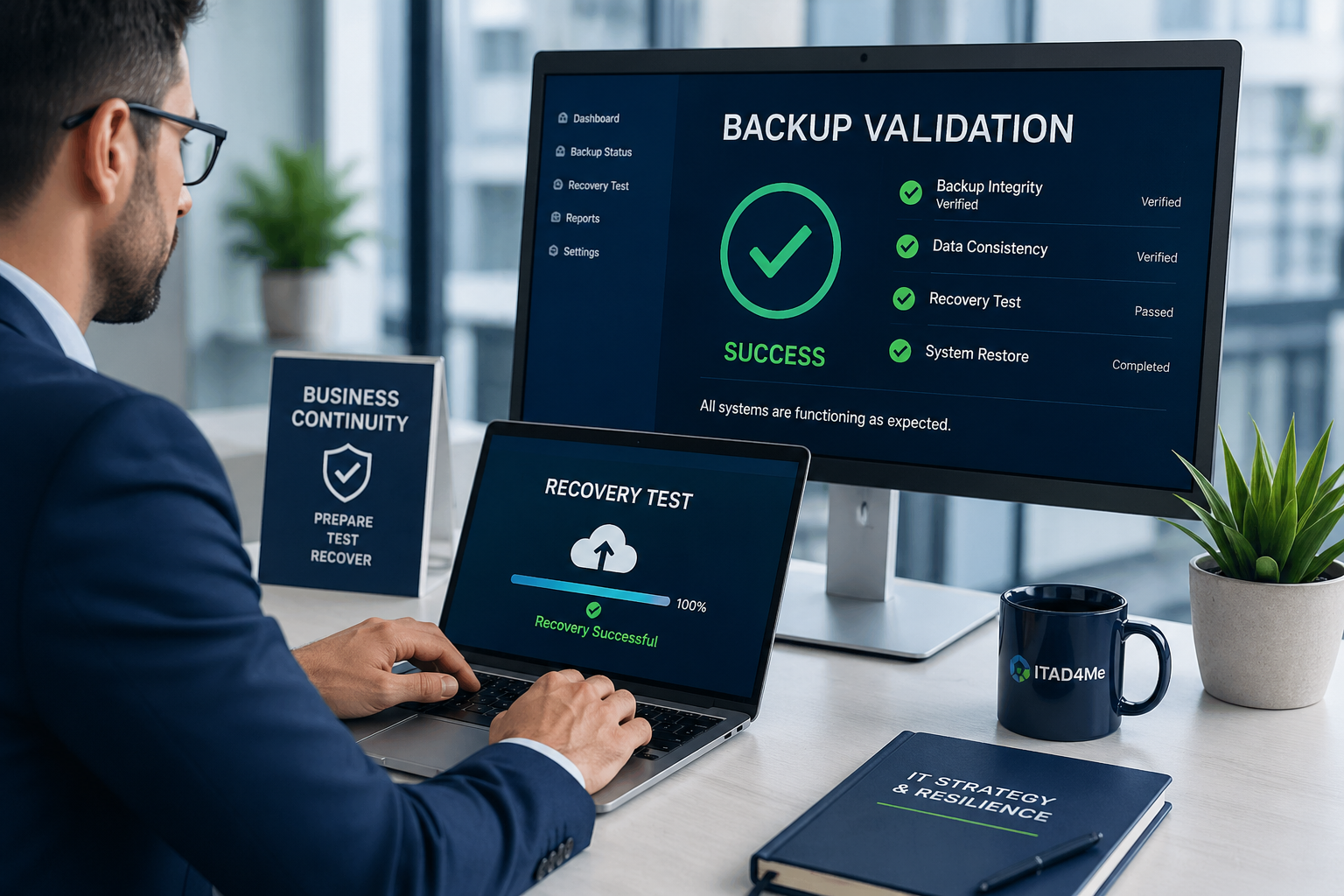
- Performed controlled recovery testing for key datasets and user environments
- Identified gaps where data was not clearly protected or easily recoverable
- Documented recovery procedures for practical, repeatable use
- Improved monitoring and alerting for failed or incomplete backup jobs
- Established a repeatable validation schedule to maintain recovery readiness
- Aligned backup validation with business continuity and cybersecurity strategy
The Results
- Confirmed that critical client data could be restored when needed
- Reduced uncertainty before peak tax and audit periods
- Provided clear recovery documentation for leadership and staff
- Improved visibility into backup failures and coverage gaps
- Strengthened resilience against outages, accidental deletion, and cyber incidents
- Established a repeatable validation process instead of relying on assumptions
Related Services Used
This case study connects to Backup & Recovery , Business Continuity , Cybersecurity , Managed IT Services , Help Desk .
Background
The firm had a backup solution in place, but leadership did not have confidence in the recovery process. Reports indicated that backups were running, but no recent validation had confirmed whether critical business data could actually be restored quickly and accurately.
For a CPA firm, that uncertainty carries real risk. Tight filing deadlines, client expectations, and regulatory obligations mean that even a short disruption can impact operations and credibility.
ITAD4Me approached the engagement as a recovery-readiness initiative, not just a backup review.
The Business Risk
The core issue was not the absence of a backup system. The issue was reliance on unverified assumptions.
A backup job can report success while still missing key data, incomplete file sets, or recent changes. Without testing, businesses cannot confirm recovery speed, accuracy, or completeness.
The firm needed clear answers to operational questions:
- What data is actually protected?
- Where are the gaps in coverage?
- How quickly can critical data be restored?
- Who is responsible for recovery?
- What happens when a backup fails?
- How often should validation occur?
ITAD4Me’s Approach
ITAD4Me began with a structured review of the existing backup environment, aligning technical configuration with real-world business usage across Microsoft 365, shared files, and user systems.
Controlled recovery testing was then performed to validate real outcomes, not assumptions. This allowed the team to identify gaps, confirm recovery capability, and document repeatable procedures.
Backup validation was also aligned with broader business continuity planning. Recovery readiness impacts operations, client service, compliance, and cybersecurity posture. Treating it as a one-time technical task leaves risk unaddressed.
Outcome
The firm gained clarity, documentation, and confidence in its ability to recover critical data.
Instead of relying on status reports, leadership now has validated recovery processes, improved visibility, and a structured approach to ongoing testing.
For a Dallas-Fort Worth CPA firm, that translates directly into reduced operational risk during peak periods, stronger resilience against disruptions, and improved confidence across the organization.
Services Connected to This Case Study
This engagement directly relates to Backup & Recovery, Business Continuity, Cybersecurity, and Managed IT Services.
A backup strategy is not just about storing data. It is about ensuring recovery works when the business depends on it.