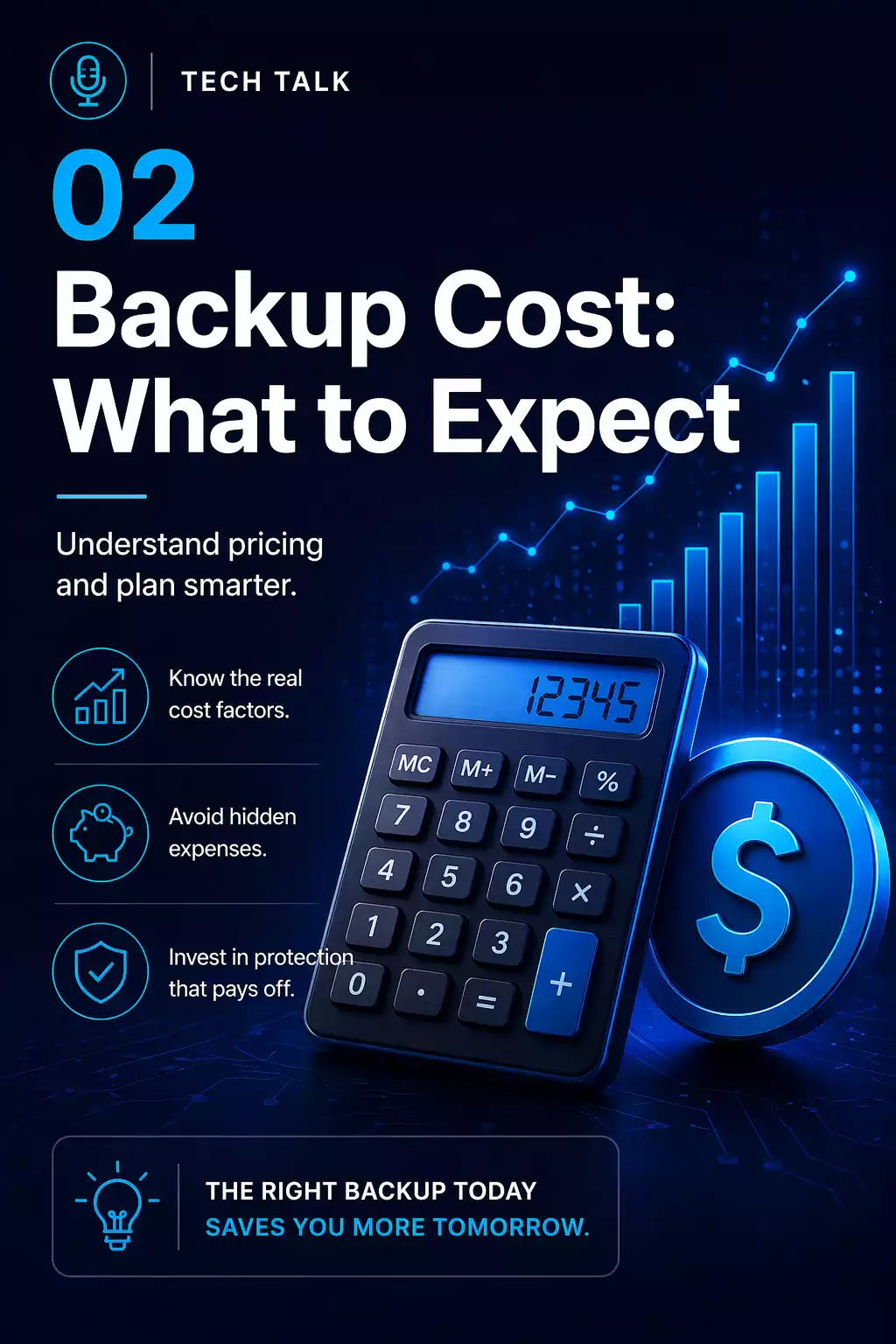
Why Backup Cost Is Often Misunderstood
Most businesses evaluate backup based on:
- storage size
- monthly price
- vendor comparison
But these factors do not reflect the true cost.
The real cost of backup is not what you pay monthly — it is what happens when recovery is needed.
What a Real Cost Scenario Looks Like
A typical situation:
- a business chooses a low-cost backup solution
- backups run successfully for months
- a failure occurs
- recovery is slow or incomplete
- downtime extends for hours or days
At that point:
- lost productivity exceeds any savings
- operations are disrupted
- financial impact increases rapidly
The cost of poor backup is almost always higher than the cost of doing it correctly.
What Actually Drives Backup Cost
Backup pricing is influenced by multiple factors.
1. Data Volume
More data requires:
- more storage
- more transfer bandwidth
This is the most visible cost driver.
2. Backup Frequency
More frequent backups:
- increase storage usage
- increase system load
But they also reduce data loss.
3. Retention Period
Longer retention:
- increases storage cost
- improves recovery options
This is a major factor in total cost.
See
backup retention.
4. Recovery Speed Requirements
Faster recovery requires:
- local backup systems
- high-performance infrastructure
- optimized storage
This directly impacts
RTO.
5. Protection and Security
Advanced features increase cost:
- immutable backups
- encryption
- access controls
But they significantly reduce risk.
6. Infrastructure Complexity
Costs increase with:
- number of systems
- cloud platforms
- application dependencies
More complexity = more management and recovery effort.
Typical Backup Cost Ranges
While pricing varies, general ranges include:
Basic Backup (Minimal Protection)
- low monthly cost
- limited retention
- slower recovery
👉 Higher risk during incidents
Standard Backup (Balanced Approach)
- moderate monthly cost
- reasonable retention
- moderate recovery speed
👉 Suitable for many small businesses
Advanced Backup (High Resilience)
- higher monthly cost
- long retention
- fast recovery
- strong protection (immutability, isolation)
👉 Designed for critical operations
Cost increases as recovery speed, retention, and protection improve.
The Hidden Costs of Backup
The biggest costs are often not visible.
Downtime
- lost productivity
- lost revenue
- operational disruption
Data Loss
- missing records
- incomplete transactions
- manual reconstruction
Recovery Delays
- extended outages
- customer impact
- reputational damage
The true cost of backup is measured during recovery — not during billing.
Why “Cheap Backup” Is Risky
Low-cost solutions often:
- prioritize storage over recovery
- lack protection against ransomware
- have limited retention
- provide slow recovery
These gaps lead to
backup failures.
Cost vs Risk Trade-Off
Backup cost is directly tied to risk.
- lower cost → higher risk
- higher cost → lower risk
Reducing backup cost often increases the potential impact of an outage.
How to Evaluate Backup Cost Properly
Instead of asking:
👉 “How much does backup cost?”
Ask:
- how quickly do we need to recover?
- how much data can we afford to lose?
- what happens if recovery fails?
These answers define:
- the solution you need
- the cost you should expect
How Cost Fits Into a Full Strategy
Backup cost must align with:
How to Know If You Are Underinvesting
You may have a gap if:
- you chose the lowest-cost solution
- recovery timelines are unknown
- backups are untested
- protection is minimal
If cost was the primary factor in your decision, your strategy may not meet your recovery needs.
What This Means for Your Business
Backup is not just an expense.
It is a risk management decision.
The right investment in backup reduces the impact of downtime and data loss.
Final Thoughts
Backup cost should be evaluated based on:
- risk
- recovery capability
- business impact
—not just price.
Need help with this topic?
Make sure your backups actually work when it matters.
Most businesses discover backup failures during an outage. We help you validate recovery, reduce downtime risk, and build a system that works under pressure.
- Backup validation and testing
- Recovery time optimization
- Clear recovery documentation