The Biggest Misconception About Cloud Applications
Many businesses believe:
👉 “Our data is safe because it’s in the cloud.”
This is one of the most common and dangerous assumptions.
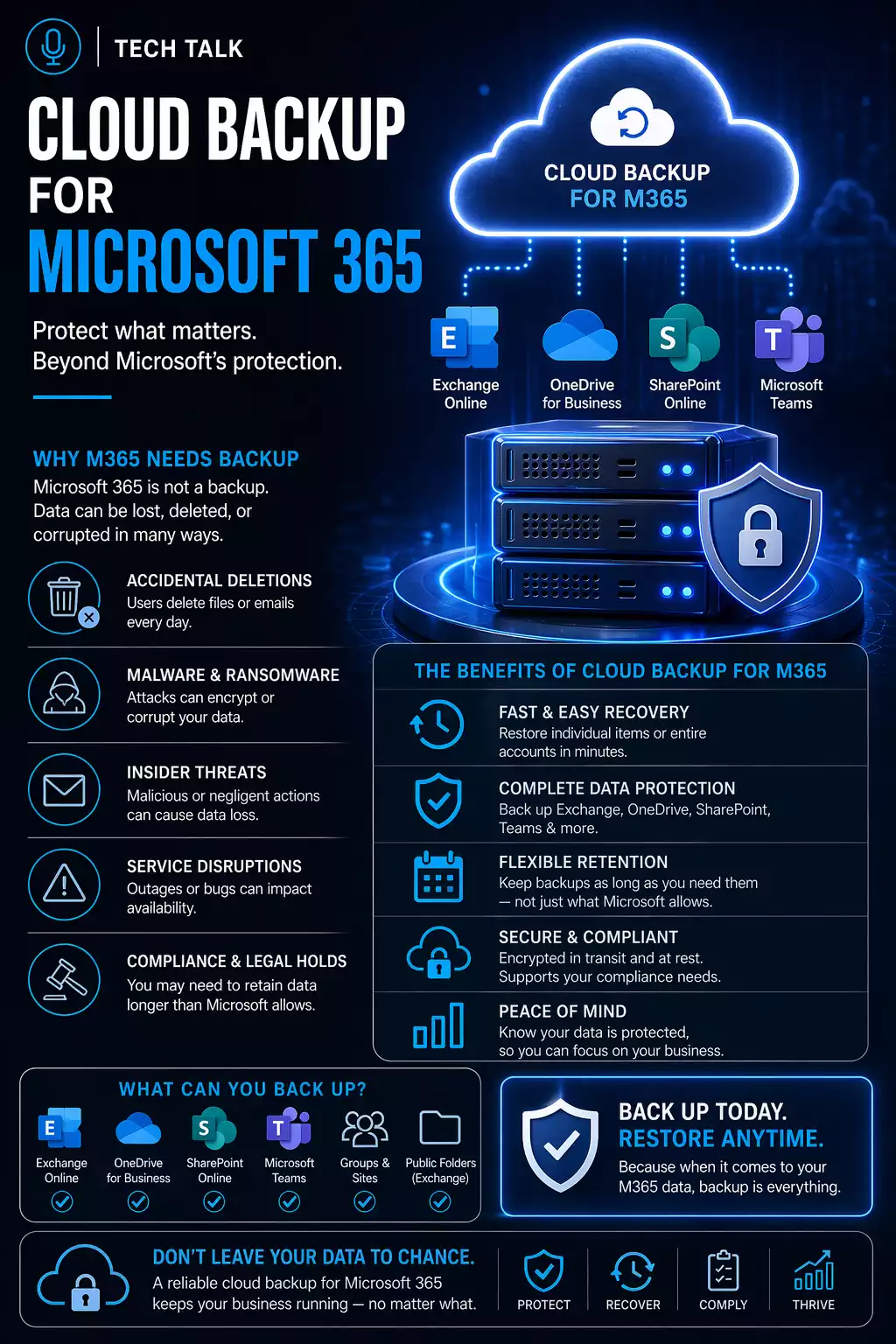
Platforms like Microsoft 365 and Google Workspace are highly reliable — but they are not backup solutions.
Cloud providers ensure availability of their service — not full protection of your data.
What the Cloud Actually Protects
Cloud platforms are responsible for:
- infrastructure uptime
- system availability
- hardware redundancy
This ensures:
- applications stay online
- systems remain accessible
But it does NOT guarantee:
- protection from deletion
- protection from ransomware
- long-term data recovery
The Shared Responsibility Model
Cloud providers operate under a shared responsibility model.
The Provider Is Responsible For:
- infrastructure
- uptime
- physical security
You Are Responsible For:
- your data
- access control
- retention
- recovery
Your data is your responsibility — even in the cloud.
What a Real Cloud Data Loss Scenario Looks Like
A typical situation:
- an employee deletes important files or emails
- data is moved to recycle bins
- retention periods expire
- data is permanently deleted
Or:
- a ransomware attack compromises user accounts
- files are encrypted or deleted
- changes sync across cloud storage
- clean versions are overwritten
At that point:
- recovery options are limited
- data may be permanently lost
Cloud platforms often replicate problems just as quickly as they replicate data.
What Built-In Retention Does (and Does Not Do)
Cloud platforms include basic retention features:
- recycle bins
- version history
- limited retention policies
These help with:
- short-term recovery
- accidental deletion
But they are limited:
- retention windows may be short
- policies may not cover all data
- changes can overwrite clean versions
Retention features are not a substitute for a true backup system.
Why Ransomware Still Impacts Cloud Data
Cloud data is not immune to ransomware.
Attackers can:
- access user accounts
- encrypt or delete files
- trigger synchronization across systems
This means:
- corrupted data replaces clean data
- version history may be limited
- recovery windows shrink quickly
Cloud platforms can propagate ransomware changes — not prevent them.
What a True Cloud Backup Solution Provides
A real backup solution for cloud apps includes:
- independent copies of data
- separate storage from the cloud platform
- long-term retention
- protection from deletion or modification
A true backup creates a separate, protected copy — not just another version of the same data.
How Cloud Backup Fits Into a Full Strategy
Cloud backup is one layer of a complete system.
A full approach includes:
- cloud application backup
- local or hybrid backup systems
- protected storage (immutability)
This aligns with modern backup strategies.
Common Mistakes Businesses Make
Many organizations:
- rely only on built-in retention
- assume cloud providers handle backups
- do not test recovery
- lack visibility into data protection
These lead to backup failures.
How to Know If You Are at Risk
You may be vulnerable if:
- you rely only on Microsoft 365 or Google Workspace retention
- you have no independent backup system
- you have never tested cloud data recovery
- you do not know how long data is retained
If your cloud data exists only in the cloud platform, it is not fully protected.
What This Means for Your Business
Cloud applications improve accessibility and collaboration.
But they do not eliminate the need for backup.
Cloud platforms ensure access — backup solutions ensure recovery.
Final Thoughts
Moving to the cloud changes how systems are managed — but not the need for data protection.
Backups are still required.
Need help with this topic?
Make sure your backups actually work when it matters.
Most businesses discover backup failures during an outage. We help you validate recovery, reduce downtime risk, and build a system that works under pressure.
- Backup validation and testing
- Recovery time optimization
- Clear recovery documentation