Start With Tolerance, Not a Calendar
Before “how often,” answer:
- How many hours of outage can we tolerate for ERP?
- How many hours of email loss are acceptable?
- How many days of file rollback are acceptable for legal or finance?
Those answers define how often you must prove recovery—not how often backups should run.
A quarterly restore test is worthless if your team deploys major ERP changes weekly and never rehearses rollback paths.
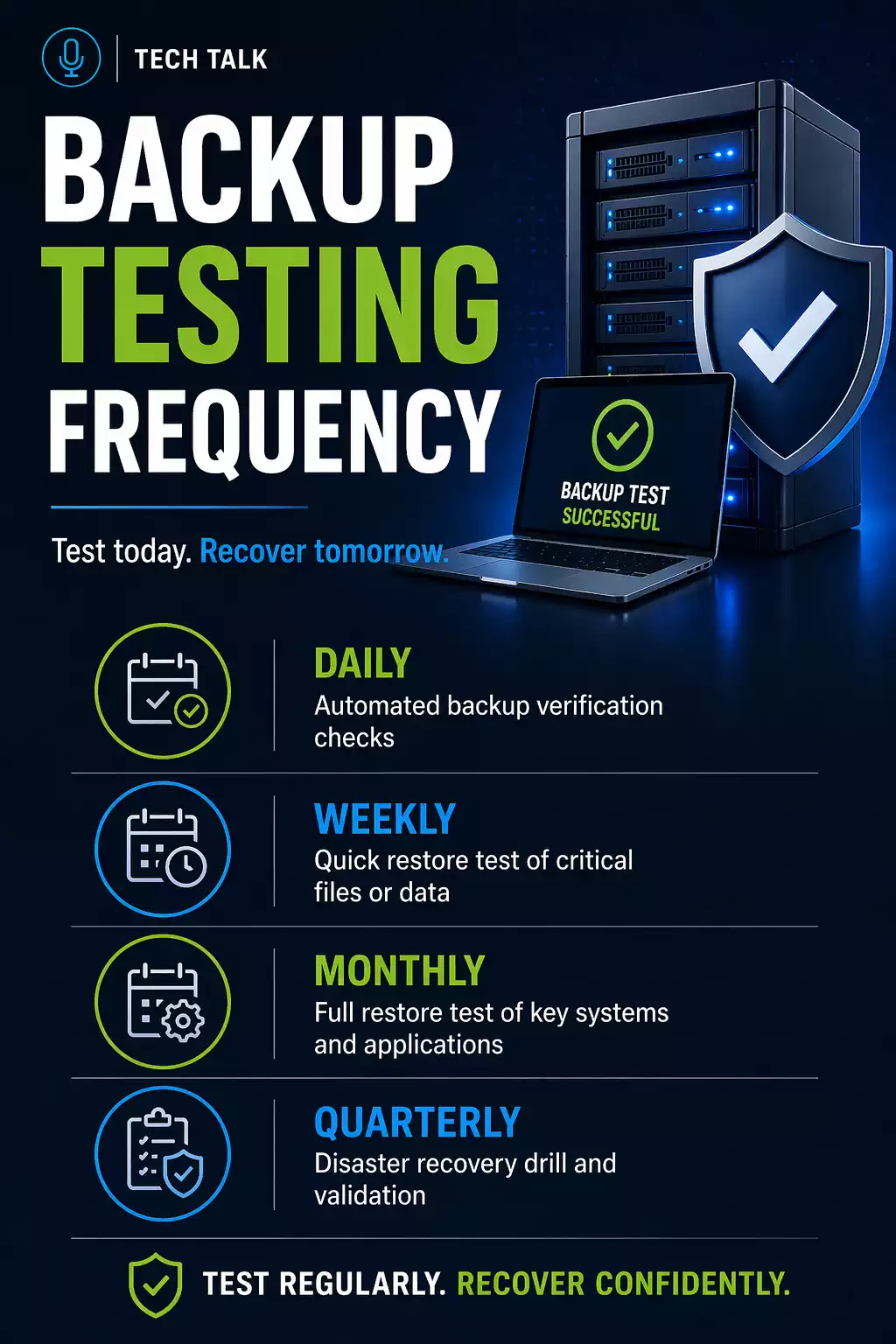
Suggested Cadence by Workload
Weekly or bi-weekly
- High-change transactional databases
- Systems where a failed deploy could stop shipping
Use small scoped restores (clone to isolated network) rather than full disasters every week.
Monthly
- Primary file services used by revenue teams
- Identity systems when frequent group policy or MFA changes occur
Quarterly (minimum for most SMBs)
- Full documented recovery exercise touching multiple dependencies
- Review of offsite copies and vendor runbooks
Pair this cadence with the deeper guidance in how often should you test backups.
Real-World Example
A manufacturer tested backups monthly—but only file restores.
When SAN firmware corrupted a LUN, the team discovered their “server restore” depended on a driver pack that had been retired from the vendor portal.
The lesson was not “test more often.” It was test the actual recovery path you would use, including bare-metal or VM rebuild assumptions.
Connect Testing to Services
- Recovery testing & runbooks formalize what “good” looks like beyond ad-hoc IT heroics.
- Fast, documented recovery is where wall-clock results meet leadership expectations.
For broader continuity context, see disaster recovery vs backup.
Final Thoughts
The right frequency is the one that keeps your worst-case story boring.
If leadership cannot articulate RTO/RPO in plain English, start there—then test restores often enough that technicians are not improvising during the first live incident.
Need help with this topic?
Make sure your backups actually work when it matters.
Most businesses discover backup failures during an outage. We help you validate recovery, reduce downtime risk, and build a system that works under pressure.
- Backup validation and testing
- Recovery time optimization
- Clear recovery documentation