Why Backup Type Matters
Not all backups work the same way.
The type of backup you use directly affects:
- how long backups take
- how much storage is required
- how quickly you can recover
The wrong backup method can slow recovery or increase risk — even if backups are running successfully.
What a Real Backup Scenario Looks Like
In a typical environment:
- backups run automatically
- incremental changes are captured daily
- full backups run periodically
When recovery is needed:
- multiple backup sets must be combined
- data must be reconstructed
- recovery takes longer than expected
Recovery complexity is often determined by how backups were created — not just whether they exist.
What Is a Full Backup
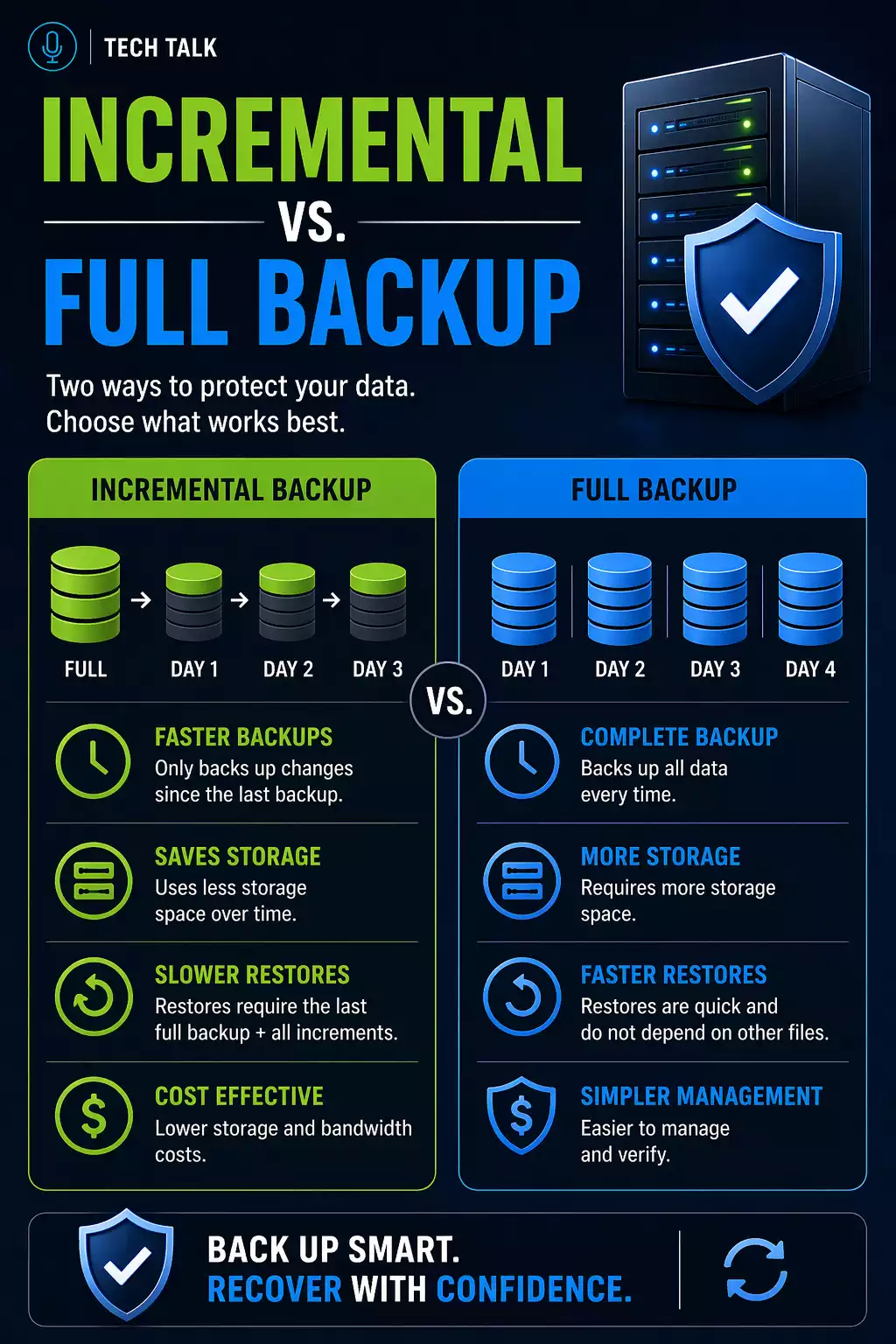
A full backup copies all data every time it runs.
This includes:
- files
- applications
- system data
Each full backup is a complete, standalone copy.
Advantages of Full Backup
- simple to restore
- independent recovery points
- lower risk of corruption during recovery
Full backups provide the simplest and most reliable recovery process.
Limitations of Full Backup
- takes longer to complete
- uses more storage
- may impact system performance
Full backups prioritize recovery simplicity over efficiency.
What Is an Incremental Backup
An incremental backup captures only data that has changed since the last backup.
This means:
- the first backup is full
- subsequent backups store only changes
Advantages of Incremental Backup
- faster backup times
- reduced storage usage
- less impact on systems
Incremental backups are efficient and minimize system load.
Limitations of Incremental Backup
- more complex recovery
- dependent on multiple backup sets
- higher risk if one backup is missing or corrupted
Recovery requires reconstructing data from multiple backup points.
How Recovery Actually Works
This is where the biggest difference appears.
Full Backup Recovery
- restore a single backup
- systems are rebuilt from one point
👉 Faster and simpler recovery
Incremental Backup Recovery
- restore the last full backup
- apply each incremental backup in sequence
- reconstruct the most recent state
👉 Slower and more complex recovery
The more incremental backups involved, the longer and more complex recovery becomes.
The Hidden Risk: Chain Dependency
Incremental backups create a chain.
If any link in that chain fails:
- recovery may fail
- data may be incomplete
- timelines increase
A single corrupted incremental backup can affect the entire recovery process.
Why Most Systems Use Both
Modern backup systems combine both approaches:
- periodic full backups
- frequent incremental backups
This balances:
- efficiency
- storage
- recovery performance
Combining full and incremental backups provides both performance and recoverability.
How Backup Type Impacts Recovery Time
Backup type directly affects
Recovery Time Objective (RTO).
- full backups → faster recovery
- incremental backups → slower recovery
Backup efficiency does not equal recovery speed.
How Backup Type Impacts Data Loss
Backup type also affects
Recovery Point Objective (RPO).
- more frequent incrementals → less data loss
- less frequent backups → more data loss
Common Mistakes Businesses Make
Many organizations:
- rely only on incremental backups
- do not run full backups often enough
- do not test recovery
- underestimate restore complexity
These lead to backup failures.
What Actually Slows Down Recovery
Even with good backups, delays occur due to:
- large data sets
- network speed limitations
- dependency between backup sets
- system complexity
Recovery is often slowed by data reconstruction — not just data transfer.
How to Choose the Right Approach
The right strategy depends on:
- data size
- system complexity
- recovery requirements
A common approach:
- full backup weekly
- incremental backups daily or hourly
This aligns with a complete
backup strategy.
How to Know If Your Setup Has Gaps
You may be at risk if:
- you rely only on incremental backups
- you do not know your recovery timeline
- you have never tested a full restore
- your backup chains are not validated
If you cannot restore quickly and reliably, your backup design may be flawed.
What This Means for Your Business
Backup type is not just a technical choice.
It affects:
- recovery speed
- data integrity
- operational continuity
The best backup strategy balances efficiency with recoverability.
Final Thoughts
Incremental and full backups serve different purposes.
The right approach is not choosing one — it is combining both effectively.
Need help with this topic?
Make sure your backups actually work when it matters.
Most businesses discover backup failures during an outage. We help you validate recovery, reduce downtime risk, and build a system that works under pressure.
- Backup validation and testing
- Recovery time optimization
- Clear recovery documentation