Why RTO and RPO Matter
Most businesses do not define how quickly they need to recover — or how much data they can afford to lose.
They assume recovery will “work when needed.”
That assumption creates risk.
If recovery expectations are not defined in advance, downtime and data loss will exceed what your business can tolerate.
RTO and RPO are the foundation of a reliable backup and recovery strategy.
What a Real Outage Looks Like
A typical failure scenario unfolds like this:
- systems go offline unexpectedly
- teams begin troubleshooting
- backups are identified
- recovery begins
- restoration takes longer than expected
- data gaps are discovered
During this time:
- employees cannot work
- customers may be impacted
- revenue is lost
Most businesses discover their true RTO and RPO during an outage — not before it.
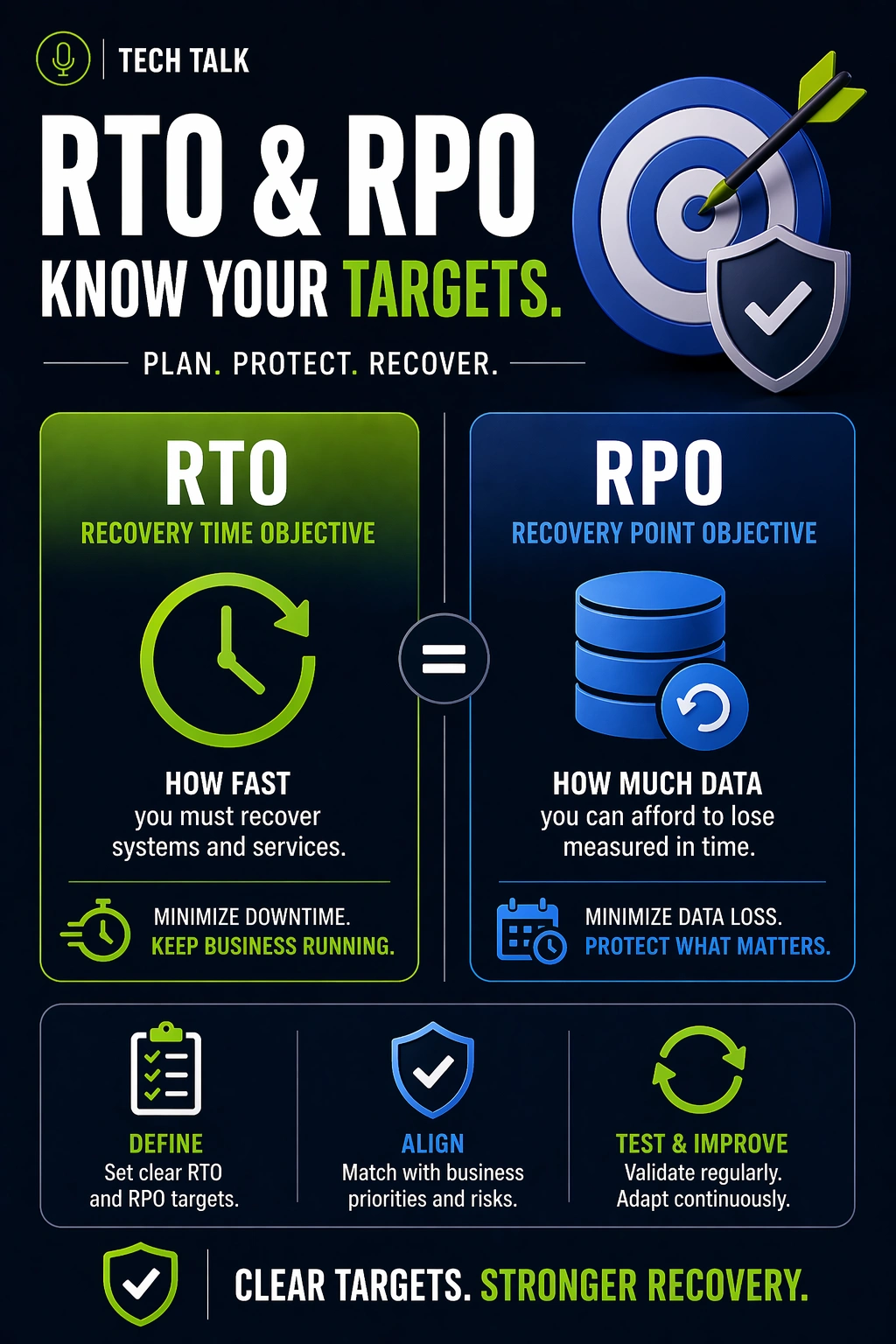
What Is RTO (Recovery Time Objective)
RTO defines how quickly your systems must be restored after an outage.
It answers:
👉 How long can your business be down before serious impact occurs?
Examples:
- RTO of 1 hour → systems must be restored within 1 hour
- RTO of 24 hours → downtime can extend to a full day
Why RTO Matters
RTO directly affects:
- downtime
- productivity loss
- revenue impact
The longer your RTO, the greater the operational and financial impact of an outage.
What Is RPO (Recovery Point Objective)
RPO defines how much data loss your business can tolerate.
It answers:
👉 How much data can you afford to lose?
Examples:
- RPO of 1 hour → up to 1 hour of data loss
- RPO of 24 hours → a full day of data may be lost
Why RPO Matters
RPO affects:
- data integrity
- operational continuity
- customer impact
The larger your RPO, the more data your business may lose during an incident.
RTO vs RPO (Side-by-Side)
RTO
- Focuses on downtime
- Measures recovery speed
- Defines how fast systems must be restored
RPO
- Focuses on data loss
- Measures recoverable data window
- Defines acceptable data loss
RTO defines how fast you recover. RPO defines how much you lose.
How RTO and RPO Play Out During Recovery
During an incident:
- RTO determines how quickly systems must be restored
- RPO determines which recovery point is acceptable
But real-world recovery introduces delays:
Recovery Phases
- Detection → identifying the issue
- Assessment → determining impact
- Backup selection → finding clean data
- Restoration → rebuilding systems
- Validation → confirming functionality
Each recovery phase introduces delays that can push actual recovery beyond your defined RTO.
Why Most Businesses Get This Wrong
Many businesses:
- never define RTO or RPO
- assume backups will meet expectations
- underestimate recovery complexity
In reality:
- recovery is slower than expected
- data loss exceeds tolerance
- business impact is higher than planned
If your RTO and RPO are not defined and validated, your recovery strategy is based on guesswork.
How RTO and RPO Shape System Design
RTO and RPO directly influence how systems are built.
For example:
Low RTO (Fast Recovery Requires)
- high-performance infrastructure
- local backup availability
- rapid failover systems
Low RPO (Minimal Data Loss Requires)
- frequent backups
- real-time replication
- continuous data protection
Lower RTO and RPO targets require more advanced systems, higher cost, and increased complexity.
The Trade-Off: Cost vs Recovery Performance
Improving RTO and RPO comes with tradeoffs.
- faster recovery → higher infrastructure cost
- lower data loss → more frequent backups and storage
You cannot improve recovery speed and reduce data loss without increasing system complexity and cost.
Misalignment Between Business and IT
A common problem is misalignment:
- business expects near-instant recovery
- systems are designed for slower recovery
This leads to:
- missed expectations
- operational disruption
- frustration during incidents
If business expectations and system capabilities are not aligned, recovery will fail to meet real needs.
How to Know If Your RTO and RPO Are Inadequate
You may have a gap if:
- you have never defined acceptable downtime
- you do not know acceptable data loss
- recovery timelines are unknown
- backups do not meet business requirements
If you cannot clearly define recovery expectations, your business is exposed to unnecessary risk.
How RTO and RPO Impact Disaster Recovery
Disaster recovery planning depends on these metrics.
They determine:
- recovery priorities
- system architecture
- response procedures
Learn more in disaster recovery planning.
Why This Matters for Ransomware
Ransomware impacts both downtime and data loss.
Without defined RTO and RPO:
- recovery may take too long
- data loss may be unacceptable
Ransomware exposes recovery expectations that were never properly defined.
See ransomware recovery.
What This Means for Your Business
RTO and RPO are not technical settings.
They are business decisions that define:
- how your systems are built
- how your recovery process works
- how your business responds to disruption
Your recovery strategy is only as strong as the expectations it is built on.
Final Thoughts
Understanding RTO and RPO is essential to building a reliable recovery strategy.
They determine whether your business can recover:
- fast enough
- with acceptable data loss
- without major disruption
Need help with this topic?
Make sure your backups actually work when it matters.
Most businesses discover backup failures during an outage. We help you validate recovery, reduce downtime risk, and build a system that works under pressure.
- Backup validation and testing
- Recovery time optimization
- Clear recovery documentation