What Business Email Compromise Really Means
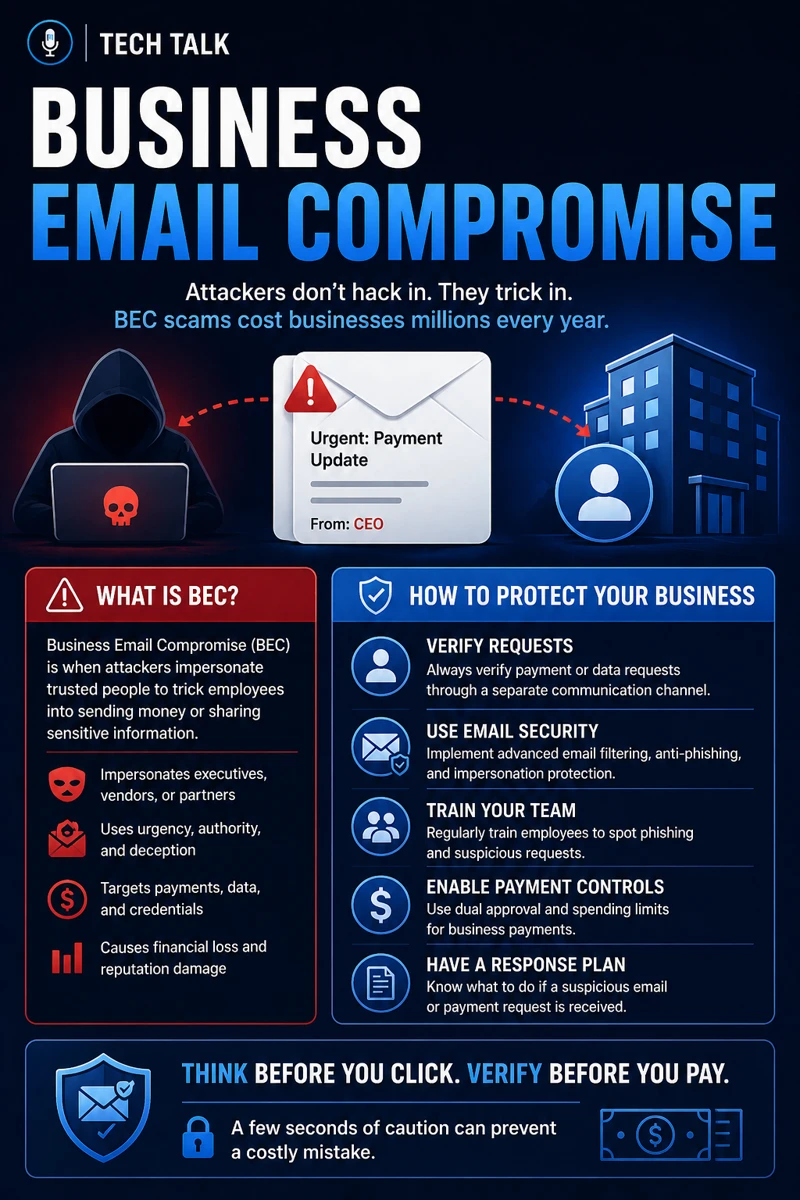
Business Email Compromise (BEC) is a type of cyberattack where attackers:
- impersonate trusted individuals
- manipulate employees
- trick organizations into sending money or sensitive data
Unlike traditional attacks, BEC does not rely on malware.
It relies on deception.
If you need foundational context, start with phishing defense real world.
BEC attacks succeed because they exploit trust — not technical vulnerabilities.
Why BEC Attacks Are So Effective
BEC attacks work because they:
- appear legitimate
- target human behavior
- bypass technical controls
They often involve:
- urgent requests
- authority impersonation
- subtle manipulation
These tactics are closely related to failures discussed in why mfa fails.
How Business Email Compromise Works
A typical BEC attack follows a pattern.
Step 1: Reconnaissance
Attackers gather information:
- company structure
- employee roles
- vendor relationships
Step 2: Account Compromise or Spoofing
They either:
- gain access to an email account
- spoof a trusted email address
Step 3: Social Engineering
They send emails that:
- request payments
- change banking details
- ask for sensitive information
Step 4: Execution
An employee:
- trusts the request
- completes the action
At that point:
- money is transferred
- data is exposed
BEC attacks are designed to look routine, not suspicious.
The Hidden Risk: Speed of Impact
BEC attacks move quickly.
In many cases:
- funds are transferred within hours
- accounts are compromised silently
- damage is discovered too late
This is why preparation must include incident response plan basics.
By the time a BEC attack is detected, the damage is often already done.
Common Types of BEC Attacks
BEC attacks come in several forms.
CEO Fraud
Attackers impersonate executives.
They request:
- urgent wire transfers
- confidential information
Vendor Fraud
Attackers impersonate vendors.
They request:
- payment changes
- invoice updates
Payroll Diversion
Attackers target HR or payroll.
They request:
- direct deposit changes
Account Takeover
Attackers gain access to real accounts.
They monitor and manipulate communications.
These attack paths often begin with techniques covered in phishing defense real world.
Why Traditional Security Fails Against BEC
BEC attacks often bypass:
- antivirus
- firewalls
- endpoint tools
This is because:
- no malware is used
- emails appear legitimate
This limitation is similar to gaps discussed in edr vs antivirus.
Traditional tools are not designed to stop human-targeted attacks.
The Role of MFA — and Its Limitations
Multi-factor authentication helps:
- protect accounts
- reduce unauthorized access
But it is not foolproof.
BEC attacks can still succeed through:
- social engineering
- session hijacking
This is explained in microsoft 365 mfa what to require and for who and why mfa fails.
The Role of User Behavior
BEC attacks depend on:
- human decisions
- trust
- urgency
Employees often:
- act quickly
- skip verification
- trust authority
This is why training is critical.
The Financial Impact of BEC
BEC is one of the most financially damaging cyber threats.
Impacts include:
- direct financial loss
- operational disruption
- reputational damage
These risks are often evaluated during cyber insurance controls.
BEC attacks can result in immediate and unrecoverable financial loss.
What Makes BEC Hard to Detect
BEC attacks are difficult to detect because:
- emails look legitimate
- no malware is present
- activity appears normal
This creates:
- delayed detection
- extended exposure
What a Strong BEC Defense Looks Like
Effective protection includes:
- email security controls
- user training
- verification procedures
- incident response readiness
Verification Processes
Always verify:
- payment requests
- account changes
- sensitive requests
User Awareness Training
Train employees to:
- identify suspicious emails
- question urgency
- verify requests
Email Security Controls
Use tools that:
- detect impersonation
- flag anomalies
Incident Response Planning
Prepare for:
- rapid containment
- financial recovery attempts
This aligns with incident response plan basics.
Verification processes are the most effective defense against BEC.
How This Connects to Other Cybersecurity Topics
BEC connects to:
- phishing defense real world
- why mfa fails
- microsoft 365 mfa what to require and for who
- incident response plan basics
- cyber insurance controls
What This Means for Your Business
Your exposure to BEC determines:
- financial risk
- operational stability
- security posture
It is not optional.
It is critical.
BEC attacks succeed when processes fail — not when technology fails.
Final Thoughts
Business Email Compromise is one of the most dangerous threats facing businesses today.
Because:
- it is simple
- it is effective
- it is hard to detect
But it is preventable.
Need help with this topic?
Make sure your backups actually work when it matters.
Most businesses discover backup failures during an outage. We help you validate recovery, reduce downtime risk, and build a system that works under pressure.
- Backup validation and testing
- Recovery time optimization
- Clear recovery documentation