What Cyber Insurance Controls Really Mean
Cyber insurance controls are the security measures insurers require before they will:
- issue a policy
- renew coverage
- pay a claim
These controls are designed to:
- reduce risk
- prevent incidents
- limit financial exposure
They are no longer optional.
They are the baseline.
If you need related context, see business email compromise, one of the most common insured threats.
Cyber insurance is no longer just about coverage — it’s about proving security maturity.
Why Cyber Insurance Requirements Are Increasing
Insurers have experienced:
- rising ransomware claims
- increased financial fraud
- costly recovery incidents
As a result:
- requirements have become stricter
- audits have become more detailed
- claims are more heavily scrutinized
These risks are highlighted in ransomware readiness 60-minute executive checklist.
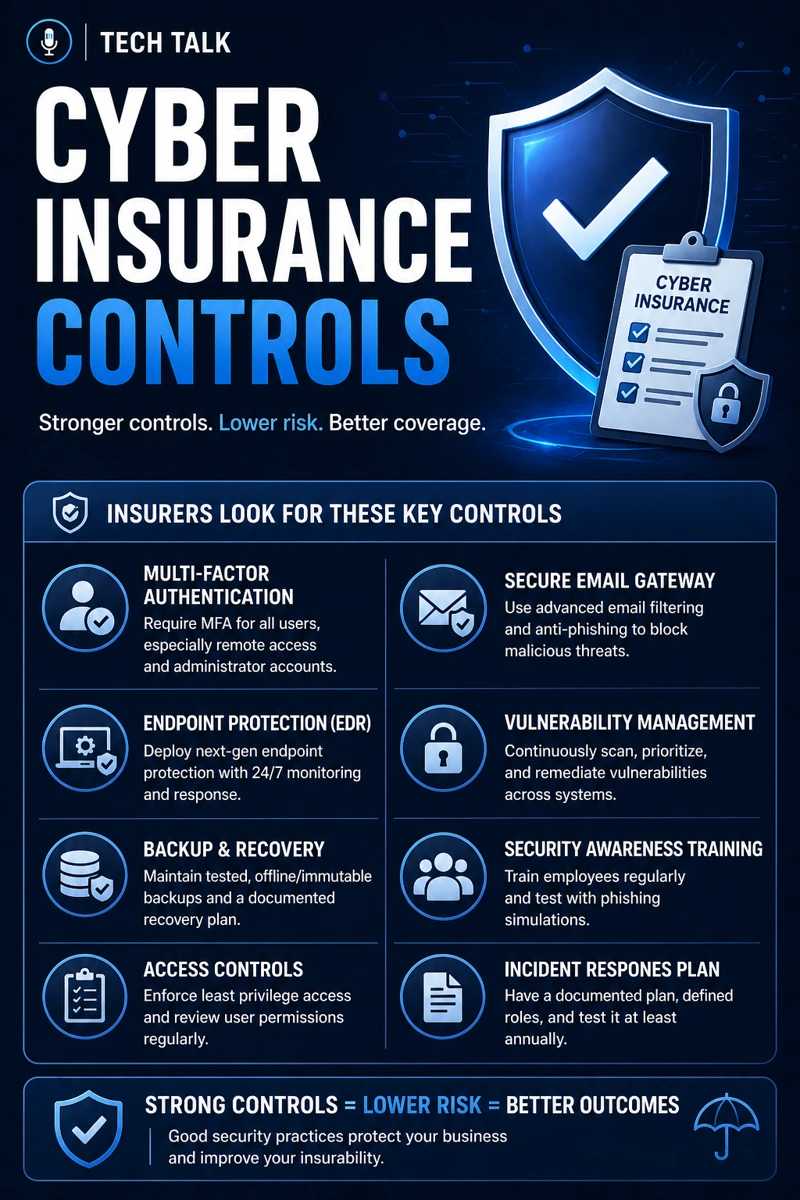
The Most Common Required Controls
Most cyber insurance policies require a core set of controls.
Multi-Factor Authentication (MFA)
MFA is one of the most critical requirements.
It must be enforced on:
- email accounts
- remote access
- administrative accounts
This aligns with microsoft 365 mfa what to require and for who.
Endpoint Protection
Organizations must deploy:
- antivirus or EDR solutions
This aligns with edr vs antivirus and endpoint security basics edr vs antivirus.
Patch Management
Systems must be updated regularly.
This includes:
- operating systems
- applications
- critical vulnerabilities
This aligns with patch management smb.
Backup and Recovery
Organizations must:
- maintain backups
- validate recovery capability
This aligns with backup validation what good looks like and recovery testing runbooks.
Email Security and Phishing Protection
Controls must reduce phishing risk.
This includes:
- filtering
- user awareness
- domain protection
This aligns with phishing defense real world.
Cyber insurance controls are designed to reduce the likelihood of common attack paths.
The Hidden Risk: “Checkbox Compliance”
Some organizations:
- implement controls only for approval
- fail to maintain or enforce them
This leads to:
- gaps in protection
- denied claims
Controls must be active and enforced — not just documented.
What Happens If Controls Are Missing
If required controls are not in place:
- coverage may be denied
- claims may be rejected
- premiums may increase
In some cases:
- policies are not issued at all
This is especially critical in incidents like business email compromise.
The Role of Documentation
Insurers require proof.
This includes:
- written policies
- configuration evidence
- audit logs
Without documentation:
- compliance cannot be verified
The Role of Continuous Monitoring
Controls must be maintained.
This includes:
- monitoring systems
- verifying enforcement
- detecting failures
The Role of Incident Response Planning
Insurers expect:
- documented response plans
- defined roles
- tested procedures
This aligns with incident response plan basics.
Controls must work in real-world scenarios — not just in theory.
The Complexity of Meeting Requirements
Meeting cyber insurance controls involves:
- technical implementation
- policy creation
- ongoing management
This creates:
- operational complexity
- compliance challenges
These challenges are part of broader issues in why mfa fails.
What a Fully Compliant Environment Looks Like
A strong environment includes:
- enforced MFA
- monitored endpoints
- validated backups
- consistent patching
- documented policies
It must also integrate with:
- ongoing monitoring
- periodic testing
Cyber insurance controls should align with real security practices — not exist separately.
How Cyber Insurance Controls Impact Business Operations
These controls directly affect:
- risk exposure
- operational stability
- financial protection
Without them:
- recovery becomes difficult
- financial loss increases
- compliance fails
Failing to meet controls can result in both security gaps and denied insurance coverage.
How to Know If You Are Not Compliant
You may have a gap if:
- MFA is not enforced everywhere
- backups are not tested
- patching is inconsistent
- policies are undocumented
If controls are not actively verified, compliance is likely incomplete.
How to Meet Cyber Insurance Requirements
Start with:
- implementing required controls
- documenting policies
- validating systems
- performing regular audits
These steps align with broader cybersecurity maturity efforts.
How This Connects to Other Cybersecurity Topics
Cyber insurance controls connect to:
- business email compromise
- backup validation what good looks like
- recovery testing runbooks
- patch management smb
- phishing defense real world
What This Means for Your Business
Your ability to meet these controls determines:
- whether you qualify for coverage
- whether claims are paid
- how protected your business is
It is not optional.
It is required.
Cyber insurance controls reflect the minimum standard for modern cybersecurity.
Final Thoughts
Cyber insurance has changed.
It is no longer just protection.
It is validation of your security posture.
When controls are implemented correctly:
- risk is reduced
- coverage is secured
- recovery is possible
Need help with this topic?
Make sure your backups actually work when it matters.
Most businesses discover backup failures during an outage. We help you validate recovery, reduce downtime risk, and build a system that works under pressure.
- Backup validation and testing
- Recovery time optimization
- Clear recovery documentation