What Endpoint Security Really Means
Endpoint security protects devices such as:
- laptops
- desktops
- servers
- mobile devices
These endpoints are where:
- users interact with systems
- data is accessed
- attacks often begin
If you need foundational comparison, see edr vs antivirus.
Most cyberattacks begin at the endpoint — not the network.
Why Endpoint Security Is Critical
Endpoints are targeted because:
- users can be manipulated
- systems can be exploited
- access to data is available
Without proper protection:
- attackers gain entry
- threats spread
- damage escalates
This is especially true for attacks like business email compromise.
The Evolution of Endpoint Security
Endpoint security has evolved over time.
Traditional Antivirus (First Generation)
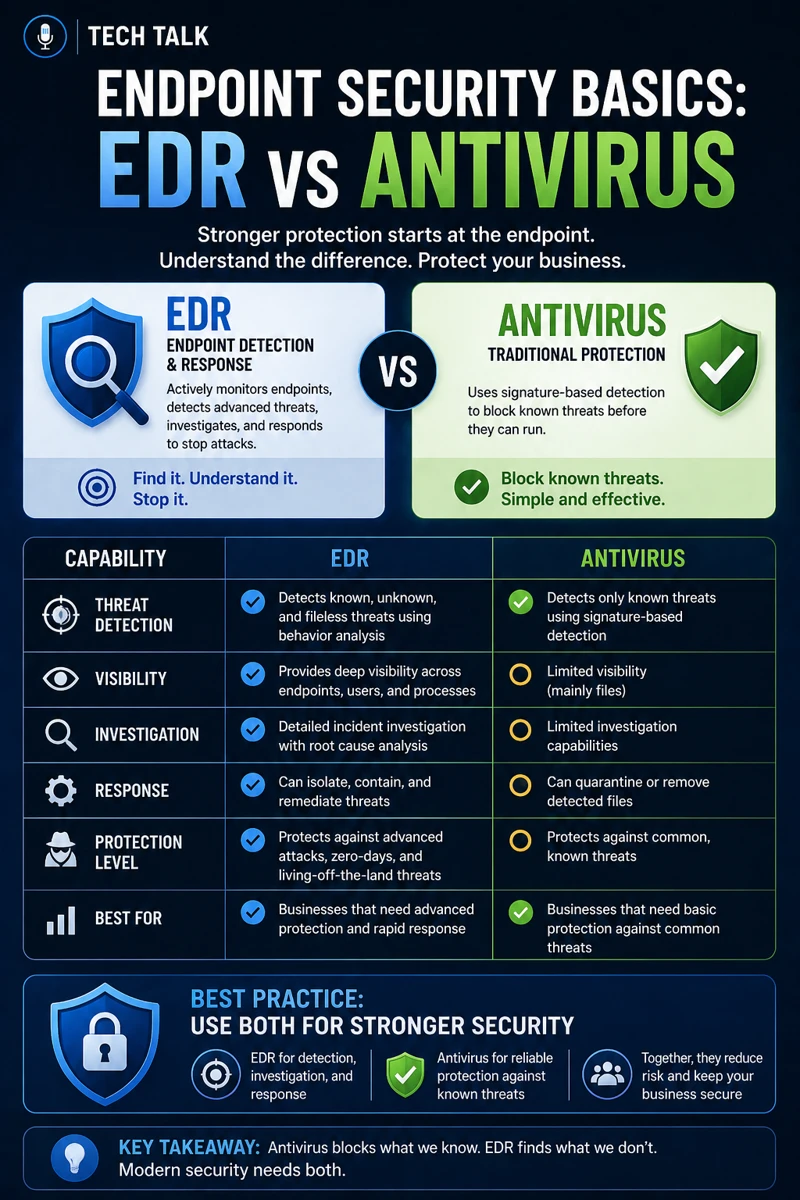
Antivirus focuses on:
- detecting known threats
- scanning files
- blocking malware
But it relies on:
- signatures
- known patterns
Modern Endpoint Security (EDR)
EDR focuses on:
- behavior monitoring
- anomaly detection
- response capabilities
This shift is necessary due to:
- evolving threats
- sophisticated attack methods
Endpoint security has shifted from detection to detection + response.
What Antivirus Does (Baseline Protection)
Antivirus provides:
- malware detection
- file scanning
- basic protection
Where Antivirus Works Well
- known threats
- common malware
- basic protection needs
Where Antivirus Falls Short
- unknown threats
- fileless attacks
- advanced attacks
These gaps are often exploited through methods discussed in phishing defense real world.
What EDR Does (Advanced Protection)
EDR provides:
- real-time monitoring
- behavior analysis
- threat detection
- response capabilities
Key EDR Capabilities
- detects suspicious activity
- identifies lateral movement
- isolates infected systems
- provides forensic visibility
Why EDR Matters
EDR detects:
- unknown threats
- evolving attack patterns
- abnormal behavior
EDR provides the visibility needed to detect and respond to modern threats.
The Hidden Risk: Gaps Between Tools
Many businesses assume:
- one tool is enough
But in reality:
- antivirus alone leaves gaps
- EDR without proper configuration is ineffective
This is often revealed during reviews like cyber insurance controls.
Security gaps exist when tools are not properly layered or managed.
How Modern Attacks Target Endpoints
Today’s attacks use:
- phishing emails
- credential theft
- fileless malware
- living-off-the-land techniques
These attacks:
- bypass traditional defenses
- rely on user interaction
This aligns with broader failures discussed in why mfa fails.
The Role of Endpoint Security in Incident Response
Endpoint security is critical for:
- detecting threats early
- containing infections
- investigating incidents
This supports processes outlined in incident response plan basics.
Without endpoint visibility, incident response becomes reactive instead of proactive.
The Role of Endpoint Security in Ransomware Defense
Endpoints are often the starting point for ransomware.
EDR helps:
- detect encryption activity
- isolate affected systems
- prevent spread
This aligns with ransomware readiness 60-minute executive checklist.
The Role of Patch Management
Endpoint protection must be supported by:
- regular updates
- vulnerability remediation
This aligns with patch management smb.
The Complexity of Endpoint Security
Endpoint security involves:
- multiple tools
- ongoing monitoring
- configuration management
This creates:
- operational complexity
- potential gaps
What a Strong Endpoint Security Strategy Looks Like
A strong strategy includes:
- antivirus as baseline protection
- EDR for detection and response
- patch management
- user awareness
It must also align with:
- ongoing monitoring
- incident response planning
Endpoint security should be layered, monitored, and continuously improved.
How Endpoint Security Impacts Business Operations
Endpoint protection directly affects:
- system availability
- data protection
- operational continuity
Poor endpoint security leads to:
- breaches
- downtime
- financial loss
Endpoints are often the first point of failure in a cyberattack.
How to Know If Your Endpoint Security Is Weak
You may have a gap if:
- you rely only on antivirus
- you lack visibility into endpoint activity
- response capabilities are limited
If you cannot detect and respond to threats in real time, your endpoint security is incomplete.
How to Improve Endpoint Security
Start with:
- deploying EDR solutions
- maintaining antivirus baseline
- implementing patch management
- monitoring endpoint activity
These steps align with broader cybersecurity maturity efforts.
How This Connects to Other Cybersecurity Topics
Endpoint security connects to:
- edr vs antivirus
- business email compromise
- phishing defense real world
- incident response plan basics
- cyber insurance controls
What This Means for Your Business
Your endpoint security determines:
- how threats are detected
- how quickly they are contained
- how much damage is prevented
It is not optional.
It is essential.
Endpoint security is the front line of your cybersecurity defense.
Final Thoughts
Endpoint security has evolved.
Antivirus alone is no longer enough.
Modern protection requires:
- visibility
- detection
- response
Need help with this topic?
Make sure your backups actually work when it matters.
Most businesses discover backup failures during an outage. We help you validate recovery, reduce downtime risk, and build a system that works under pressure.
- Backup validation and testing
- Recovery time optimization
- Clear recovery documentation