Why This Comparison Matters
Many businesses rely on VPNs for secure connectivity.
But as networks grow more complex—with:
- remote work
- cloud applications
- multiple locations
VPNs often become:
👉 a bottleneck instead of a solution
At the same time, SD-WAN is widely promoted as a replacement.
But the reality is:
👉 SD-WAN and VPN are not direct replacements—they serve different roles
Understanding the difference is critical for:
- security
- performance
- scalability
Using VPN as a full network strategy can create hidden performance and security limitations.
What Is a VPN?
A VPN (Virtual Private Network) creates:
👉 an encrypted tunnel between a user or site and a network
It is commonly used for:
- remote employee access
- secure connections over the internet
- protecting data in transit
Key Benefits
- strong encryption
- secure remote access
- relatively simple setup
Limitations
- centralized traffic routing
- performance bottlenecks
- limited scalability
- poor visibility and control
What Is SD-WAN?
SD-WAN (Software-Defined Wide Area Network) is:
👉 a modern network architecture that intelligently routes traffic across multiple connections
It is designed to:
- optimize performance
- improve reliability
- enhance security
Key Capabilities
- dynamic traffic routing
- application-aware prioritization
- multiple connection support (ISP, LTE, fiber)
- centralized management
SD-WAN vs VPN: Key Differences
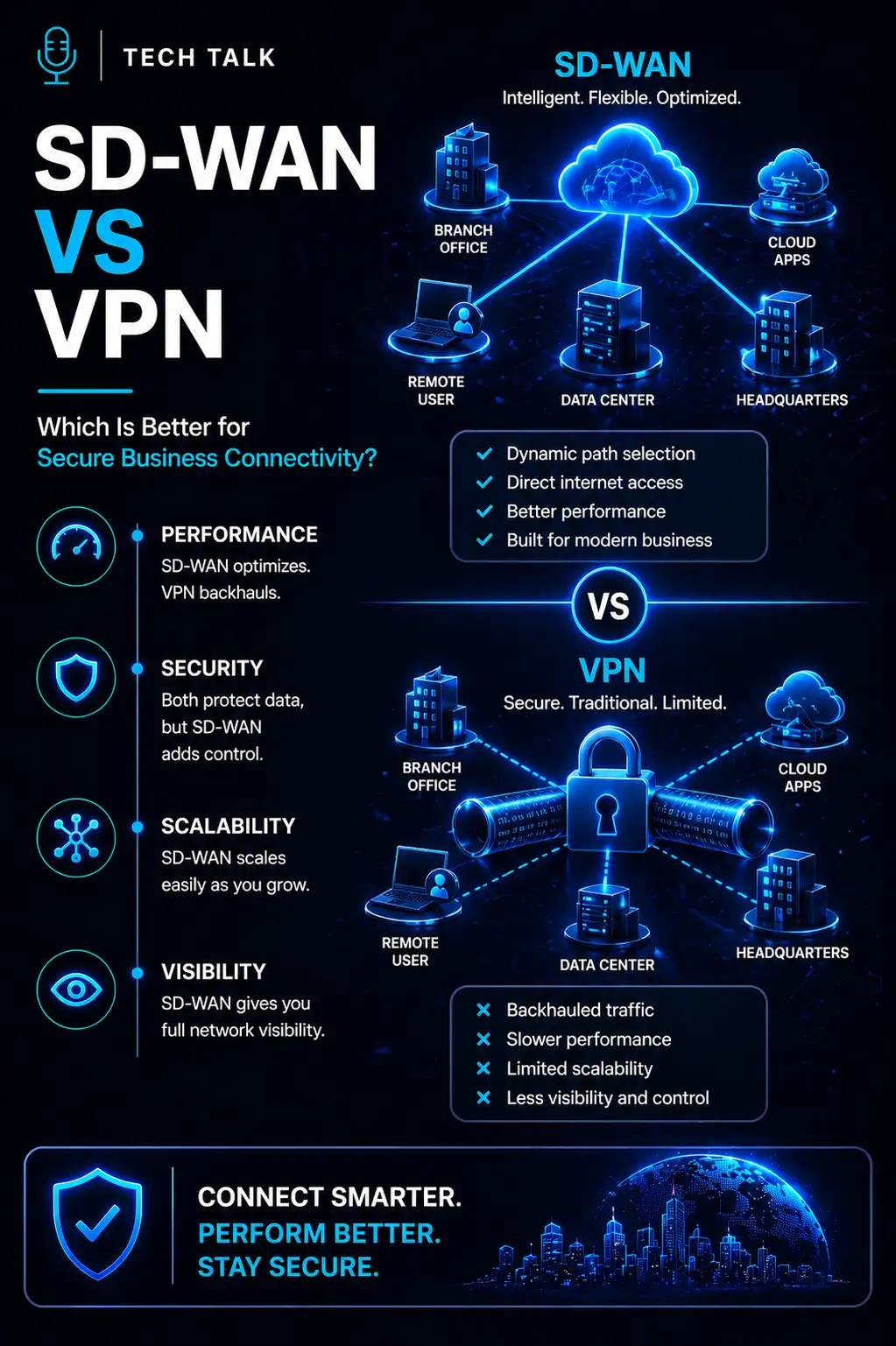
| Feature | VPN | SD-WAN |
|---|---|---|
| Primary Purpose | Secure remote access | Network optimization + security |
| Traffic Routing | Centralized | Dynamic, optimized |
| Performance | Often slower | Optimized for speed |
| Scalability | Limited | Highly scalable |
| Visibility | Minimal | High visibility and control |
| Use Case | Remote users | Multi-site networks, cloud environments |
Performance: Where VPN Falls Short
VPN traffic typically:
- routes through a central data center
- creates latency
- slows down cloud application access
This is known as:
👉 backhauling
Result:
- poor user experience
- slower applications
- increased congestion
SD-WAN eliminates this by:
- routing traffic directly to cloud services
- selecting the best path in real time
Security: Not as Simple as It Seems
VPNs provide:
- encryption
- secure tunnels
But they also:
- extend network access broadly
- rely on perimeter-based security
SD-WAN enhances security by:
- segmenting traffic
- enforcing policies
- integrating with modern frameworks
Including:
👉 Zero Trust principles
SD-WAN and Network Segmentation
Modern SD-WAN solutions support:
- segmentation between users, systems, and applications
- isolation of sensitive environments
Related concept:
This allows:
- reduced lateral movement
- improved containment during incidents
When to Use a VPN
VPN is still the right choice when:
- supporting remote users
- providing temporary secure access
- connecting to legacy environments
It works best as:
👉 a tool—not a full network strategy
When to Use SD-WAN
SD-WAN is ideal when:
- you have multiple office locations
- your business relies on cloud applications
- performance and uptime are critical
- you need centralized network control
It becomes essential for:
- scaling operations
- optimizing connectivity
- improving resilience
Real-World Scenario
VPN-Only Environment
- employees connect through a central VPN
- all traffic routed through HQ
- cloud apps perform poorly
Result:
- slow performance
- frustrated users
- increased downtime risk
SD-WAN Deployment
- traffic routed intelligently
- cloud apps accessed directly
- failover between connections
Result:
- improved speed
- better uptime
- stronger control
Common Mistakes Businesses Make
- relying entirely on VPN for all connectivity
- assuming VPN = full security strategy
- ignoring performance impact
- not adapting to cloud-first environments
These lead to:
- bottlenecks
- increased risk
- poor scalability
Outdated network models create both performance issues and security gaps.
How This Impacts Business Continuity
Network design directly affects:
- uptime
- system availability
- disruption impact
Related reading:
Without modern networking:
- outages last longer
- failover is limited
- recovery is slower
With SD-WAN:
- traffic reroutes automatically
- downtime is minimized
- resilience improves
How to Know If You Need SD-WAN
Warning signs include:
- slow cloud applications
- VPN performance complaints
- multiple office locations
- lack of network visibility
- frequent connectivity issues
If your network struggles to keep up with your business, it may be time to move beyond VPN.
What This Means for Your Business
The choice is not:
👉 SD-WAN vs VPN
The real question is:
👉 Are you using the right tool for the right purpose?
Modern businesses typically need:
- VPN for secure access
- SD-WAN for network performance and control
Together, they create:
- secure connectivity
- optimized performance
- scalable infrastructure
Final Thoughts
VPN is not obsolete.
But it is:
👉 no longer enough on its own
As businesses evolve:
- networks must adapt
- performance must improve
- security must modernize
SD-WAN provides the foundation for that evolution.
Next Step
If your network still relies heavily on VPN:
- you may be experiencing hidden limitations
- your infrastructure may not be optimized for growth
Now is the time to:
- evaluate your current network
- identify performance bottlenecks
- implement modern connectivity solutions
Need help with this topic?
Make sure your backups actually work when it matters.
Most businesses discover backup failures during an outage. We help you validate recovery, reduce downtime risk, and build a system that works under pressure.
- Backup validation and testing
- Recovery time optimization
- Clear recovery documentation