Why Continuity Architecture Matters
Many organizations build continuity capabilities over time.
They add:
- backup systems
- failover solutions
- recovery plans
- operational procedures
But without a clear structure:
- components remain disconnected
- coordination breaks down
- response becomes inconsistent
Continuity fails when it is assembled piece by piece instead of designed as a system.
What Is Business Continuity Architecture?
Business continuity architecture is:
👉 the structured design of systems, processes, and workflows that enable an organization to maintain operations during disruption
It defines:
- how components interact
- how continuity is executed
- how recovery integrates with operations
Architecture answers:
👉 How does everything work together during disruption?
Why Architecture Is Different From Planning
Planning defines:
- what should happen
Architecture defines:
- how it actually happens
Without architecture:
- plans are theoretical
- execution is inconsistent
- dependencies are unclear
Planning creates intent — architecture enables execution.
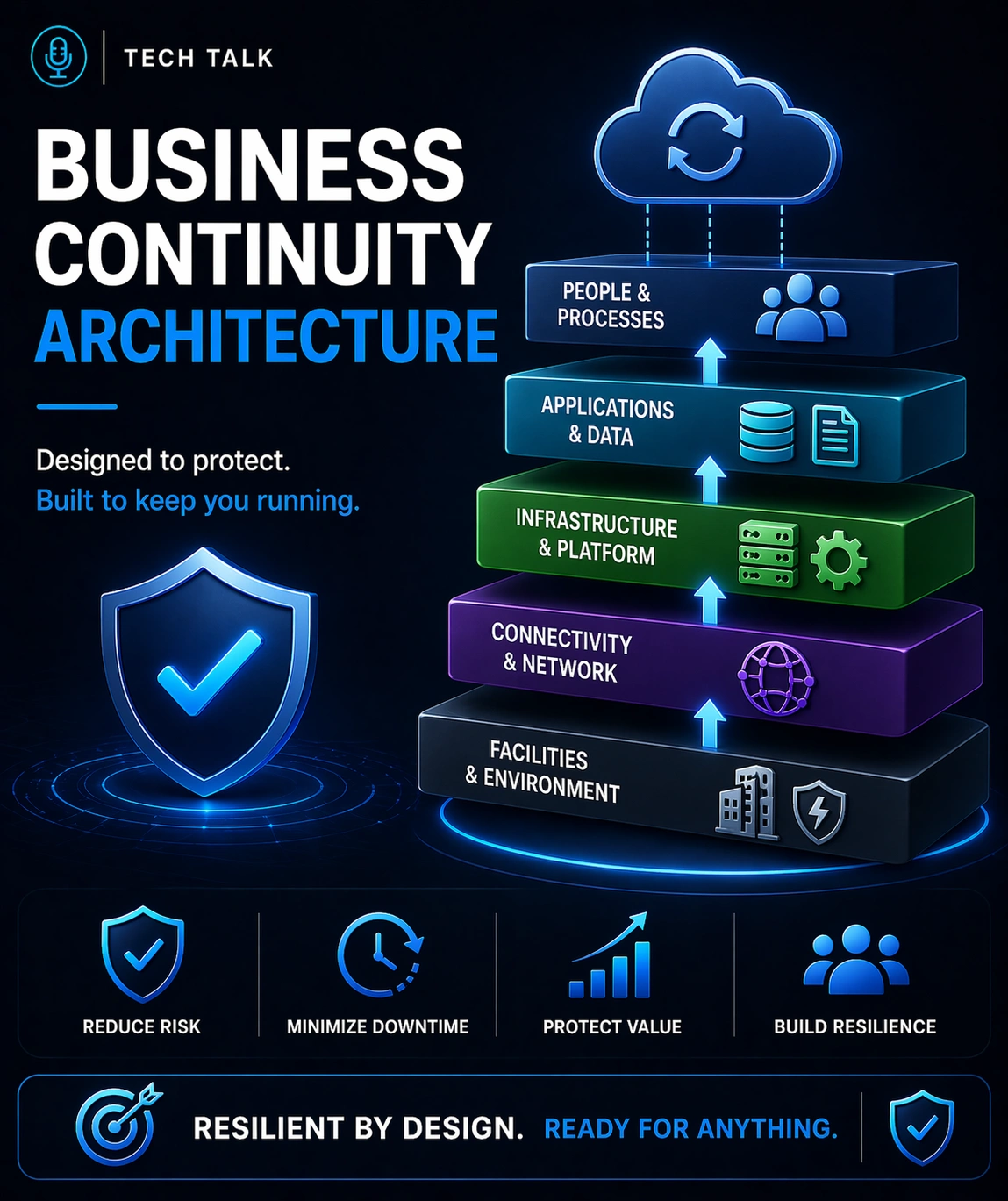
The Core Layers of Continuity Architecture
A strong architecture is built across integrated layers.
1. Risk and Dependency Layer
Defines:
- potential disruptions
- internal and external dependencies
Includes:
- risk assessments
- dependency mapping
2. Systems and Infrastructure Layer
Defines:
- how systems support continuity
Includes:
- redundancy and failover
- cloud and hybrid infrastructure
- backup and recovery systems
3. Operational Process Layer
Defines:
- how business functions continue
Includes:
- fallback workflows
- manual processes
- operational prioritization
4. Coordination and Communication Layer
Defines:
- how teams interact during disruption
Includes:
- communication plans
- escalation paths
- decision-making structures
5. Recovery Integration Layer
Defines:
- how systems are restored
Includes:
- disaster recovery processes
- system restoration workflows
- return-to-normal operations
6. Testing and Validation Layer
Defines:
- how the architecture is verified
Includes:
- testing scenarios
- validation exercises
- performance measurement
Architecture connects every layer into a single, coordinated system.
How Continuity Architecture Works in Practice
During disruption:
-
Risk Layer Identifies Impact
- dependencies and affected systems are understood
-
Systems Layer Responds
- failover or redundancy activates
-
Process Layer Adapts
- fallback workflows maintain operations
-
Communication Layer Coordinates
- teams stay aligned and informed
-
Recovery Layer Restores Systems
- infrastructure is rebuilt
-
Validation Layer Measures Performance
- effectiveness is evaluated
Architecture ensures that continuity is coordinated — not improvised.
What Happens Without Architecture
Without a defined architecture:
- systems may work independently
- processes may conflict
- teams may not coordinate effectively
This leads to:
- delayed response
- operational breakdown
- increased disruption
Without architecture, continuity components cannot function as a unified system.
Common Architecture Mistakes
Organizations often:
- focus only on technology
- neglect process design
- fail to map dependencies
- overlook communication planning
- do not integrate recovery with operations
These mistakes result in:
- fragmented strategies
- inconsistent execution
- limited resilience
How to Build a Continuity Architecture
To design an effective architecture:
1. Map Dependencies and Risks
Identify:
- critical systems
- key processes
- external dependencies
2. Define System Capabilities
Ensure:
- redundancy exists where needed
- recovery capabilities align with business priorities
3. Design Operational Workflows
Create:
- fallback processes
- adaptive workflows
4. Integrate Communication and Coordination
Define:
- roles and responsibilities
- communication paths
- escalation procedures
5. Align Recovery With Operations
Ensure:
- recovery supports operational needs
- restoration priorities match business impact
6. Test and Validate the Architecture
Simulate:
- real-world disruptions
- integrated failure scenarios
Testing ensures:
👉 the architecture works as intended
Architecture evolves as systems, processes, and risks change.
How to Know If Your Architecture Is Weak
Warning signs include:
- disconnected continuity components
- unclear dependencies
- inconsistent response during incidents
- gaps between continuity and recovery
- limited testing across systems and processes
If your continuity strategy is not clearly structured, it is likely not fully functional.
What This Means for Your Business
Continuity architecture determines:
- how effectively your organization responds to disruption
- how well systems and processes integrate
- how quickly operations stabilize
- how resilient your business becomes
Architecture is what turns continuity from a collection of tools into a working system.
Final Thoughts
Business continuity requires more than tools and plans.
It requires design.
With strong architecture:
- systems align
- processes adapt
- teams coordinate
Without it:
- gaps appear
- response fails
Need help with this topic?
Make sure your backups actually work when it matters.
Most businesses discover backup failures during an outage. We help you validate recovery, reduce downtime risk, and build a system that works under pressure.
- Backup validation and testing
- Recovery time optimization
- Clear recovery documentation