Why Continuity Performance Metrics Matter
Many organizations build continuity plans.
Some even test them.
But very few measure performance in a meaningful way.
Without metrics:
- performance is unclear
- improvement is inconsistent
- readiness is assumed
If you are not measuring continuity performance, you are relying on assumptions instead of evidence.
What Are Continuity Performance Metrics?
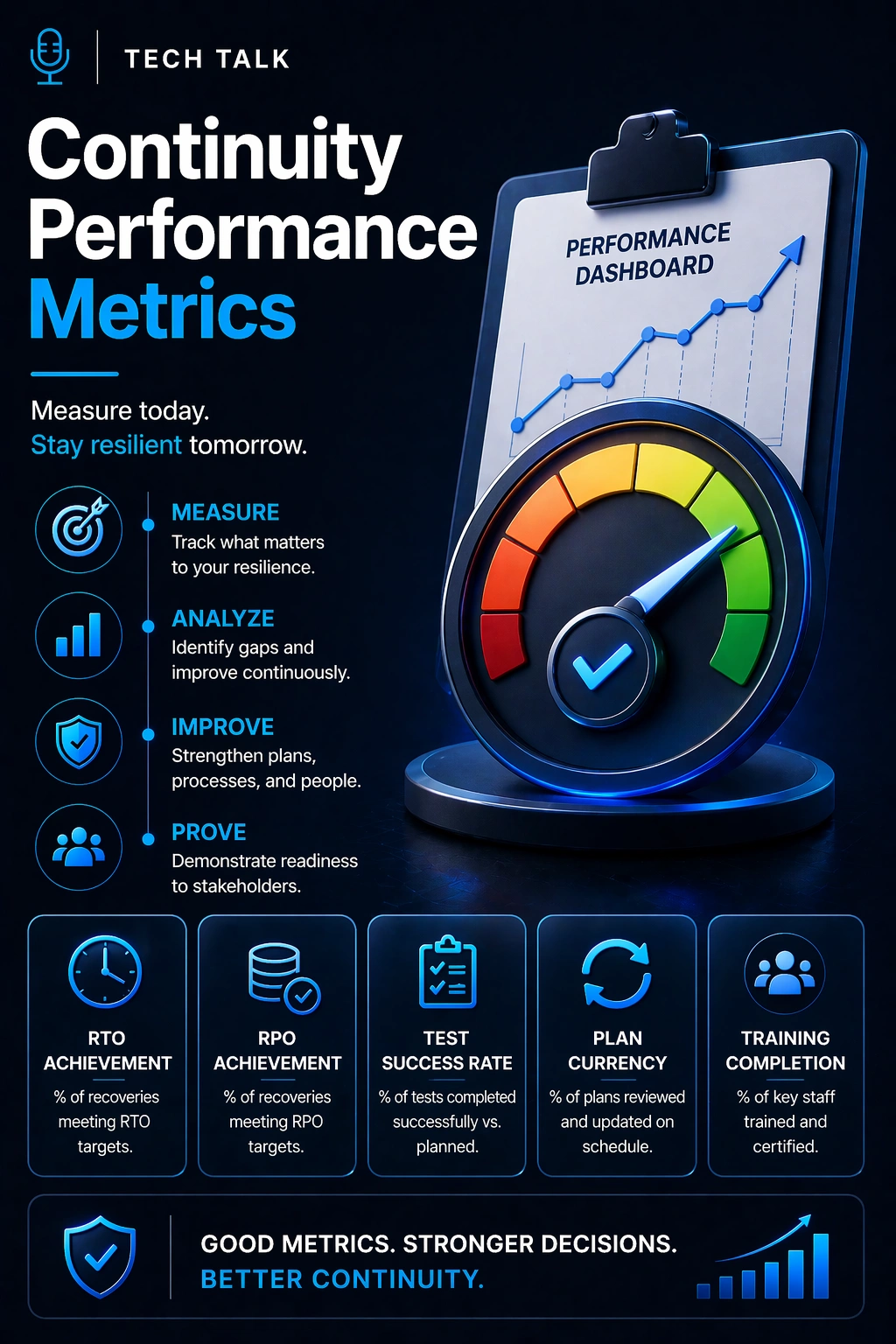
Continuity performance metrics are:
👉 quantifiable indicators used to evaluate how effectively your business continuity strategy performs during disruption
They measure:
- response speed
- recovery effectiveness
- operational continuity
- overall resilience
Metrics answer:
👉 How well does your business perform under disruption?
The Core Categories of Continuity Metrics
To measure effectively, metrics should be grouped into key categories.
1. Response Metrics
Measure how quickly your organization reacts.
Key metrics include:
- Mean Time to Detect (MTTD)
- Mean Time to Respond (MTTR - response)
- time to activate continuity plans
These metrics show:
👉 how quickly disruption is addressed
2. Recovery Metrics
Measure how effectively systems are restored.
Key metrics include:
- Recovery Time Objective (RTO) performance
- actual recovery time vs target
- recovery success rate
These metrics show:
👉 how well recovery meets expectations
3. Data Protection Metrics
Measure how well data is preserved.
Key metrics include:
- Recovery Point Objective (RPO) performance
- backup success rate
- data integrity after recovery
These metrics show:
👉 how effectively data is protected
4. Operational Continuity Metrics
Measure how well the business continues to function.
Key metrics include:
- uptime of critical processes
- service availability
- productivity levels during disruption
These metrics show:
👉 how well operations are maintained
5. Communication Metrics
Measure the effectiveness of communication.
Key metrics include:
- time to notify stakeholders
- clarity of communication
- coordination across teams
These metrics show:
👉 how well teams stay aligned during disruption
6. Testing and Validation Metrics
Measure how well your plan is validated.
Key metrics include:
- test frequency
- test success rate
- number of issues identified per test
- time to resolve identified gaps
These metrics show:
👉 how well your continuity strategy is maintained and improved
Continuity performance is multi-dimensional — no single metric tells the full story.
How to Use Continuity Metrics Effectively
Metrics are only valuable if they are used correctly.
1. Align Metrics With Business Priorities
Focus on:
- critical systems
- high-impact processes
- key operational risks
This ensures:
👉 metrics reflect real business needs
2. Set Clear Targets
Define acceptable performance levels.
Examples:
- RTO targets for critical systems
- response time thresholds
- acceptable downtime limits
Without targets:
👉 metrics lack meaning
3. Track Performance Consistently
Collect data from:
- testing exercises
- real incidents
- monitoring tools
Consistency ensures:
👉 reliable insights over time
4. Analyze and Identify Trends
Look for:
- recurring delays
- repeated failures
- performance improvements or declines
This reveals:
👉 systemic issues and opportunities
5. Drive Continuous Improvement
Use insights to:
- refine processes
- improve systems
- enhance training
- adjust strategies
Metrics should drive decisions — not just reporting.
What Happens Without Performance Metrics
Without metrics:
- readiness cannot be validated
- gaps go unnoticed
- improvement is reactive
During disruption, this leads to:
- slower response
- longer downtime
- greater impact
Without metrics, you cannot prove your continuity strategy works — or improve it.
Common Metric Mistakes
Organizations often:
- track too many metrics without focus
- ignore operational performance
- fail to align metrics with business impact
- collect data but do not act on it
- set unrealistic or undefined targets
These mistakes result in:
- confusion
- poor decision-making
- limited improvement
How to Build a Strong Metrics Framework
To improve continuity performance measurement:
- define a focused set of KPIs
- align metrics with business objectives
- measure both technical and operational performance
- integrate metrics into testing and validation
- review and refine metrics regularly
A strong framework is:
- clear
- actionable
- aligned with real-world conditions
How to Know If Your Metrics Are Inadequate
Warning signs include:
- lack of defined KPIs
- inconsistent data collection
- unclear performance targets
- no reporting or analysis
- repeated issues during incidents
If you cannot clearly measure your continuity performance, your strategy is not fully developed.
What This Means for Your Business
Continuity performance metrics determine:
- how well your organization responds to disruption
- how effectively recovery is executed
- how consistently operations continue
- how resilient your business becomes
Metrics turn continuity from a plan into a measurable, improvable capability.
Final Thoughts
Business continuity is not just about planning.
It is about performance.
Performance must be measured.
With the right metrics:
- readiness becomes visible
- improvement becomes possible
- resilience becomes real
Need help with this topic?
Make sure your backups actually work when it matters.
Most businesses discover backup failures during an outage. We help you validate recovery, reduce downtime risk, and build a system that works under pressure.
- Backup validation and testing
- Recovery time optimization
- Clear recovery documentation