Why This Difference Matters
Modern disruptions are increasingly cyber-driven.
Organizations face:
- ransomware attacks
- system compromises
- data breaches
- infrastructure disruptions
Many businesses respond by investing in:
- security tools
- backup systems
- recovery capabilities
But they often overlook how these elements fit together.
That gap exists because:
👉 cyber resilience and business continuity solve different — but connected — problems
Security alone does not keep your business running — and continuity alone does not protect you from cyber threats.
What Is Cyber Resilience?
Cyber resilience is:
👉 the ability to anticipate, withstand, respond to, and recover from cyber incidents
It focuses on:
- preventing attacks
- detecting threats early
- responding effectively
- adapting to evolving risks
Cyber resilience answers:
👉 Can your organization survive and adapt to cyber threats?
What Is Business Continuity?
Business continuity is:
👉 the ability to maintain critical operations during and after disruption
It focuses on:
- keeping business functions running
- maintaining service delivery
- adapting operations when systems are unavailable
Business continuity answers:
👉 Can your business continue operating during disruption?
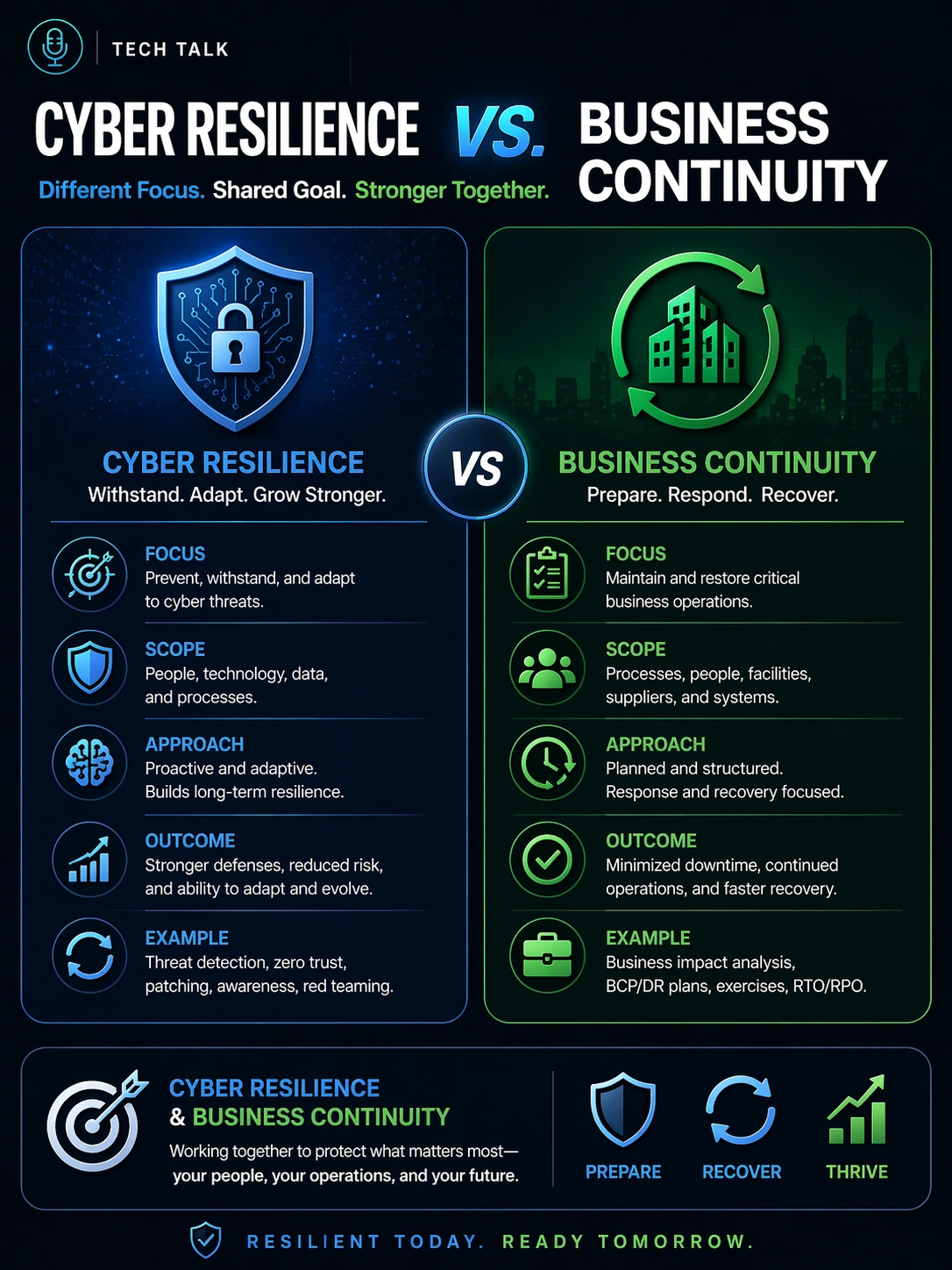
Cyber Resilience vs Business Continuity (Core Difference)
Cyber Resilience
- Focuses on cyber threats and attacks
- Includes prevention, detection, response, and recovery
- Centers on security and IT systems
- Adapts to evolving threat landscape
Business Continuity
- Focuses on maintaining operations
- Includes processes, people, and systems
- Centers on business function and service delivery
- Ensures operations continue during disruption
Cyber resilience protects against threats — continuity protects your ability to operate during them.
How They Work Together
Cyber resilience and business continuity are not separate strategies.
They are complementary.
- cyber resilience reduces the likelihood and impact of attacks
- business continuity ensures operations continue when attacks occur
Together, they ensure:
👉 your business can both withstand and operate through disruption
What Happens During a Cyber Incident
Consider a ransomware attack:
-
Cyber Resilience in Action
- threat detection
- incident response
- containment of the attack
-
Business Continuity in Action
- fallback processes activated
- operations continue at reduced capacity
- communication maintained
-
Recovery Phase
- systems restored
- operations return to normal
Cyber resilience manages the threat — continuity manages the business impact.
Why Cyber Resilience Alone Is Not Enough
Cyber resilience focuses on:
- preventing and responding to attacks
But it does not fully address:
- operational continuity
- process adaptation
- business workflow disruption
This leads to:
- systems being secured
- but operations still stopping
Why Business Continuity Alone Is Not Enough
Business continuity focuses on:
- maintaining operations
But without cyber resilience:
- threats may go undetected
- attacks may spread
- recovery may be more difficult
This leads to:
- increased risk exposure
- greater disruption
Continuity without resilience leaves you vulnerable — resilience without continuity leaves you operationally exposed.
What a Complete Strategy Looks Like
A modern resilience strategy includes both elements.
Cyber Resilience Capabilities
- threat detection and monitoring
- incident response planning
- endpoint and network security
- vulnerability management
Business Continuity Capabilities
- fallback operational processes
- communication planning
- continuity testing
- defined roles and responsibilities
Integrated Approach
- coordinated response across teams
- alignment between security and operations
- shared objectives and priorities
This ensures:
👉 a unified response to disruption
Common Mistakes
Organizations often:
- treat cyber resilience and continuity as separate efforts
- focus only on prevention
- neglect operational planning
- fail to test integrated scenarios
These mistakes result in:
- fragmented response
- delayed recovery
- increased impact
How to Know If You Have a Gap
Warning signs include:
- security teams and operations teams are not aligned
- continuity plans do not include cyber scenarios
- incident response does not consider business impact
- testing does not include integrated exercises
If your cyber and continuity strategies are not aligned, your resilience is incomplete.
What This Means for Your Business
The relationship between cyber resilience and continuity determines:
- how well you withstand cyber attacks
- how effectively you continue operating
- how quickly you recover
- how resilient your organization truly is
Cyber resilience protects your systems — business continuity protects your operations.
Final Thoughts
Cyber threats are unavoidable.
The goal is not just to prevent them — but to survive them.
That requires:
- strong cyber resilience
- effective business continuity
Together, they create:
👉 true operational resilience
Need help with this topic?
Make sure your backups actually work when it matters.
Most businesses discover backup failures during an outage. We help you validate recovery, reduce downtime risk, and build a system that works under pressure.
- Backup validation and testing
- Recovery time optimization
- Clear recovery documentation