Why Recovery Time Matters
When disruption occurs, recovery time becomes the most critical factor.
Many organizations focus on:
- restoring systems
- recovering data
- resolving technical issues
But what truly matters is:
👉 how long your business is impacted while recovery is happening
Every additional minute of downtime increases business impact — often exponentially.
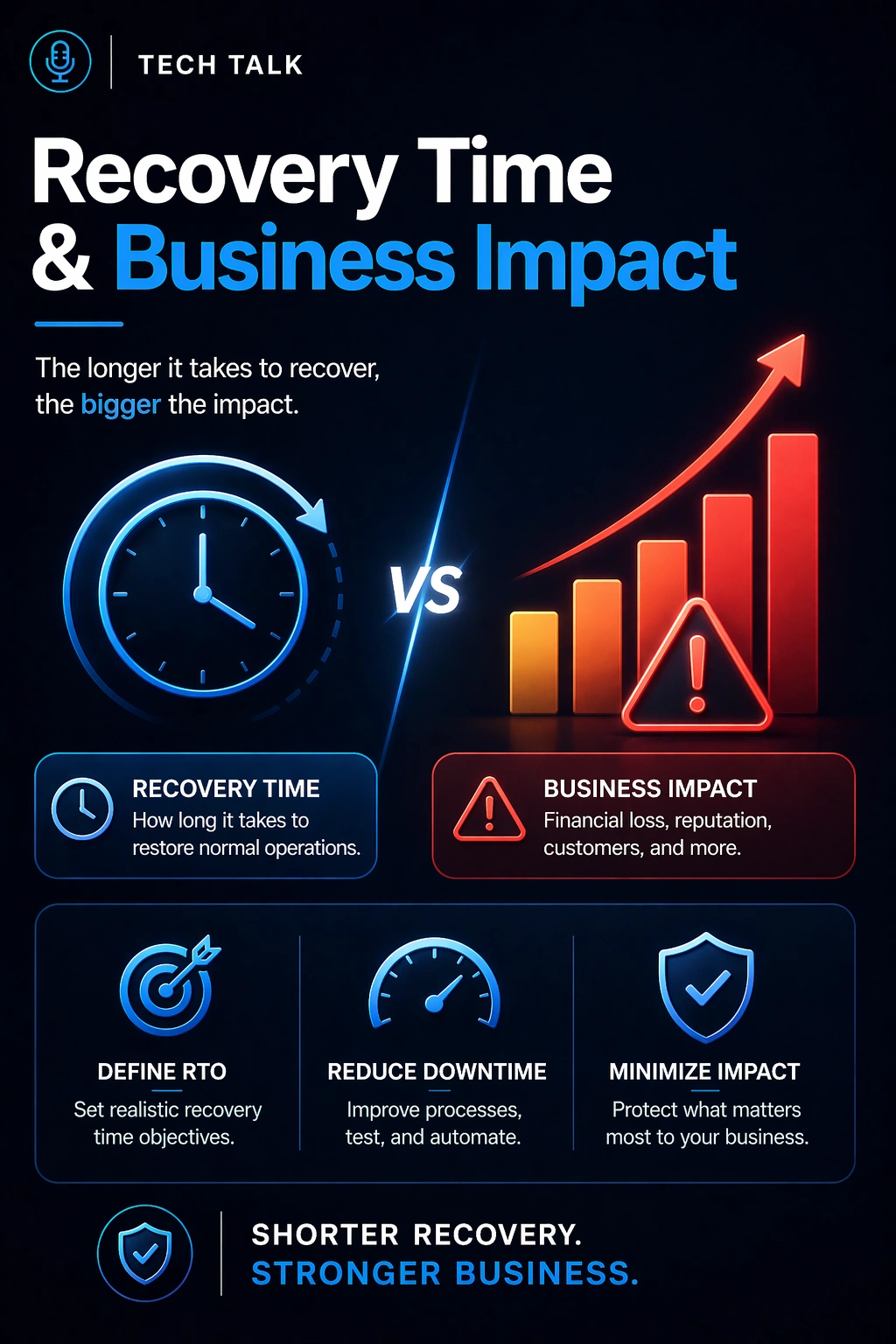
What Is Recovery Time?
Recovery time refers to:
👉 the total time required to restore systems and return operations to a usable state
It includes:
- system restoration
- operational stabilization
- return to normal workflows
Recovery time answers:
👉 How long will your business be disrupted?
How Recovery Time Drives Business Impact
The relationship is direct:
- longer recovery time → greater impact
- shorter recovery time → reduced impact
Impact increases across multiple areas.
The Key Areas of Business Impact
1. Operational Impact
As recovery time increases:
- employees cannot perform tasks
- workflows break down
- productivity declines
Even if systems are partially restored:
- operations may still be limited
2. Financial Impact
Downtime directly affects revenue.
Examples include:
- lost sales opportunities
- delayed transactions
- increased operational costs
Longer recovery time leads to:
👉 higher financial loss
3. Customer Impact
Customers experience:
- service interruptions
- delays in response
- reduced reliability
This leads to:
- dissatisfaction
- loss of trust
- potential churn
4. Reputational Impact
Extended downtime damages perception.
Over time, this results in:
- reduced confidence
- competitive disadvantage
- long-term brand impact
5. Compliance and Risk Impact
In regulated industries:
- downtime may trigger compliance issues
- data loss may create legal exposure
Long recovery times increase:
👉 risk and liability
Business impact is not limited to downtime — it extends into revenue, reputation, and risk.
How Impact Increases Over Time
Business impact is not linear.
It compounds over time:
- first minutes → minor disruption
- first hours → operational slowdown
- extended downtime → significant financial and customer impact
This creates:
👉 an accelerating cost of downtime
The longer recovery takes, the more complex and costly the disruption becomes.
The Role of RTO in Managing Impact
Recovery Time Objective (RTO) defines:
👉 the maximum acceptable recovery time for your business
It acts as a limit:
- if recovery is within RTO → impact is manageable
- if recovery exceeds RTO → impact becomes unacceptable
RTO helps:
- prioritize recovery efforts
- align expectations with business needs
Why Recovery Time Is Often Underestimated
Organizations often assume:
- recovery will be quick
- systems will restore without issues
- operations will resume immediately
In reality:
- recovery delays are common
- systems may be unstable after restoration
- operations require time to normalize
This leads to:
👉 longer-than-expected disruption
What Happens When Recovery Time Is Too Long
When recovery exceeds acceptable limits:
- operations may stop entirely
- revenue loss increases
- customers lose confidence
- backlog accumulates
Recovery becomes more difficult because:
- systems must catch up
- teams are overwhelmed
- processes are strained
How to Reduce Recovery Time
To minimize impact:
- define realistic recovery objectives (RTO)
- prioritize critical systems and processes
- implement failover and redundancy
- test recovery processes regularly
- improve coordination between teams
- include operational stabilization in recovery planning
How to Measure Recovery Impact
To understand your exposure, measure:
- actual recovery time during tests
- downtime cost per hour
- productivity loss during incidents
- customer impact metrics
This provides:
👉 clear visibility into business risk
How to Know If Recovery Time Is a Problem
Warning signs include:
- recovery takes longer than expected
- operations struggle after restoration
- downtime causes significant disruption
- recovery objectives are unclear or unmet
If your recovery time exceeds what your business can tolerate, your continuity strategy is misaligned.
What This Means for Your Business
Recovery time determines:
- how long your business is disrupted
- how much revenue is lost
- how customers experience outages
- how resilient your operations are
Recovery time is not just a technical metric — it is a direct measure of business impact.
Final Thoughts
Recovery time is one of the most important factors in business continuity.
It defines:
- the severity of disruption
- the cost of downtime
- the effectiveness of your response
Reducing recovery time reduces impact.
Need help with this topic?
Make sure your backups actually work when it matters.
Most businesses discover backup failures during an outage. We help you validate recovery, reduce downtime risk, and build a system that works under pressure.
- Backup validation and testing
- Recovery time optimization
- Clear recovery documentation