Why RTO and RPO Matter
Many businesses invest in backup and recovery systems.
But they do not define:
- how fast systems must be restored
- how much data can be lost
Without these definitions:
- recovery is inconsistent
- priorities are unclear
- business impact increases
Without RTO and RPO, recovery decisions are guesswork during a disruption.
What Is RTO (Recovery Time Objective)?
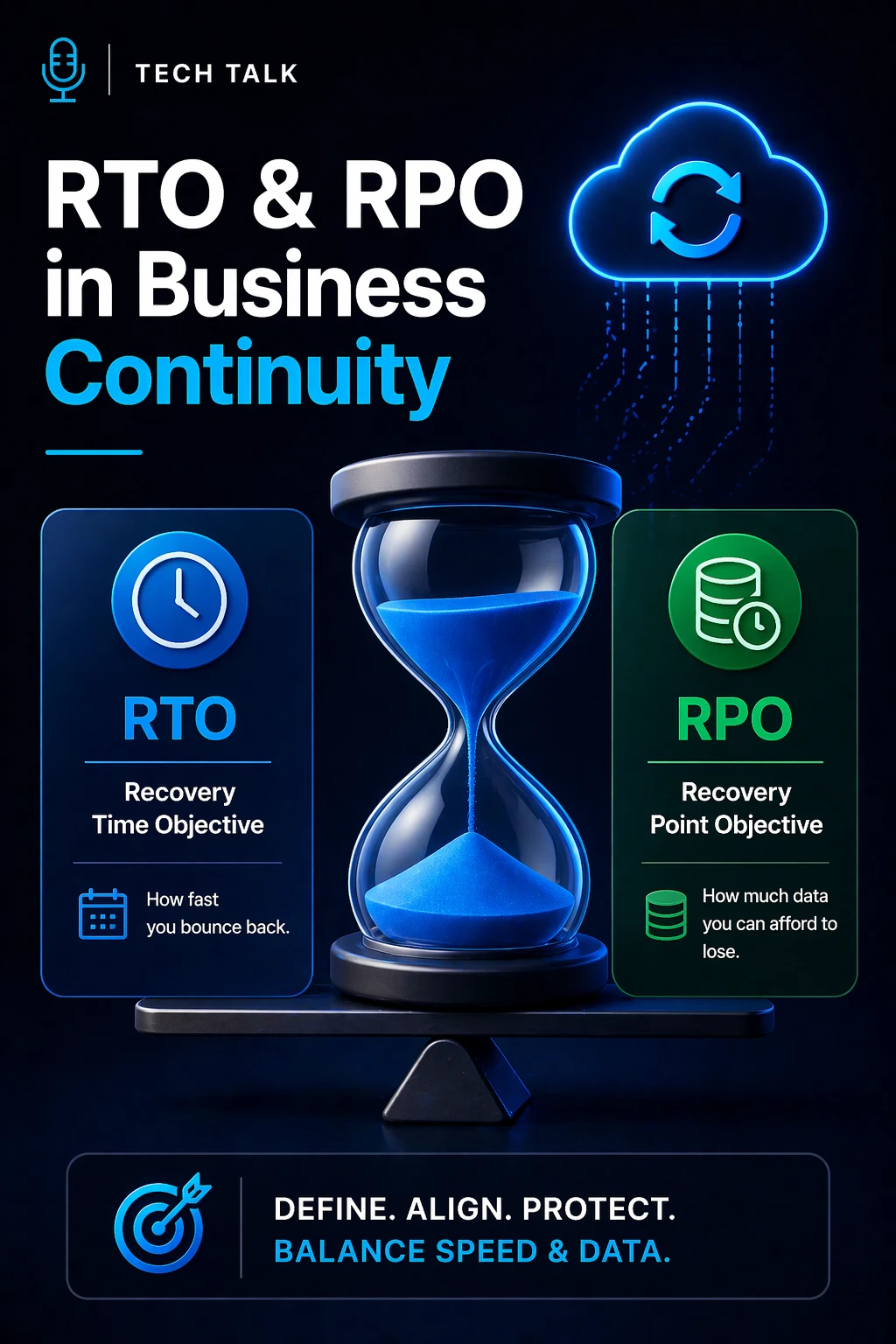
RTO is:
👉 the maximum amount of time your systems can be down after a disruption
It defines:
- how quickly systems must be restored
- acceptable downtime duration
RTO answers:
👉 How fast do we need to recover?
Example:
- RTO of 1 hour → systems must be restored within 1 hour
- RTO of 24 hours → systems can remain down for up to a day
What Is RPO (Recovery Point Objective)?
RPO is:
👉 the maximum amount of data your business can afford to lose
It defines:
- how far back recovery can go
- acceptable data loss
RPO answers:
👉 How much data can we afford to lose?
Example:
- RPO of 5 minutes → only 5 minutes of data loss is acceptable
- RPO of 24 hours → up to a full day of data loss is acceptable
RTO vs RPO (Core Difference)
RTO
- Measures downtime
- Focuses on speed of recovery
- Defines how quickly systems must return
RPO
- Measures data loss
- Focuses on data recovery point
- Defines how much data can be lost
RTO and RPO define different risks — downtime and data loss — both must be managed.
How RTO and RPO Work Together
RTO and RPO are closely connected.
- RTO determines recovery speed
- RPO determines data protection level
Together, they define:
👉 your overall recovery strategy
Example:
- low RTO + low RPO → fast recovery, minimal data loss (high investment)
- high RTO + high RPO → slower recovery, more data loss (lower cost)
Lower RTO and RPO require more advanced systems and higher investment.
How to Determine the Right RTO and RPO
RTO and RPO should be based on business impact.
Key factors include:
- criticality of systems
- financial impact of downtime
- regulatory requirements
- customer expectations
The process typically involves:
- business impact analysis (BIA)
- identifying critical systems
- defining acceptable downtime and data loss
What Happens When RTO and RPO Are Undefined
Without defined objectives:
- recovery priorities are unclear
- systems may be restored in the wrong order
- downtime may exceed acceptable limits
- data loss may be greater than expected
This leads to:
- operational disruption
- financial loss
- customer dissatisfaction
Undefined RTO and RPO result in unpredictable recovery outcomes.
Common RTO and RPO Mistakes
Organizations often:
- set unrealistic targets
- apply the same RTO/RPO to all systems
- fail to align objectives with business impact
- do not test recovery against defined targets
These mistakes result in:
- failed recovery expectations
- misaligned resources
- increased risk
Real-World Example
Consider a business-critical application:
- RTO = 2 hours
- RPO = 15 minutes
This means:
- systems must be restored within 2 hours
- no more than 15 minutes of data can be lost
To achieve this:
- frequent backups are required
- rapid recovery infrastructure is needed
- failover systems may be implemented
How to Align RTO and RPO With Your Strategy
To build an effective recovery strategy:
- define RTO and RPO for each critical system
- align objectives with business priorities
- invest in appropriate technology
- test recovery performance against targets
- adjust based on results
How to Know If Your RTO and RPO Are Inadequate
Warning signs include:
- recovery takes longer than expected
- data loss exceeds acceptable limits
- objectives are not documented
- systems have identical recovery targets regardless of importance
If your recovery objectives are unclear or untested, your continuity strategy is incomplete.
What This Means for Your Business
RTO and RPO determine:
- how quickly your business recovers
- how much data is lost
- how customers experience disruption
- how resilient your operations are
RTO controls downtime — RPO controls data loss.
Final Thoughts
RTO and RPO are not technical details.
They are business decisions.
They define:
- acceptable risk
- recovery expectations
- operational resilience
Need help with this topic?
Make sure your backups actually work when it matters.
Most businesses discover backup failures during an outage. We help you validate recovery, reduce downtime risk, and build a system that works under pressure.
- Backup validation and testing
- Recovery time optimization
- Clear recovery documentation