Why Tabletop Exercises Matter
Many organizations avoid testing because they fear disruption.
They worry about:
- interrupting operations
- impacting systems
- creating risk during testing
As a result:
- plans go untested
- teams lack confidence
- gaps remain hidden
Tabletop exercises solve this problem.
If your team has never walked through a disruption scenario, they will struggle to respond during a real incident.
What Is a Tabletop Exercise?
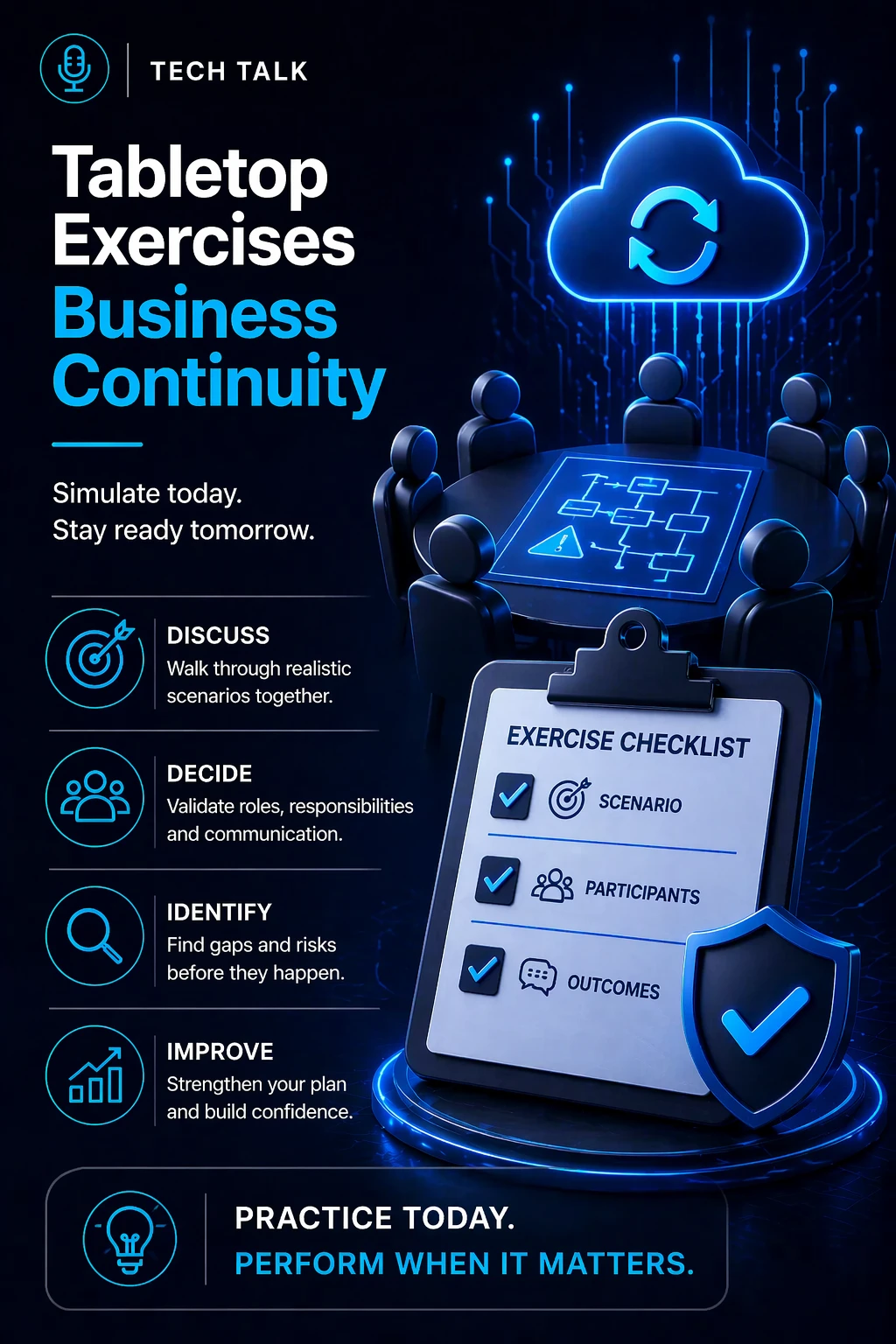
A tabletop exercise is:
👉 a structured, discussion-based simulation of a disruption scenario
It is designed to:
- walk teams through a realistic incident
- test decision-making and coordination
- evaluate understanding of the continuity plan
Tabletop exercises do not involve:
- live system changes
- real failover
- operational disruption
They answer:
👉 Does your team know what to do during a disruption?
What Tabletop Exercises Test
Tabletop exercises focus on:
- decision-making under pressure
- communication between teams
- role clarity and responsibilities
- escalation paths
- coordination across departments
They validate:
👉 understanding — not execution
Tabletop exercises test how people think — not how systems perform.
How Tabletop Exercises Work
A tabletop exercise follows a structured format.
1. Scenario Is Introduced
Participants are presented with a realistic situation.
Examples include:
- ransomware attack
- cloud outage
- network failure
- vendor disruption
The scenario unfolds in stages.
2. Teams Discuss Their Response
Participants explain:
- what actions they would take
- how they would communicate
- how decisions would be made
This reveals:
- gaps in understanding
- unclear responsibilities
3. Facilitator Guides the Discussion
A facilitator:
- introduces new developments
- asks probing questions
- challenges assumptions
The goal is to:
👉 simulate real pressure without real risk
4. Observations Are Recorded
During the exercise:
- strengths are identified
- weaknesses are documented
- confusion points are noted
5. Debrief and Improvement
After the exercise:
- results are reviewed
- gaps are analyzed
- improvements are planned
The value of a tabletop exercise comes from the discussion and the lessons learned — not the scenario itself.
Example Tabletop Scenario
Consider this situation:
- a ransomware attack locks critical systems
- employees cannot access applications
- customers begin reporting service issues
During the exercise, teams must answer:
- Who declares the incident?
- How is communication handled?
- What operations continue and how?
- When is recovery initiated?
This reveals:
👉 whether your plan is clear and actionable
Benefits of Tabletop Exercises
Tabletop exercises provide:
- low-risk testing environment
- improved team understanding
- early identification of gaps
- better communication planning
- increased confidence during incidents
They are especially useful for:
- organizations new to continuity testing
- validating newly created plans
Limitations of Tabletop Exercises
Tabletop exercises are valuable — but incomplete.
They do not test:
- real system performance
- failover capability
- recovery execution
- technical dependencies
This means:
👉 they must be combined with other testing methods
Tabletop exercises validate understanding — not real-world execution.
Common Tabletop Exercise Mistakes
Organizations often:
- use unrealistic scenarios
- avoid challenging situations
- fail to involve key decision-makers
- rush through discussions
- skip documenting results
These mistakes reduce:
- effectiveness
- insight
- improvement value
How to Run an Effective Tabletop Exercise
To get the most value:
- use realistic, high-impact scenarios
- involve cross-functional teams
- assign a strong facilitator
- encourage open discussion
- document all findings
- focus on learning — not perfection
How Often Should You Run Tabletop Exercises?
Tabletop exercises should be conducted:
- at least annually
- after major plan updates
- after significant organizational changes
More frequent testing is recommended for:
- high-risk environments
- critical operations
How to Know If You Need Tabletop Exercises
You likely need tabletop exercises if:
- your continuity plan is new
- teams are unfamiliar with their roles
- testing has not been performed
- communication processes are unclear
If your team has never walked through a disruption scenario, your readiness is unproven.
What This Means for Your Business
Tabletop exercises help determine:
- how well your team understands the plan
- how clearly decisions are made
- how effectively communication flows
- how prepared your organization is for disruption
Understanding the plan is the first step — execution comes next.
Final Thoughts
Tabletop exercises are the safest way to begin testing your business continuity plan.
They provide:
- clarity
- insight
- confidence
But they are only the starting point.
Real resilience requires:
- deeper testing
- continuous improvement
Need help with this topic?
Make sure your backups actually work when it matters.
Most businesses discover backup failures during an outage. We help you validate recovery, reduce downtime risk, and build a system that works under pressure.
- Backup validation and testing
- Recovery time optimization
- Clear recovery documentation