Why Continuity Plans Fail
Most organizations believe they are prepared for disruption.
They have:
- documented plans
- defined processes
- recovery strategies
But when disruption occurs:
- plans are not followed
- teams hesitate or guess
- operations break down
That failure is rarely due to a lack of planning.
It happens because:
👉 continuity plans are not built for real-world execution
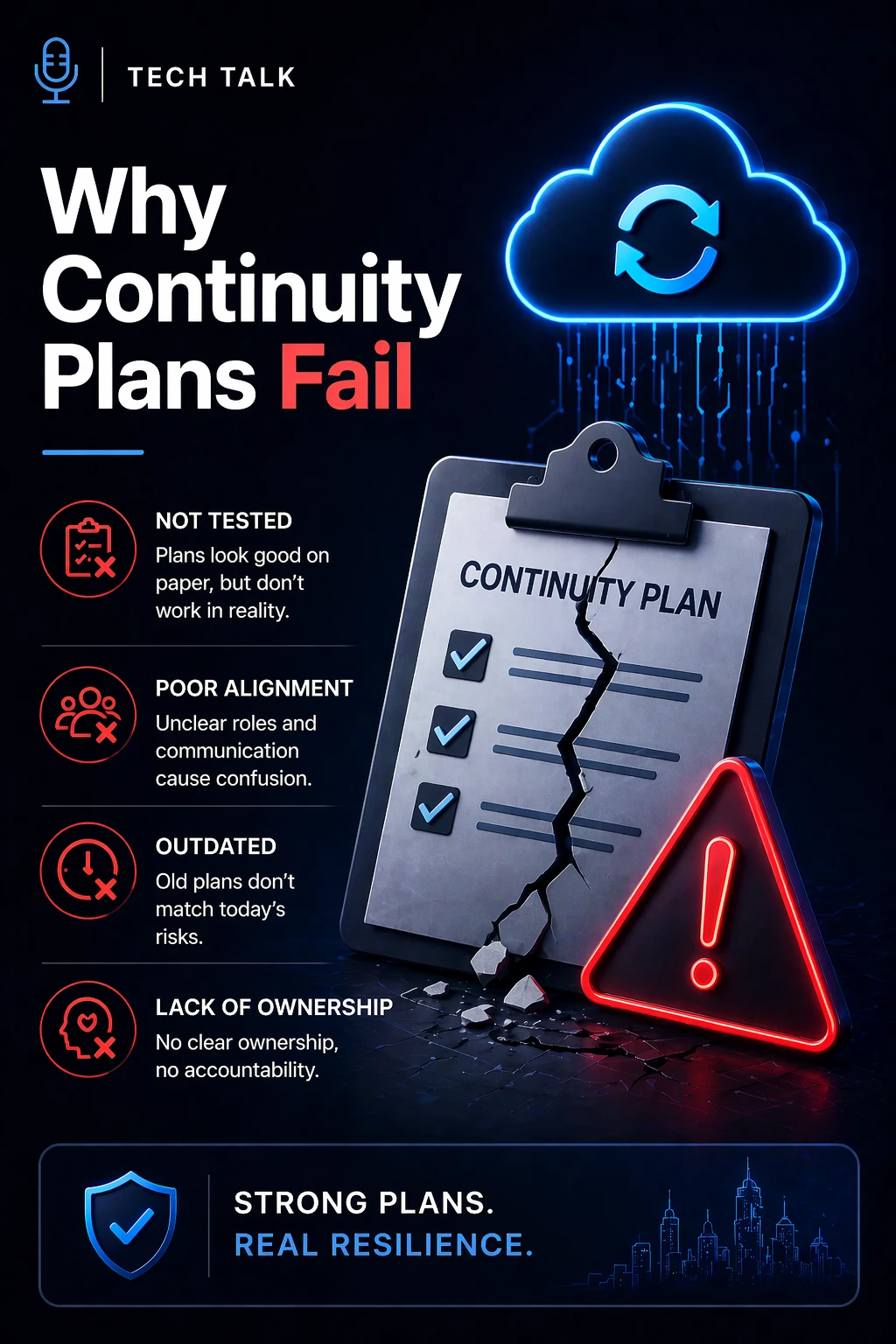
Most continuity plans fail not because they don’t exist — but because they don’t work under pressure.
The Root Cause of Failure
Continuity planning often focuses on:
- documentation
- compliance
- theoretical scenarios
But real incidents involve:
- pressure
- uncertainty
- incomplete information
This mismatch leads to:
👉 plans that look correct on paper but fail in practice
The Most Common Reasons Continuity Plans Fail
1. Lack of Testing
Plans are created — but never validated.
Without testing:
- teams are unfamiliar with procedures
- gaps remain hidden
- execution is inconsistent
During a real incident:
- confusion replaces coordination
If a plan has not been tested, it should be assumed to fail.
2. Unrealistic Assumptions
Plans often assume:
- systems will be available
- recovery will be fast
- communication will be clear
In reality:
- systems may be partially available
- delays are common
- communication breaks down
This leads to:
👉 plans that do not reflect real conditions
3. Lack of Clear Roles and Responsibilities
When roles are unclear:
- decisions are delayed
- accountability is lost
- teams wait for direction
During disruption:
- critical actions are not taken in time
4. Over-Reliance on Technology
Many plans focus heavily on:
- backup systems
- failover infrastructure
- recovery tools
But they neglect:
- people
- processes
- coordination
This results in:
👉 systems being available — but operations still failing
5. Poor Communication Planning
Communication is often overlooked.
Plans may not define:
- who communicates
- what is communicated
- how communication flows
During incidents:
- misinformation spreads
- teams act independently
- customers receive inconsistent updates
Without clear communication, even well-designed plans break down quickly.
6. Lack of Integration Between Continuity and Recovery
Continuity and recovery are often treated separately.
This creates gaps such as:
- operations continuing without system support
- systems being restored without operational coordination
Result:
👉 disconnected response efforts
7. Infrequent Updates
Business environments change constantly.
Plans that are not updated become:
- outdated
- misaligned with current systems
- ineffective during real incidents
8. Ignoring Dependencies
Plans often overlook:
- system interdependencies
- vendor dependencies
- process dependencies
This leads to:
- unexpected failures
- cascading disruptions
9. Lack of Leadership Involvement
Continuity planning is sometimes delegated entirely to IT.
Without leadership involvement:
- decision-making authority is unclear
- priorities are misaligned
- response is slower
10. Treating Continuity as a One-Time Project
Continuity is not static.
Organizations that treat it as a one-time effort:
- stop testing
- stop improving
- fall behind evolving risks
Continuity planning is not a project — it is an ongoing operational capability.
What Failure Looks Like in a Real Incident
When continuity plans fail:
- teams are unsure what to do
- communication breaks down
- operations stop or degrade significantly
- recovery takes longer than expected
The result is:
- extended downtime
- financial loss
- customer impact
Failure is rarely caused by one issue — it is the result of multiple gaps occurring at the same time.
How to Prevent Continuity Plan Failure
To build a plan that works:
- test regularly under realistic conditions
- eliminate unrealistic assumptions
- define clear roles and responsibilities
- integrate continuity and recovery processes
- strengthen communication planning
- update plans continuously
- involve leadership in planning and execution
How to Know If Your Plan Is at Risk
Warning signs include:
- lack of testing
- unclear roles
- outdated documentation
- overconfidence without validation
- reliance on recovery alone
If your plan has not been tested and updated regularly, it is likely to fail during a real disruption.
What This Means for Your Business
The effectiveness of your continuity plan determines:
- how your organization responds under pressure
- how long disruption lasts
- how customers experience outages
- how resilient your operations truly are
Continuity plans fail when they are not built, tested, and maintained as real operational systems.
Final Thoughts
Most continuity plans fail for predictable reasons.
The good news:
👉 these failures can be prevented
With the right approach:
- plans become executable
- teams become confident
- disruption becomes manageable
Need help with this topic?
Make sure your backups actually work when it matters.
Most businesses discover backup failures during an outage. We help you validate recovery, reduce downtime risk, and build a system that works under pressure.
- Backup validation and testing
- Recovery time optimization
- Clear recovery documentation