What Cloud Infrastructure Architecture Really Means
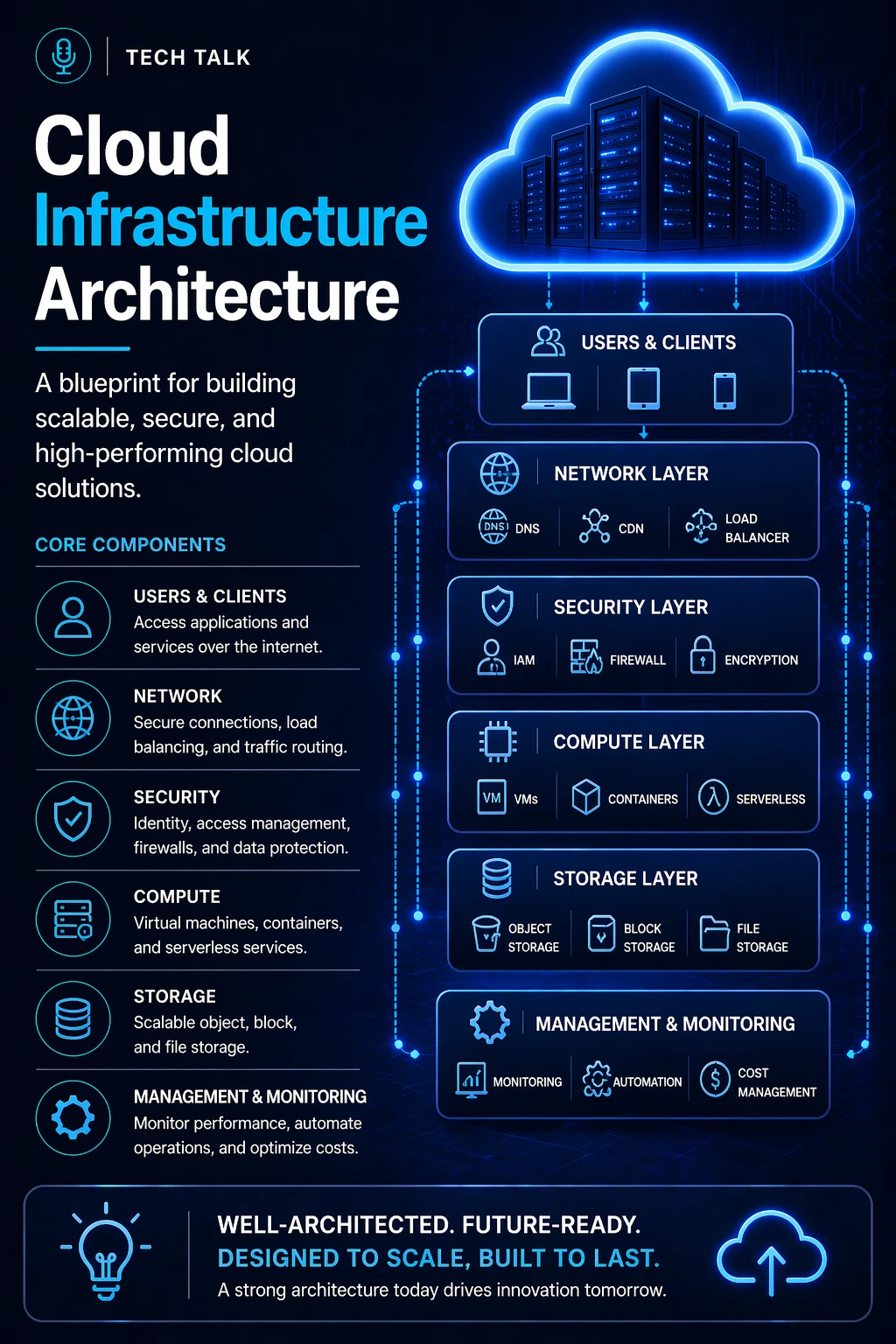
Cloud infrastructure architecture is how your systems are designed, connected, and structured.
It defines:
- how resources are deployed
- how systems interact
- how workloads are distributed
- how failures are handled
It is not about individual tools.
It is about how everything works together.
Cloud architecture determines whether your systems succeed or fail — not the platform you use.
Why Architecture Matters More Than the Cloud Provider
Many businesses believe choosing a provider solves their infrastructure challenges.
It does not.
AWS, Azure, and Google Cloud all provide:
- compute
- storage
- networking
- security tools
What they do not provide is:
- proper design
- correct configuration
- operational strategy
A poorly designed architecture will fail on any cloud platform.
What a Real Architecture Failure Looks Like
Architecture failures often appear during growth or stress.
A typical scenario:
- systems perform well under normal conditions
- demand increases
- resources cannot scale properly
- bottlenecks form
- dependencies fail
- services go down
At that point:
- downtime increases
- recovery becomes complex
- business operations are disrupted
Architecture failures are not sudden — they are exposed when systems are pushed beyond their limits.
The Core Principles of Strong Cloud Architecture
Effective architecture is built on key principles.
1. Scalability
Systems must handle growth without failure.
This includes:
- auto-scaling compute
- flexible resource allocation
- load distribution
2. Redundancy
Systems must continue operating even when components fail.
This includes:
- multiple availability zones
- replicated data
- failover systems
3. Performance
Systems must deliver consistent speed and responsiveness.
This includes:
- optimized storage
- efficient networking
- proper resource allocation
4. Security
Systems must be protected at every layer.
This includes:
- access control
- encryption
- network segmentation
5. Observability
You must be able to see what is happening.
This includes:
- monitoring
- logging
- alerting
Strong cloud architecture balances scalability, performance, and resilience — not just one of them.
Common Cloud Architecture Patterns
Most environments follow recognizable patterns.
Single-Tier Architecture (High Risk)
- everything runs in one layer
- minimal separation
- easy to deploy
Risk:
- single point of failure
- poor scalability
Multi-Tier Architecture
- separate layers for applications, data, and networking
- improved organization
- better performance
Benefit:
- easier scaling
- improved reliability
Distributed Architecture
- systems spread across multiple environments
- services operate independently
Benefit:
- high resilience
- fault tolerance
The more distributed your architecture, the more resilient — but also more complex — it becomes.
The Hidden Risk: Architecture That Evolves Without Design
Many environments are not designed — they evolve.
This leads to:
- inconsistent configurations
- unknown dependencies
- inefficient resource usage
Over time:
- systems become harder to manage
- troubleshooting becomes slower
- risk increases
Cloud environments that grow without architecture become fragile and unpredictable.
What Breaks Cloud Architecture
Most architecture failures come from predictable issues:
- lack of redundancy
- improper scaling configuration
- network misconfiguration
- insufficient security controls
- lack of monitoring
These issues often remain hidden until:
- demand increases
- systems fail
- recovery is needed
What a Well-Designed Cloud Architecture Looks Like
A strong architecture includes:
- segmented environments (production, staging, testing)
- scalable compute resources
- distributed storage systems
- isolated and secure networks
- automated monitoring and scaling
Good architecture assumes failure will happen — and plans for it.
How Architecture Impacts Cost
Architecture directly affects cost.
Poor design leads to:
- overprovisioned resources
- inefficient scaling
- unnecessary services
Well-designed systems:
- optimize usage
- scale efficiently
- reduce waste
Cloud cost is not determined by usage alone — it is determined by architecture.
How to Know If Your Architecture Is at Risk
You may have a gap if:
- systems fail under load
- scaling is unpredictable
- infrastructure is undocumented
- dependencies are unclear
If your architecture cannot scale or recover reliably, it needs redesign.
How This Connects to Other Cloud Topics
Architecture is the foundation for:
- cloud infrastructure explained
- cloud scaling and performance
- cloud infrastructure security
- cloud vs on-premise
What This Means for Your Business
Your architecture determines:
- how your systems perform
- how your business scales
- how resilient your operations are
It is not just technical.
It is strategic.
Cloud architecture is the difference between systems that work — and systems that fail when they matter most.
Final Thoughts
Cloud infrastructure architecture is not about building systems that work.
It is about building systems that:
- scale under pressure
- survive failure
- recover quickly
Need help with this topic?
Make sure your backups actually work when it matters.
Most businesses discover backup failures during an outage. We help you validate recovery, reduce downtime risk, and build a system that works under pressure.
- Backup validation and testing
- Recovery time optimization
- Clear recovery documentation