Why a Business Impact Analysis Matters
Most businesses assume they know what is critical.
In reality:
- priorities are often unclear
- dependencies are misunderstood
- impact is underestimated
Without a clear understanding:
- planning becomes guesswork
- recovery is misaligned
- continuity fails under pressure
You cannot protect what you have not clearly defined.
What Is a Business Impact Analysis (BIA)?
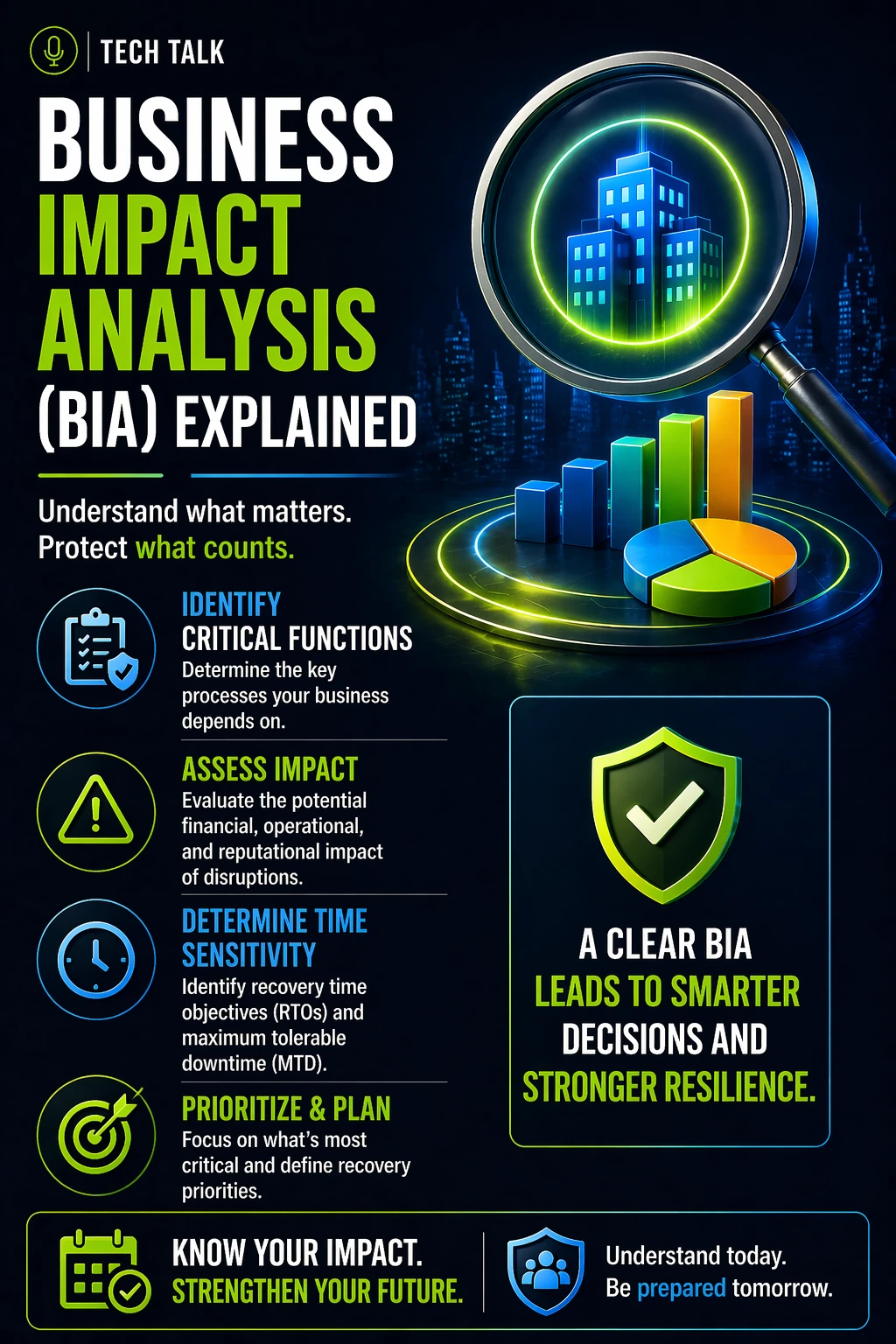
A business impact analysis (BIA) is the process of:
👉 identifying critical business functions and evaluating the impact of their disruption
It answers key questions:
- what operations are essential?
- what happens if they stop?
- how long can they be down?
- what is the cost of that downtime?
A BIA defines:
- priorities
- dependencies
- acceptable downtime
What a BIA Is Not
A BIA is often misunderstood.
It is not:
- a technical system inventory
- a backup strategy
- a disaster recovery plan
A BIA focuses on business impact — not just technology.
What Happens Without a BIA
Without a BIA:
- all systems may be treated as equally important
- recovery efforts may focus on the wrong priorities
- critical operations may be delayed
A common scenario:
- systems fail
- recovery begins without prioritization
- non-critical systems are restored first
- critical functions remain down
At that point:
- downtime increases
- impact escalates
- recovery becomes inefficient
The Core Outputs of a BIA
A completed BIA produces clear, actionable outputs.
1. Critical Business Functions
- identifies essential operations
- prioritizes what must continue
2. Impact Analysis
- financial impact
- operational impact
- customer impact
- reputational impact
3. Maximum Acceptable Downtime (MAD)
- defines how long a function can be unavailable
- sets thresholds for recovery urgency
4. Recovery Time Objectives (RTO)
- defines how quickly systems must be restored
5. Recovery Point Objectives (RPO)
- defines acceptable data loss
6. Dependencies
- systems and applications
- personnel and roles
- vendors and third parties
- infrastructure and connectivity
A BIA connects business operations to the systems and processes that support them.
How a BIA Supports Business Continuity
A BIA is the foundation of:
- business continuity planning
- disaster recovery strategy
- backup and recovery design
It ensures:
- resources are focused correctly
- recovery priorities are aligned with business needs
- continuity strategies are realistic
See:
How a BIA Works in Practice
A simplified process:
- Identify business functions
- Determine criticality
- Assess impact of disruption
- Define acceptable downtime
- Map dependencies
- Establish recovery priorities
This creates a clear framework for:
- planning
- response
- recovery
Common Mistakes in BIA
Common issues include:
- overestimating or underestimating impact
- failing to identify dependencies
- treating all systems equally
- not involving business stakeholders
- failing to update the analysis
An inaccurate BIA leads to incorrect priorities — which leads to ineffective recovery.
What a Strong BIA Looks Like
An effective BIA is:
- business-focused
- data-driven
- clearly documented
- aligned with real operations
- regularly updated
It should provide:
- clarity
- prioritization
- actionable insights
How to Know If You Lack a BIA
You may not have a proper BIA if:
- all systems are treated as equally important
- recovery priorities are unclear
- downtime impact is unknown
- dependencies are not documented
If you do not know what must be restored first, your recovery strategy is incomplete.
What This Means for Your Business
A business impact analysis determines:
- what matters most
- how quickly you must respond
- how much disruption you can tolerate
- how effectively you recover
The quality of your recovery depends on the accuracy of your priorities — and those priorities come from your BIA.
Final Thoughts
A business continuity plan without a BIA is incomplete.
It lacks:
- clarity
- prioritization
- direction
A BIA provides the foundation for everything that follows.
Need help with this topic?
Make sure your backups actually work when it matters.
Most businesses discover backup failures during an outage. We help you validate recovery, reduce downtime risk, and build a system that works under pressure.
- Backup validation and testing
- Recovery time optimization
- Clear recovery documentation