Why Downtime Is More Expensive Than It Appears
Many businesses underestimate downtime.
They assume:
- it will be short
- the impact will be manageable
- recovery will restore normal operations quickly
In reality:
- downtime costs begin immediately
- impact spreads across the organization
- recovery does not reverse all losses
Downtime is not just lost time — it is compounding business impact.
The First Layer of Cost: Immediate Loss
When systems go down:
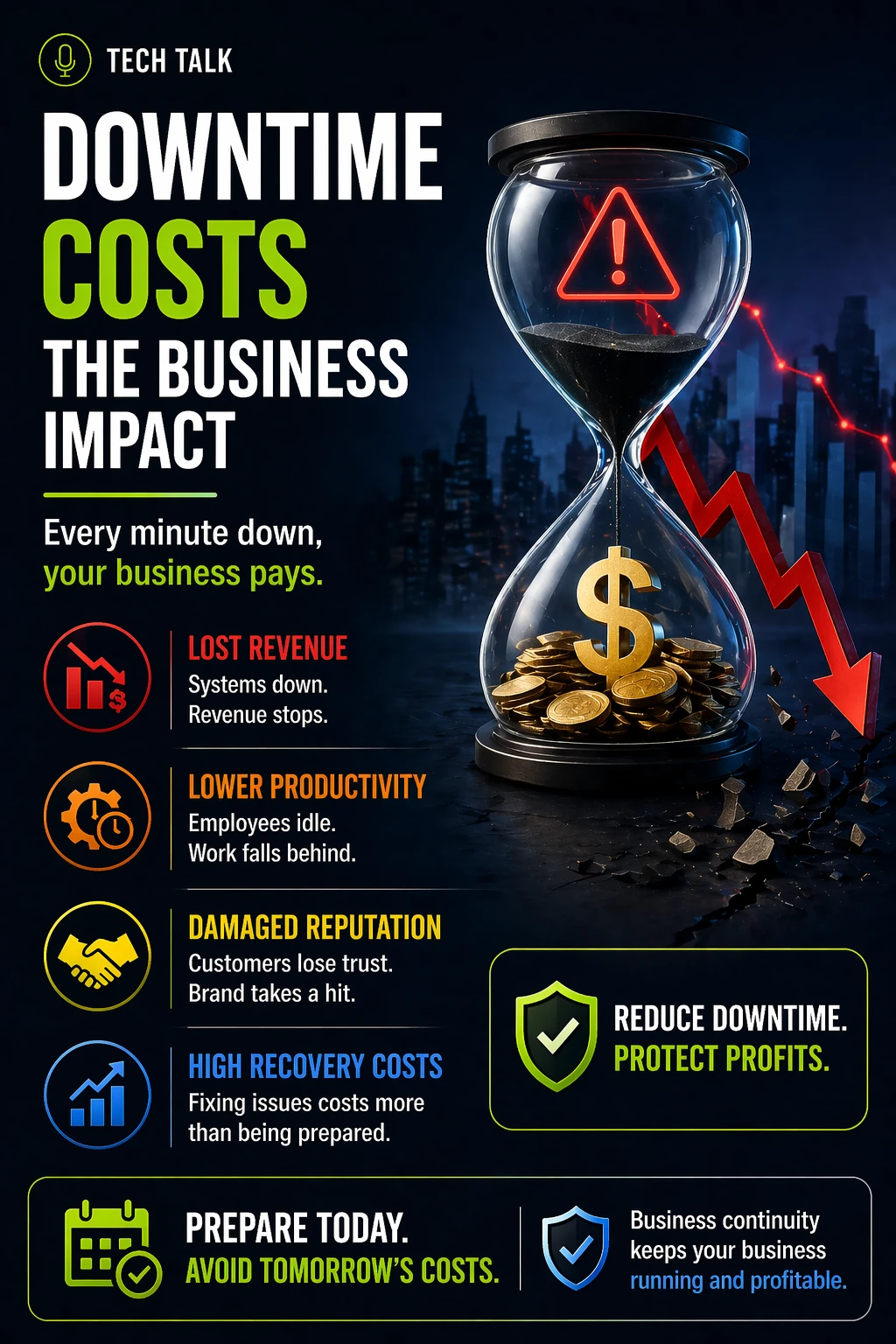
Revenue Impact
- transactions stop
- sales opportunities are lost
- billing may be delayed
Productivity Impact
- employees cannot perform their work
- workflows are interrupted
- output drops instantly
Operational Impact
- processes stop or become manual
- coordination becomes difficult
- efficiency declines
These costs begin:
👉 the moment disruption occurs
The Second Layer: Escalating Impact
As downtime continues:
Backlog Growth
- work accumulates
- deadlines are missed
- recovery becomes more complex
Customer Impact
- service delays increase
- response times slow
- customer satisfaction declines
Decision Pressure
- leadership must act quickly
- incomplete information leads to risk
- errors become more likely
Downtime impact increases over time — it does not remain constant.
The Third Layer: Long-Term Damage
Even after recovery:
Financial Impact
- lost revenue cannot be recovered
- additional costs are incurred
- profitability is affected
Reputational Impact
- trust is reduced
- brand perception declines
- customers may not return
Operational Impact
- teams must clear backlogs
- processes must stabilize
- productivity takes time to recover
Why Downtime Cost Is Not Linear
Downtime does not increase at a steady rate.
It compounds.
Early minutes:
- limited impact
Extended downtime:
- widespread disruption
- escalating costs
- long-term consequences
The longer downtime lasts, the faster its impact grows.
What Determines Downtime Cost
The cost of downtime varies by business, but key factors include:
- dependency on technology
- volume of transactions
- customer expectations
- operational complexity
- recovery speed
Businesses with:
- real-time operations
- customer-facing systems
- high transaction volume
experience significantly higher impact.
The Hidden Cost: Lost Momentum
One of the most overlooked impacts:
👉 operational momentum loss
When systems fail:
- workflows are interrupted
- priorities shift
- teams lose efficiency
After recovery:
- it takes time to regain pace
- backlog must be cleared
- coordination must be restored
This extends the true cost far beyond the outage.
Why Recovery Alone Does Not Solve the Problem
Many organizations focus on:
- backup systems
- disaster recovery
These reduce downtime duration.
They do not reduce:
- immediate impact
- operational disruption
- customer experience issues
See:
Recovery reduces downtime length — business continuity reduces downtime impact.
How Business Continuity Reduces Downtime Cost
With business continuity:
- operations continue at reduced capacity
- employees remain productive
- customer service is maintained
This reduces:
- revenue loss
- operational disruption
- customer dissatisfaction
Instead of stopping:
👉 the business adapts
How to Estimate Your Downtime Cost
To understand your risk, consider:
- revenue generated per hour
- number of employees affected
- cost of idle time
- customer-facing impact
- recovery duration
Ask:
- how much does one hour of downtime cost?
- what happens if downtime lasts a full day?
These answers define your exposure.
Warning Signs You Underestimate Downtime
You may be underestimating cost if:
- downtime impact is not quantified
- recovery speed is assumed
- continuity planning is limited
- operational dependencies are unclear
If you have not calculated downtime impact, you are making decisions without understanding risk.
What This Means for Your Business
Downtime cost determines:
- how much disruption you can tolerate
- how quickly you must respond
- how important continuity becomes
Understanding downtime cost is what drives effective continuity and recovery planning.
Final Thoughts
Downtime is not just an inconvenience.
It is a business event with real consequences.
The longer it lasts:
- the greater the impact
- the harder the recovery
Need help with this topic?
Make sure your backups actually work when it matters.
Most businesses discover backup failures during an outage. We help you validate recovery, reduce downtime risk, and build a system that works under pressure.
- Backup validation and testing
- Recovery time optimization
- Clear recovery documentation