The Reality of Operating Without Continuity
Many businesses believe they can manage disruption.
They assume:
- downtime will be short
- recovery will be fast
- operations can pause temporarily
But when disruption actually occurs:
- systems fail
- access is lost
- processes stop
At that moment:
👉 the business is no longer operating — it is waiting
Without business continuity, disruption immediately becomes downtime.
The First 15 Minutes of Disruption
When there is no continuity plan:
- employees lose access to systems
- communication becomes fragmented
- leadership begins assessing the situation
Early signs of failure:
- no clear direction
- uncertainty about next steps
- delays in decision-making
Even in the first few minutes:
- productivity drops sharply
- confusion begins to spread
The First Hour: Operational Breakdown
As disruption continues:
- teams are unable to perform their roles
- customer-facing services are impacted
- internal processes begin to fail
Without continuity:
- there are no fallback procedures
- manual alternatives are unclear
- communication gaps widen
At this stage:
- downtime becomes visible
- business impact begins to escalate
The First Day: Business Impact Accelerates
After several hours:
- revenue loss becomes measurable
- customer dissatisfaction increases
- operational backlogs grow
Employees may:
- attempt workarounds
- create inconsistent processes
- operate without coordination
This leads to:
- inefficiency
- errors
- increased recovery complexity
Without continuity, businesses shift from structured operations to improvisation.
The Longer-Term Impact
As disruption extends:
Financial Impact
- sustained revenue loss
- increased recovery costs
- missed business opportunities
Customer Impact
- service delays
- loss of trust
- potential customer churn
Operational Impact
- backlog accumulation
- process breakdown
- reduced productivity
Reputational Impact
- damage to brand perception
- reduced confidence from partners
- long-term relationship impact
Why Recovery Alone Cannot Fix This
Many businesses rely on:
- backup systems
- disaster recovery plans
These are essential — but limited.
Recovery happens:
👉 after systems are restored
During the recovery window:
- operations remain down
- employees are idle
- customers are impacted
See:
Recovery reduces downtime length — continuity reduces downtime impact.
The Hidden Cost: Lost Momentum
One of the most overlooked impacts:
👉 loss of operational momentum
When operations stop:
- workflows are interrupted
- priorities shift
- teams lose focus
Even after recovery:
- it takes time to regain efficiency
- backlogs must be cleared
- processes must be stabilized
This extends the impact far beyond the outage itself.
What Businesses Without Continuity Experience
Common outcomes include:
- extended downtime
- operational confusion
- inconsistent decision-making
- increased financial loss
- customer dissatisfaction
These are not rare outcomes.
They are expected when continuity is missing.
What Continuity Would Change
With business continuity in place:
- operations continue at reduced capacity
- teams follow defined processes
- communication remains structured
- customer impact is minimized
Instead of stopping:
👉 the business adapts
The difference is not whether disruption happens — it is whether your business can function through it.
How to Know If You Are at Risk
You may lack business continuity if:
- operations stop when systems go down
- employees cannot work without technology
- fallback processes are undefined
- communication plans do not exist
- disruption response is reactive
If your business cannot operate during disruption, you are fully exposed to its impact.
What This Means for Your Business
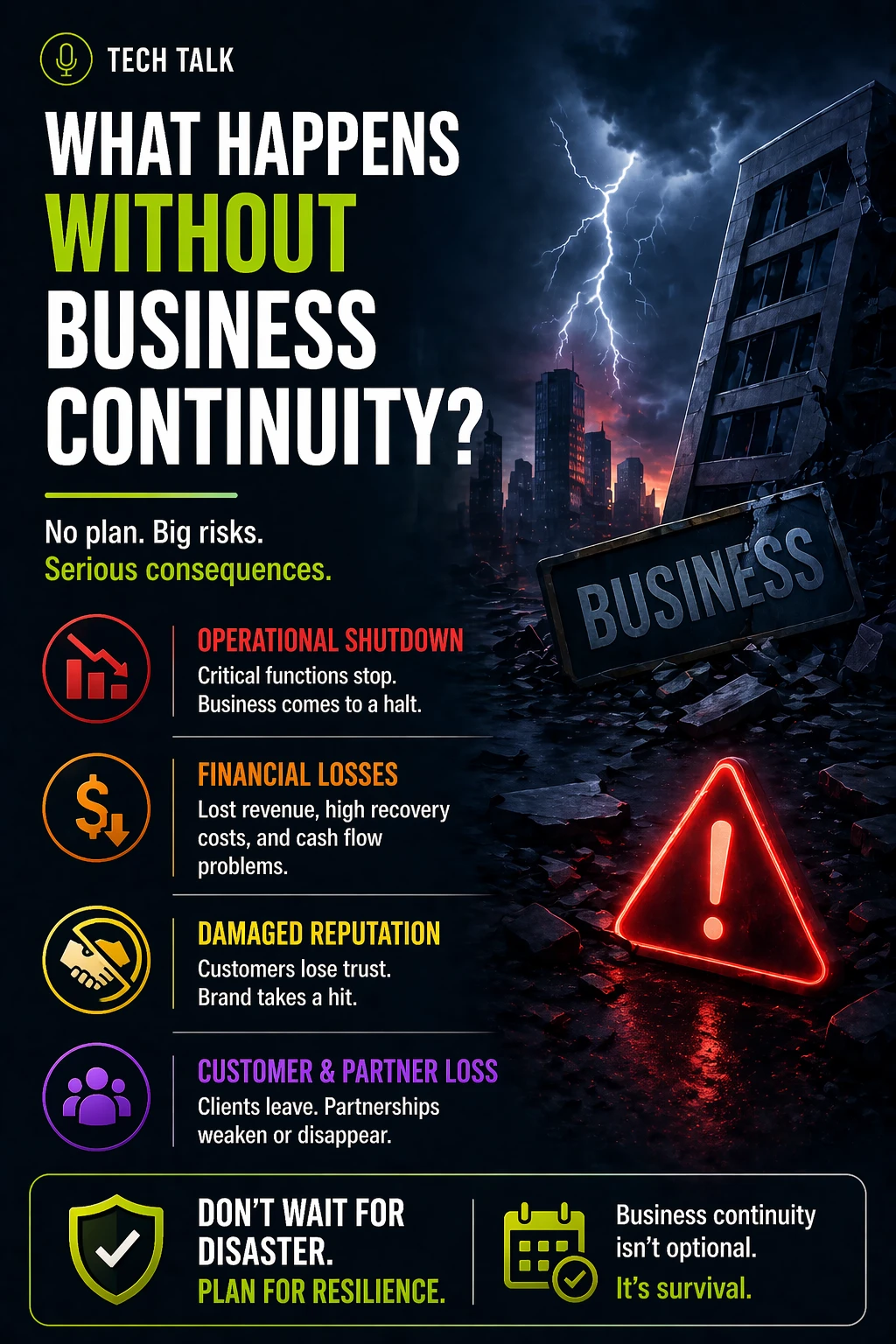
Operating without business continuity means:
- disruption equals downtime
- downtime equals impact
- impact escalates quickly
Business continuity determines:
- whether your business continues
- how customers experience disruption
- how much damage is sustained
Final Thoughts
Disruption is inevitable.
Operational failure is not.
Without business continuity:
- your business stops
With continuity:
- your business adapts
Need help with this topic?
Make sure your backups actually work when it matters.
Most businesses discover backup failures during an outage. We help you validate recovery, reduce downtime risk, and build a system that works under pressure.
- Backup validation and testing
- Recovery time optimization
- Clear recovery documentation