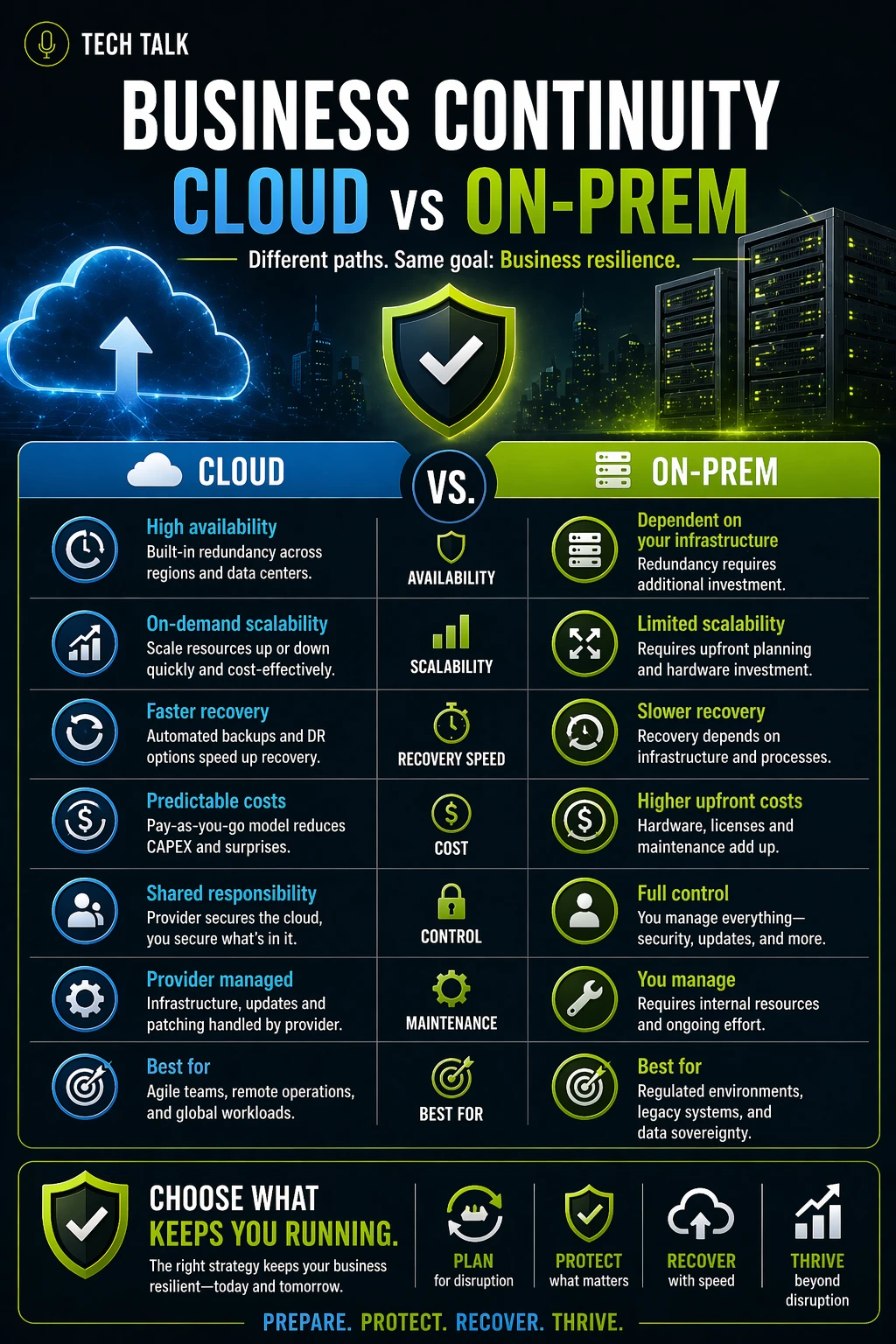
Why This Decision Matters
Infrastructure choices directly impact business continuity.
Many organizations ask:
- should we move to the cloud?
- should we stay on-prem?
The wrong question is:
👉 Which is better?
The right question is:
👉 Which design supports continuity under real-world failure?
Both cloud and on-premises environments can fail — the difference is how they fail and how you recover.
What “Cloud vs On-Prem” Really Means for Continuity
On-Premises Infrastructure
- systems hosted locally
- managed internally
- dependent on physical location
Cloud Infrastructure
- systems hosted in remote data centers
- managed by providers
- accessible over the internet
Each approach affects:
- availability
- recovery
- operational continuity
On-Premises: Strengths and Weaknesses
Strengths
- full control over systems
- predictable performance
- local access without internet dependency
Weaknesses
- single location risk
- limited redundancy
- higher exposure to physical disruption
- scaling challenges
A typical failure scenario:
- local outage occurs
- systems become unavailable
- no secondary environment exists
At that point:
- operations stop
Cloud: Strengths and Weaknesses
Strengths
- geographic redundancy
- scalable infrastructure
- built-in resilience features
Weaknesses
- dependency on internet connectivity
- shared infrastructure risks
- provider outages
- reduced direct control
A typical failure scenario:
- connectivity is lost
- cloud services become inaccessible
At that point:
- operations may be impacted despite systems still running
Cloud systems may still be running — but if you cannot access them, operations stop.
How Each Impacts Business Continuity
On-Premises
- faster local access
- higher risk of full outage
- recovery depends on local resources
Cloud
- higher resilience to localized failure
- slower recovery in some scenarios
- dependency on external factors
On-prem fails locally — cloud fails through access and dependency.
Common Misconceptions
“Cloud Means No Downtime”
False.
- cloud providers can experience outages
- access issues can disrupt operations
“On-Prem Is More Reliable”
False.
- local systems are vulnerable to single points of failure
- redundancy is often limited
The Real Risk: Single-Environment Dependency
The biggest risk is not cloud or on-prem.
It is:
👉 relying entirely on one environment
If that environment fails:
- operations stop
- recovery becomes critical
Why Hybrid Infrastructure Is Often the Best Approach
A hybrid model combines:
- on-prem systems
- cloud infrastructure
Benefits include:
- improved redundancy
- reduced dependency on a single environment
- better recovery flexibility
Example:
- local systems for speed
- cloud systems for resilience
Resilience comes from distribution — not from choosing a single environment.
How to Design for Continuity (Not Preference)
Instead of asking:
- cloud or on-prem?
Ask:
- what happens if this fails?
- how do we maintain access?
- where are the dependencies?
- how do we recover?
This aligns with:
- risk assessment
- business impact analysis
- continuity planning
See:
Common Infrastructure Mistakes
Avoid these pitfalls:
- assuming cloud eliminates risk
- relying on a single data center
- ignoring connectivity dependencies
- not planning for access failure
- lack of redundancy
These lead to:
- unexpected outages
- increased downtime
How to Know If Your Environment Is a Risk
Warning signs include:
- operations depend entirely on one system
- no redundancy exists
- recovery is unclear
- access failure stops work
If one environment failure stops your business, your continuity strategy is incomplete.
What This Means for Your Business
Your infrastructure choice determines:
- how disruption affects operations
- how quickly you can recover
- how resilient your business is
Continuity is not about where your systems run — it is about how they survive failure.
Final Thoughts
Cloud and on-prem are not opposing strategies.
They are tools.
The goal is not to choose one.
👉 It is to design for resilience across both.
Need help with this topic?
Make sure your backups actually work when it matters.
Most businesses discover backup failures during an outage. We help you validate recovery, reduce downtime risk, and build a system that works under pressure.
- Backup validation and testing
- Recovery time optimization
- Clear recovery documentation