Why a Framework Is Necessary
Many organizations approach business continuity in pieces.
They may have:
- backup systems
- recovery plans
- basic procedures
But without structure:
- efforts are disconnected
- priorities are unclear
- execution breaks down
Without a framework, continuity becomes reactive instead of strategic.
A framework ensures:
👉 every part of continuity works together under real-world conditions
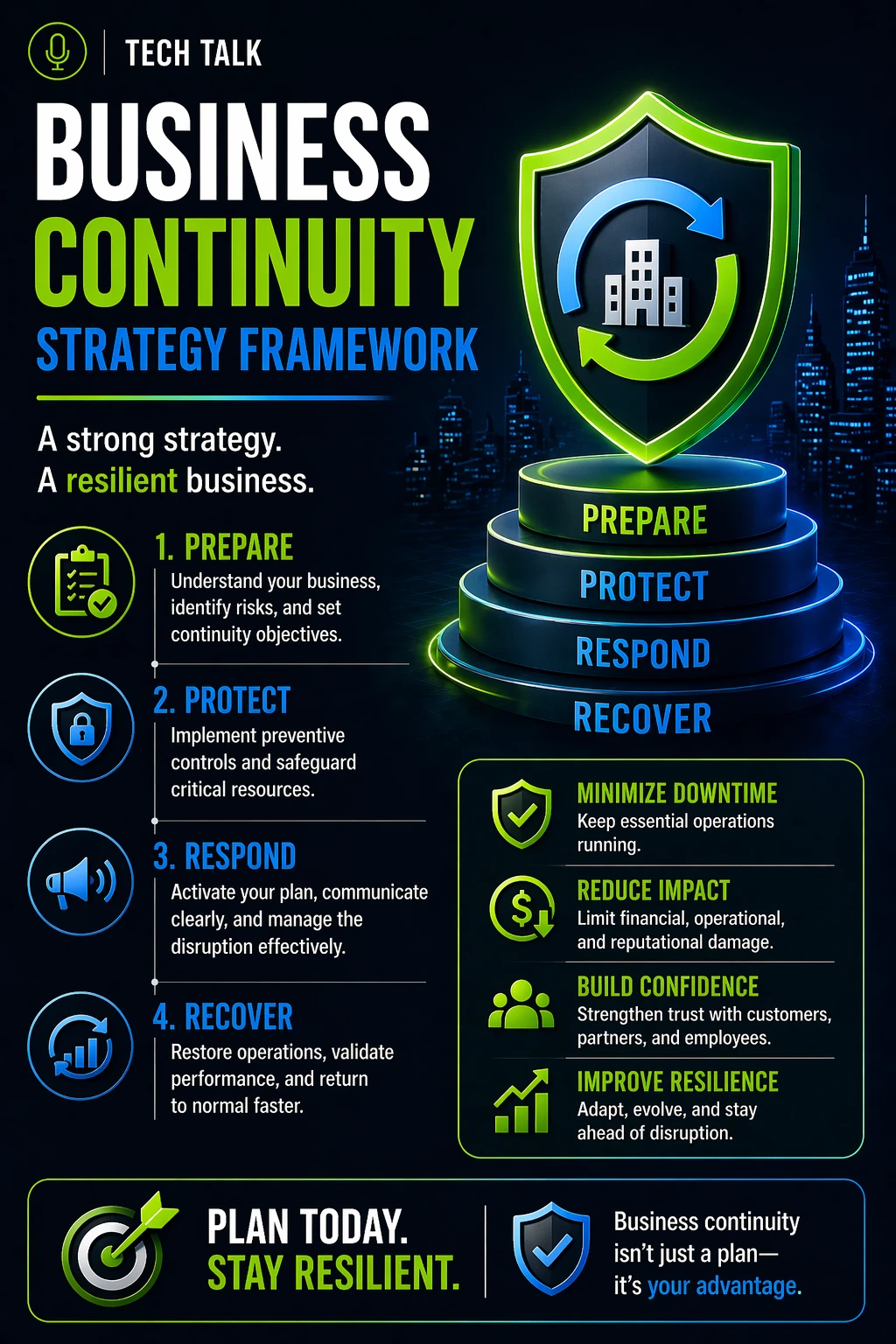
What Is a Business Continuity Strategy Framework?
A business continuity strategy framework is a structured model that defines:
👉 how your organization prepares for, responds to, and operates through disruption
It connects:
- risk identification
- operational priorities
- continuity processes
- recovery capabilities
The goal is simple:
👉 maintain operations while minimizing impact
What a Framework Solves
A structured framework addresses key challenges:
- unclear priorities
- inconsistent planning
- gaps between continuity and recovery
- lack of coordination across teams
It ensures:
- alignment across the organization
- consistent execution
- scalable continuity planning
The Core Layers of a Continuity Framework
A complete framework is built in layers.
1. Risk Awareness Layer
Defines what could go wrong.
Includes:
- threat identification
- vulnerability analysis
- likelihood assessment
See
risk assessment
2. Business Impact Layer
Defines what matters most.
Includes:
- critical business functions
- operational priorities
- impact of downtime
3. Strategy Layer
Defines how operations continue.
Includes:
- continuity strategies
- fallback processes
- alternative workflows
4. Execution Layer
Defines how the plan is carried out.
Includes:
- roles and responsibilities
- decision-making structure
- communication processes
5. Technology Layer
Supports continuity with infrastructure.
Includes:
- backup and recovery systems
- redundant environments
- cloud and hybrid infrastructure
See
backup and recovery resilience
6. Recovery Integration Layer
Aligns continuity with recovery.
Includes:
- disaster recovery processes
- system restoration
- return-to-normal operations
7. Testing and Validation Layer
Ensures the framework works.
Includes:
- testing scenarios
- validation exercises
- continuous improvement
See
business continuity testing
How the Framework Works in Practice
During disruption:
-
Risk Event Occurs
- systems or processes are impacted
-
Framework Activates
- continuity strategies are triggered
-
Operations Continue
- fallback processes maintain function
-
Recovery Runs in Parallel
- systems are restored
-
Return to Normal
- continuity processes phase out
A framework ensures continuity is coordinated — not improvised.
Why Most Strategies Fail Without a Framework
Common issues include:
- isolated planning efforts
- lack of coordination between teams
- unclear responsibilities
- gaps between continuity and recovery
- lack of testing
Fragmented strategies fail because they are not designed to work together under pressure.
What a Strong Framework Looks Like
An effective continuity framework is:
- structured and layered
- aligned with business operations
- integrated across departments
- regularly tested and updated
- designed for real-world execution
It should:
- provide clarity
- enable coordination
- support rapid response
How to Know If You Lack a Framework
You may have a gap if:
- continuity efforts are inconsistent
- roles and responsibilities are unclear
- plans do not align with operations
- testing is not performed
- recovery and continuity are disconnected
If your continuity efforts are not coordinated, your strategy is incomplete.
What This Means for Your Business
A business continuity strategy framework determines:
- how well your organization prepares for disruption
- how effectively it responds
- how consistently operations continue
- how quickly recovery is achieved
Structure is what turns continuity from a plan into a capability.
Final Thoughts
Continuity is not a single solution.
It is a system.
A framework ensures that system works — consistently and under pressure.
Need help with this topic?
Make sure your backups actually work when it matters.
Most businesses discover backup failures during an outage. We help you validate recovery, reduce downtime risk, and build a system that works under pressure.
- Backup validation and testing
- Recovery time optimization
- Clear recovery documentation