Why Business Continuity Plans Fail
Most organizations have some form of continuity planning.
The problem is not the existence of a plan.
It is whether that plan works under real conditions.
In many cases:
- plans look complete on paper
- processes seem logical
- recovery appears achievable
But when disruption happens:
- execution breaks down
- assumptions fail
- impact escalates
Business continuity failures do not happen in planning — they happen in execution.
The Most Common Failure Scenario
A typical breakdown looks like this:
- disruption occurs
- teams attempt to follow the plan
- unexpected gaps appear
- decisions are delayed
- communication breaks down
- operations stop
At that point:
- recovery slows
- confusion increases
- business impact grows
This is not unusual.
It is the most common outcome of untested or incomplete plans.
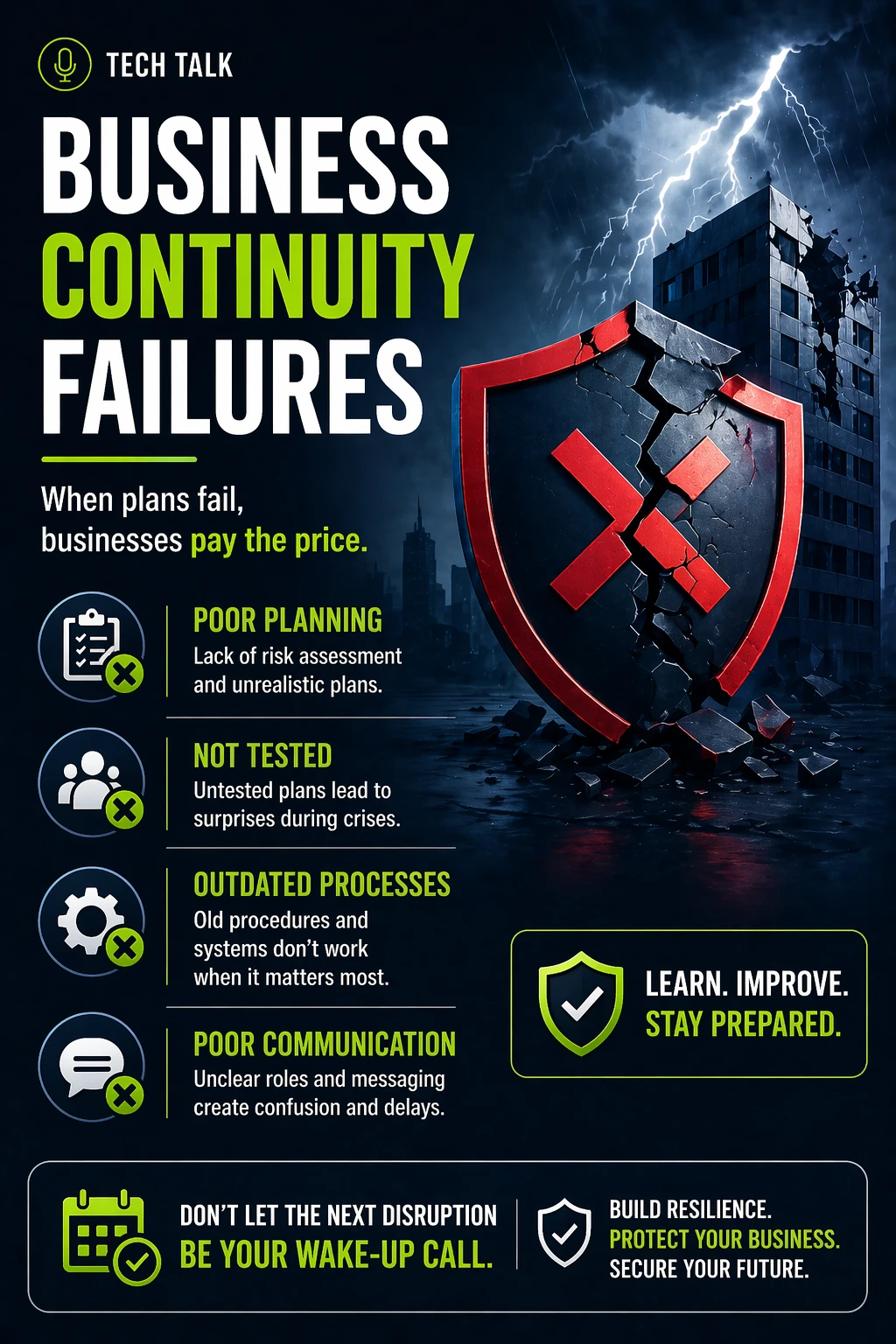
Failure #1: Lack of Testing
The most common reason continuity plans fail:
👉 they have never been tested
Without testing:
- execution is unproven
- assumptions go unchallenged
- weaknesses remain hidden
During real disruption:
- processes do not work as expected
- teams are unfamiliar with procedures
- delays occur at every step
See
business continuity testing
An untested plan is not a plan — it is an assumption.
Failure #2: Unclear Roles and Responsibilities
During disruption, clarity is critical.
When roles are unclear:
- decisions are delayed
- tasks are duplicated or missed
- accountability is lost
Common issues include:
- no defined decision-makers
- unclear escalation paths
- lack of ownership
This leads to:
- slower response
- operational confusion
Failure #3: Poor Understanding of Dependencies
Continuity plans often fail because dependencies are overlooked.
Examples:
- a critical application depends on another system
- a vendor outage impacts internal operations
- network access is required for fallback processes
Without understanding dependencies:
- continuity strategies fail unexpectedly
Unidentified dependencies are one of the most common causes of continuity failure.
Failure #4: Over-Reliance on Technology
Many plans assume:
- systems will be restored quickly
- backup solutions will work immediately
- technology will solve the problem
In reality:
- recovery takes time
- systems may remain unavailable
- technology can fail under pressure
This creates a gap:
- operations cannot continue without systems
See
business continuity vs backup recovery
Failure #5: Lack of Realistic Scenarios
Plans often focus on ideal scenarios.
They may not account for:
- multiple failures occurring simultaneously
- extended outages
- partial system availability
- human factors under stress
This leads to:
- plans that work in theory
- failure in real-world conditions
Failure #6: Outdated Plans
Continuity plans must evolve.
Common issues:
- systems have changed
- processes have evolved
- risks have increased
If plans are not updated:
- they no longer reflect reality
An outdated plan is as risky as having no plan at all.
Failure #7: Weak Communication Strategy
During disruption:
- communication becomes critical
Without a clear plan:
- teams lack direction
- stakeholders are uninformed
- confusion increases
Common gaps include:
- no defined communication channels
- lack of escalation procedures
- unclear messaging
Failure #8: No Alignment Between Continuity and Recovery
Continuity and recovery must work together.
When they are disconnected:
- continuity processes fail
- recovery is delayed
- coordination breaks down
See:
What All Failures Have in Common
Despite different causes, most failures share a common pattern:
- assumptions instead of validation
- planning without testing
- complexity without clarity
Continuity failures are rarely caused by a single issue — they are the result of multiple small gaps working together.
How to Prevent Business Continuity Failures
To reduce risk:
- test your plan regularly
- define clear roles and responsibilities
- identify and document dependencies
- build realistic scenarios
- keep plans updated
- align continuity with recovery
These steps transform:
- theoretical plans into operational capability
How to Know If Your Plan Might Fail
Warning signs include:
- the plan has never been tested
- roles are unclear
- dependencies are undocumented
- recovery is the only focus
- plans have not been updated
If your plan has not been validated under realistic conditions, there is a strong chance it will fail when needed.
What This Means for Your Business
Business continuity failures determine:
- how long your business is down
- how customers experience disruption
- how much impact is sustained
- how difficult recovery becomes
The effectiveness of your plan is not measured by its existence — but by its performance during disruption.
Final Thoughts
Most continuity failures are preventable.
They happen because:
- plans are incomplete
- assumptions go untested
- execution is not validated
The goal is not just to have a plan.
👉 It is to have a plan that works.
Need help with this topic?
Make sure your backups actually work when it matters.
Most businesses discover backup failures during an outage. We help you validate recovery, reduce downtime risk, and build a system that works under pressure.
- Backup validation and testing
- Recovery time optimization
- Clear recovery documentation