What the Shared Responsibility Model Really Means
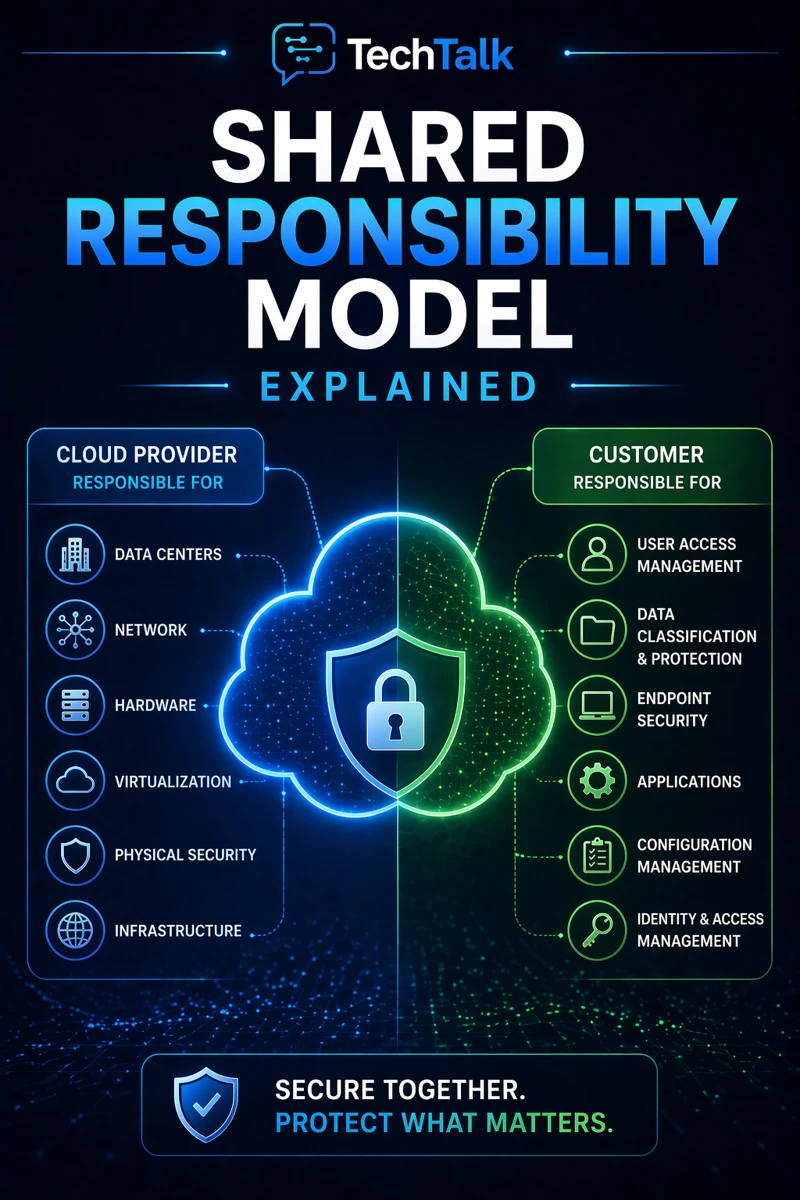
The shared responsibility model defines who is responsible for security in a cloud environment.
It separates responsibility between:
- the cloud provider
- the customer (your business)
Understanding this model is critical to avoiding security gaps.
If you need foundational context, start with what cloud infrastructure is.
Cloud providers do not secure your entire environment — they secure the platform you build on.
Why the Shared Responsibility Model Matters
Many businesses assume:
- “we are secure because we are in the cloud”
This assumption creates risk.
Without understanding responsibility:
- security gaps are introduced
- configurations are overlooked
- monitoring is incomplete
This is a common issue discussed in cloud infrastructure security.
Most cloud security failures are caused by misunderstanding responsibility — not lack of technology.
What a Real Failure Looks Like
A typical scenario:
- a business stores sensitive data in the cloud
- access permissions are misconfigured
- monitoring is limited
- unauthorized access occurs
The assumption:
- “the provider should have prevented this”
The reality:
- the provider secured the infrastructure
- the business failed to secure its environment
These failures are often tied to gaps in cloud infrastructure risk management.
Security incidents often happen in areas where responsibility is misunderstood.
What the Cloud Provider Is Responsible For
Cloud providers secure the underlying platform.
This includes:
- physical data centers
- hardware
- networking infrastructure
- core cloud services
They ensure:
- uptime of the platform
- protection of the physical environment
- reliability of cloud services
The provider secures the infrastructure of the cloud — not how you use it.
What You Are Responsible For
Your business is responsible for everything built on top of the cloud platform.
This includes:
- user access and permissions
- data security
- system configuration
- network controls
- monitoring and alerts
These responsibilities align with securing cloud infrastructure.
You are responsible for securing your data, access, and configurations.
Where Most Businesses Get It Wrong
Common misunderstandings include:
- assuming encryption is automatic
- assuming access is controlled by default
- assuming monitoring is built-in
These assumptions create:
- exposure
- vulnerabilities
- security gaps
These risks are often caused by cloud misconfigurations and risk.
How Responsibility Changes by Service Type
Responsibility varies depending on the type of cloud service.
Infrastructure as a Service (IaaS)
You control:
- operating systems
- applications
- configurations
Provider controls:
- physical infrastructure
Platform as a Service (PaaS)
You control:
- applications
- data
- access
Provider controls:
- platform
- runtime
Software as a Service (SaaS)
You control:
- user access
- data
- usage
Provider controls:
- application
- infrastructure
The more control you have, the more responsibility you carry.
The Hidden Risk: Partial Responsibility
Many businesses:
- partially understand responsibility
- secure some areas
- overlook others
This creates gaps:
- access is controlled, but monitoring is missing
- data is encrypted, but permissions are too broad
This issue is common in environments without proper cloud infrastructure planning.
Partial responsibility leads to incomplete security.
How Responsibility Connects to Architecture
Responsibility is enforced through design.
This includes:
- how systems are structured
- how access is controlled
- how networks are segmented
This ties directly to cloud infrastructure architecture.
What Happens Without Clear Responsibility
Without clear ownership:
- security gaps appear
- issues go unaddressed
- risk increases
This often leads to:
- data breaches
- downtime
- operational disruption
What a Well-Managed Environment Looks Like
A strong approach includes:
- clearly defined responsibilities
- documented controls
- consistent configuration
- continuous monitoring
It also aligns with cloud infrastructure strategy.
Clear responsibility leads to consistent and effective security.
How Responsibility Impacts Business Risk
Misunderstanding responsibility leads to:
- security incidents
- compliance issues
- operational disruption
Understanding responsibility ensures:
- systems are protected
- risks are controlled
- responsibilities are clear
Unclear responsibility is one of the biggest sources of cloud risk.
How to Know If Responsibility Is Unclear
You may have a gap if:
- you assume your provider handles security
- access controls are inconsistent
- monitoring is limited
- responsibilities are undocumented
If responsibility is not clearly defined, your environment is at risk.
How This Connects to Other Cloud Topics
The shared responsibility model connects to:
- what is cloud infrastructure
- cloud infrastructure security
- securing cloud infrastructure
- cloud infrastructure risk management
- cloud misconfigurations and risk
What This Means for Your Business
Understanding responsibility determines:
- how secure your environment is
- how risks are managed
- how systems are controlled
It is not optional.
It is foundational.
You cannot secure what you do not know you are responsible for.
Final Thoughts
The shared responsibility model is one of the most important concepts in cloud infrastructure.
But it is also one of the most misunderstood.
Understanding it ensures:
- security gaps are reduced
- responsibilities are clear
- systems are properly protected
Need help with this topic?
Make sure your backups actually work when it matters.
Most businesses discover backup failures during an outage. We help you validate recovery, reduce downtime risk, and build a system that works under pressure.
- Backup validation and testing
- Recovery time optimization
- Clear recovery documentation