What Cloud Tools Really Mean for Small Businesses
Cloud tools are software and platforms that run in the cloud and support business operations.
They replace:
- on-premise systems
- manual processes
- legacy software
Cloud tools enable:
- remote access
- automation
- scalability
If you need foundational context, start with what cloud infrastructure is.
Small businesses don’t need more tools — they need the right tools.
Why Cloud Tools Matter for SMBs
Cloud tools help small businesses:
- improve productivity
- reduce IT overhead
- scale efficiently
These benefits are explained in cloud infrastructure for small business.
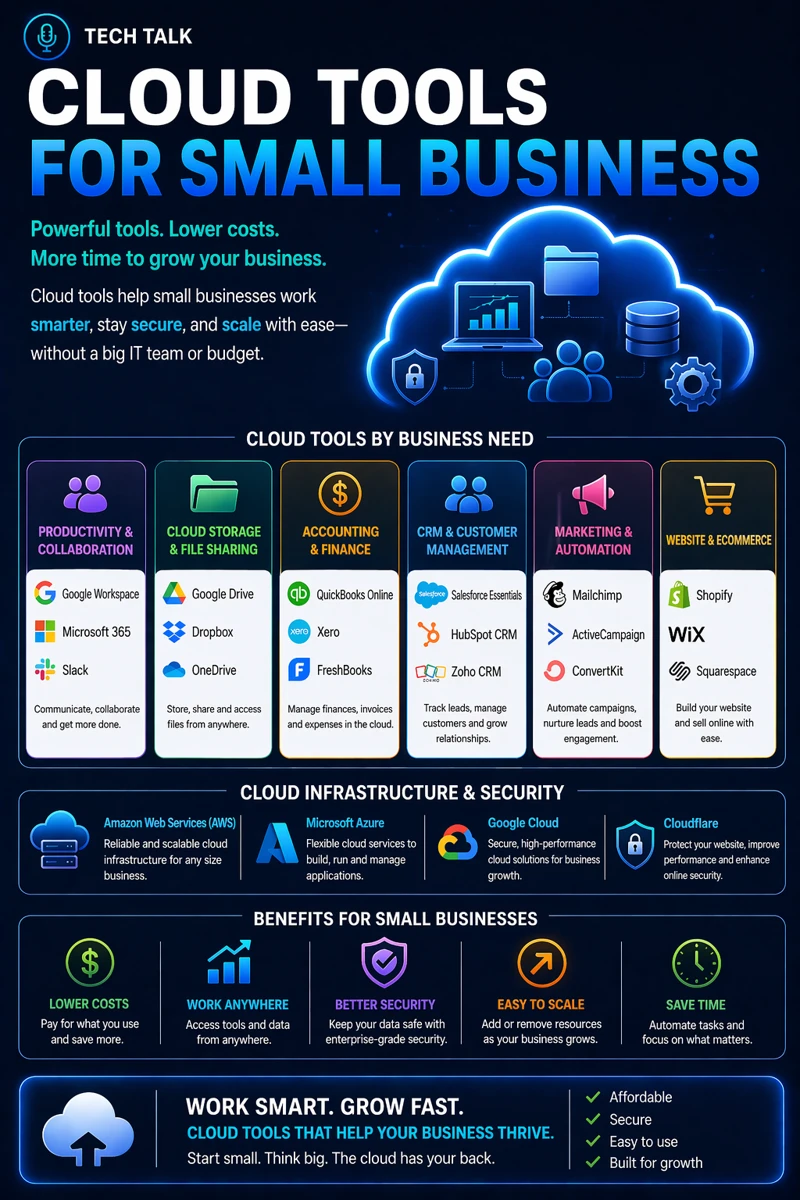
The Core Categories of Cloud Tools
Small businesses typically need a few essential types of tools.
File Storage and Sharing Tools
These tools allow:
- storing files securely
- sharing across teams
- accessing data remotely
This supports simple cloud setup for business.
Collaboration Tools
These tools enable:
- team communication
- project coordination
- real-time collaboration
Backup and Recovery Tools
These tools protect data.
This includes:
- backups
- recovery systems
This aligns with cloud disaster recovery explained.
Security Tools
These tools protect systems.
This includes:
- access control
- monitoring
This aligns with cloud infrastructure security.
Management and Monitoring Tools
These tools provide visibility.
This includes:
- performance tracking
- alerts
This aligns with cloud infrastructure monitoring.
Most small businesses only need a few core tools to operate efficiently.
The Hidden Risk: Too Many Tools
Many businesses:
- adopt too many platforms
- use overlapping tools
This leads to:
- higher costs
- inefficiency
- complexity
This is common in environments facing cloud adoption challenges.
Too many tools can reduce efficiency instead of improving it.
What Makes Cloud Tools Effective
Effective tools are:
- easy to use
- well-integrated
- aligned with business needs
Poor tool selection leads to:
- inefficiency
- confusion
- wasted resources
These issues are often tied to cloud infrastructure mistakes.
The Role of Integration
Tools must work together.
This includes:
- data sharing
- system compatibility
The Role of Simplicity
Simple toolsets are easier to manage.
This aligns with simple cloud setup for business.
Simplicity improves usability and reduces operational burden.
The Role of Cost Management
Tool costs must be controlled.
This includes:
- avoiding unnecessary subscriptions
- optimizing usage
This aligns with cloud cost management strategies.
The Role of Security in Tool Selection
Security must be considered.
This includes:
- data protection
- access management
This aligns with cloud infrastructure security.
The Complexity of Tool Selection
Choosing tools involves:
- evaluating needs
- comparing options
- ensuring compatibility
This creates:
- decision complexity
- potential inefficiencies
These challenges are explained in cloud infrastructure explained.
What a Well-Designed Tool Stack Looks Like
A strong setup includes:
- essential tools only
- integrated systems
- cost-efficient solutions
- scalable platforms
It must also align with cloud infrastructure strategy.
Choose fewer tools that do more, rather than more tools that overlap.
How Cloud Tools Impact Business Operations
Cloud tools directly affect:
- productivity
- efficiency
- scalability
Poor tool choices lead to:
- inefficiency
- increased cost
- operational challenges
The right tools improve efficiency — the wrong ones create complexity.
How to Know If You Have Too Many Tools
You may have a problem if:
- tools overlap
- systems are difficult to manage
- costs are increasing
- teams are confused
If your toolset feels complex, it likely needs simplification.
How to Choose the Right Cloud Tools
Start with:
- identifying business needs
- selecting essential tools
- ensuring integration
- monitoring usage
These steps align with broader cloud infrastructure strategy.
How This Connects to Other Cloud Topics
Cloud tools connect to:
- what is cloud infrastructure
- cloud infrastructure for small business
- simple cloud setup for business
- cloud infrastructure monitoring
- cloud infrastructure strategy
What This Means for Your Business
Your tool selection determines:
- how efficiently you operate
- how easily you scale
- how well your team performs
It is not optional.
It is strategic.
The right tools simplify operations and enable growth.
Final Thoughts
Cloud tools are powerful.
But only when used correctly.
When chosen carefully:
- systems become efficient
- teams become productive
- businesses grow
Need help with this topic?
Make sure your backups actually work when it matters.
Most businesses discover backup failures during an outage. We help you validate recovery, reduce downtime risk, and build a system that works under pressure.
- Backup validation and testing
- Recovery time optimization
- Clear recovery documentation