What a Cloud Infrastructure Roadmap Really Is
A cloud infrastructure roadmap is a structured plan for how your environment should evolve over time.
It defines:
- where you are today
- where you need to go
- how to get there
Without a roadmap:
- infrastructure grows reactively
- systems become inconsistent
- risk increases over time
If you need foundational context, start with what cloud infrastructure is.
Most cloud environments do not fail immediately — they fail over time without a clear roadmap.
Why a Roadmap Matters More Than Individual Decisions
Many businesses make infrastructure decisions one at a time:
- adding new systems
- upgrading tools
- fixing issues as they arise
Without a roadmap:
- decisions are disconnected
- systems become complex
- long-term performance suffers
This is a common issue in environments lacking cloud infrastructure strategy.
Isolated improvements do not create strong infrastructure — coordinated planning does.
What a Real Roadmap Failure Looks Like
A typical scenario:
- a business adopts cloud systems gradually
- no long-term plan is defined
- dependencies increase over time
- performance issues appear
- costs grow unpredictably
At that point:
- systems are difficult to manage
- changes are risky
- redesign becomes necessary
These issues are often tied to poor cloud infrastructure planning.
Infrastructure problems often result from missing direction — not missing technology.
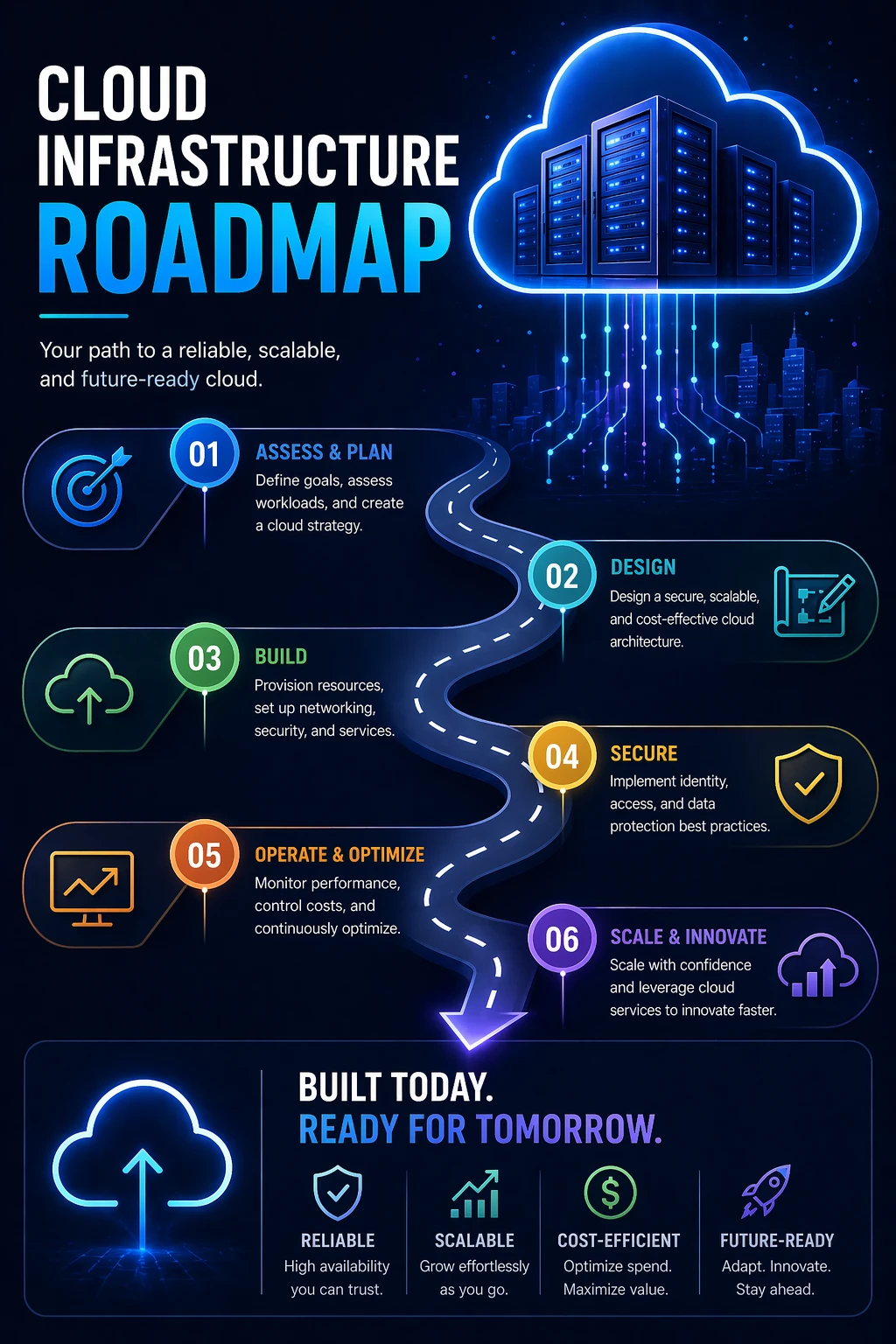
The Phases of a Cloud Infrastructure Roadmap
A strong roadmap is built in stages.
Phase 1: Assessment and Visibility
Before making changes, you must understand your current environment.
This includes:
- identifying systems and dependencies
- documenting infrastructure
- evaluating performance and cost
This aligns with understanding cloud infrastructure basics for business.
Goal: clarity and visibility
Phase 2: Stabilization
Address immediate risks and inefficiencies.
This includes:
- fixing performance bottlenecks
- improving reliability
- implementing monitoring
Many of these issues are rooted in gaps identified in cloud infrastructure explained.
Goal: consistent performance
Phase 3: Standardization
Create consistency across your environment.
This includes:
- defining architecture standards
- implementing consistent configurations
- improving documentation
See cloud infrastructure architecture.
Goal: predictability and control
Phase 4: Optimization
Improve efficiency and performance.
This includes:
- right-sizing resources
- optimizing scaling
- reducing unnecessary cost
This phase ties directly to cloud scaling and performance.
Goal: efficiency and cost control
Phase 5: Resilience and Security
Strengthen reliability and protection.
This includes:
- implementing redundancy
- improving security controls
- enhancing monitoring
See cloud infrastructure security.
Goal: risk reduction and continuity
Phase 6: Continuous Improvement
Infrastructure is not static.
This phase includes:
- ongoing optimization
- adapting to business growth
- refining systems over time
Strong infrastructure evolves intentionally — not reactively.
The Role of Design and Components in the Roadmap
Each phase depends on proper design and alignment.
This includes:
- how systems are structured
- how components interact
- how resources are allocated
See:
A roadmap must align architecture, components, and operations — not treat them separately.
The Hidden Risk: Skipping Phases
Many businesses try to:
- optimize before stabilizing
- scale before standardizing
- secure systems after deployment
This leads to:
- inefficiency
- increased risk
- higher long-term cost
Skipping foundational steps creates fragile infrastructure that fails under pressure.
What Breaks a Cloud Infrastructure Roadmap
Roadmaps fail when:
- they are not documented
- they are not followed consistently
- business goals are not aligned
- environments change without updates
These issues often result in the same problems seen in poorly planned systems.
What a Strong Roadmap Looks Like
A well-defined roadmap ensures:
- clear direction for infrastructure decisions
- alignment with business goals
- predictable system behavior
- controlled growth
It also supports a broader cloud infrastructure strategy.
A roadmap should guide decisions — not just document them.
How a Roadmap Impacts Cost
Without a roadmap:
- resources are added inefficiently
- scaling is inconsistent
- costs increase unpredictably
With a roadmap:
- investments are planned
- systems are optimized
- costs are controlled
Cloud cost issues are often the result of missing long-term planning.
How to Know If You Need a Roadmap
You may have a gap if:
- infrastructure decisions are reactive
- systems are inconsistent
- performance issues appear unexpectedly
- costs are difficult to predict
If your infrastructure lacks direction, it lacks a roadmap.
How This Connects to Other Cloud Topics
A roadmap ties together all aspects of cloud infrastructure:
- what is cloud infrastructure
- cloud infrastructure explained
- cloud infrastructure architecture
- cloud infrastructure planning guide
- cloud infrastructure strategy
What This Means for Your Business
Your roadmap determines:
- how your infrastructure evolves
- how your systems perform
- how efficiently you operate
It is not just a technical document.
It is a strategic asset.
Without a roadmap, infrastructure growth becomes unpredictable and risky.
Final Thoughts
Cloud infrastructure is not built all at once.
It evolves over time.
A roadmap ensures that evolution is:
- intentional
- controlled
- aligned with your business
Need help with this topic?
Make sure your backups actually work when it matters.
Most businesses discover backup failures during an outage. We help you validate recovery, reduce downtime risk, and build a system that works under pressure.
- Backup validation and testing
- Recovery time optimization
- Clear recovery documentation