What Cloud Operations Really Mean
Cloud operations refer to the day-to-day management of cloud infrastructure.
This includes:
- monitoring systems
- managing resources
- maintaining security
- optimizing performance
It is the operational layer that keeps everything running.
If you need foundational context, start with what cloud infrastructure is.
Cloud infrastructure only performs as well as the operations behind it.
Why Best Practices Matter
Cloud environments are:
- dynamic
- distributed
- constantly evolving
Without best practices:
- issues go undetected
- inefficiencies grow
- risk increases
Best practices ensure:
- stability
- efficiency
- scalability
This builds on concepts in managing cloud infrastructure.
What Poor Cloud Operations Look Like
A typical scenario:
- monitoring is limited
- processes are undefined
- changes are inconsistent
- issues are reactive
At that point:
- downtime increases
- costs rise
- security risks grow
These failures are often tied to lack of cloud infrastructure monitoring.
Reactive operations lead to higher cost, lower performance, and increased risk.
The Core Cloud Operations Best Practices
Effective cloud operations rely on several key practices.
Continuous Monitoring (Visibility First)
You must monitor systems at all times.
This includes:
- performance metrics
- usage tracking
- alerting
This aligns with cloud infrastructure monitoring.
What it solves:
- hidden issues
- delayed response
Automation (Reducing Manual Work)
Automate repetitive tasks.
This includes:
- provisioning
- scaling
- alert responses
This aligns with cloud infrastructure automation.
What it solves:
- manual errors
- inefficiency
Standardization (Consistent Environments)
Ensure systems follow consistent configurations.
This includes:
- defined baselines
- enforced policies
This aligns with cloud configuration management.
What it solves:
- configuration drift
- inconsistency
Cost Control (Managing Spending)
Actively manage costs.
This includes:
- monitoring usage
- optimizing resources
- enforcing budgets
This aligns with cloud cost management strategies.
What it solves:
- overspending
- inefficiency
Security Integration (Protecting Systems)
Security must be part of operations.
This includes:
- continuous monitoring
- access control
- policy enforcement
This aligns with cloud infrastructure security.
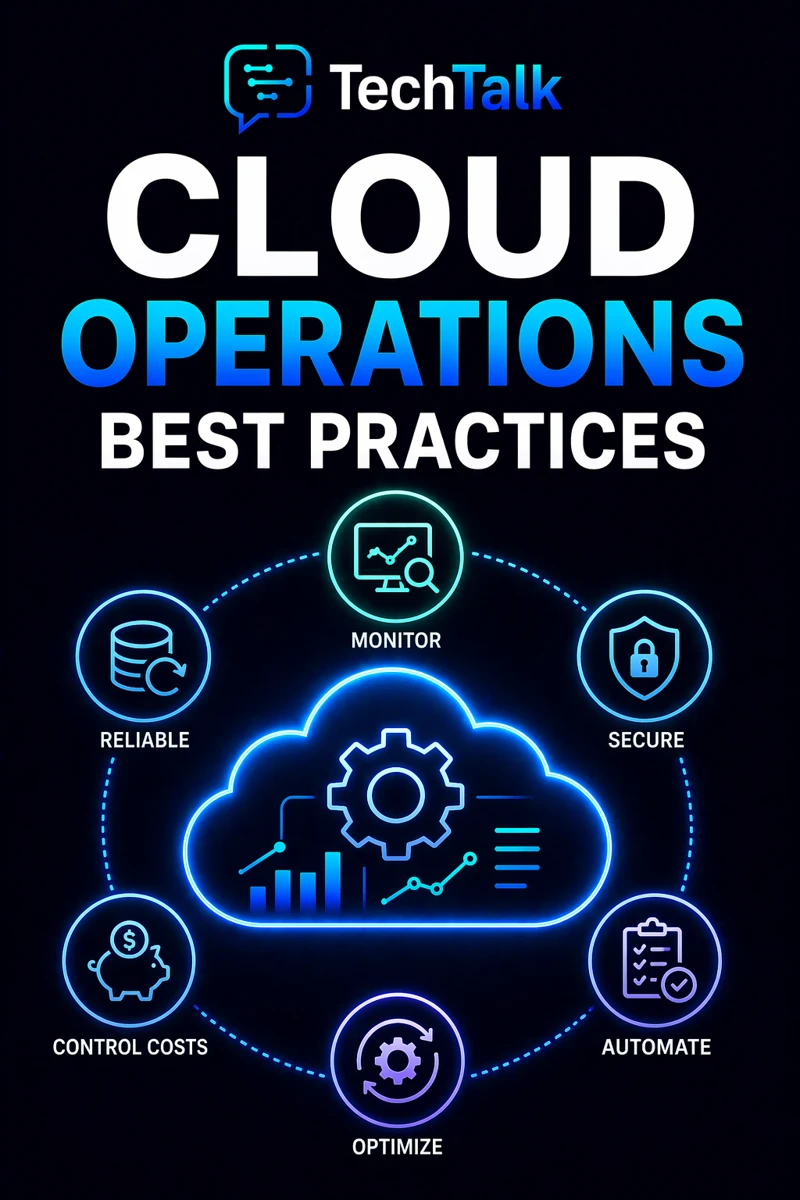
Effective cloud operations combine monitoring, automation, standardization, cost control, and security.
The Hidden Risk: Reactive Operations
Many businesses:
- respond to issues after they occur
- lack proactive processes
This leads to:
- delayed response
- increased downtime
- higher costs
This is common in environments lacking cloud infrastructure strategy.
Reactive operations increase risk and reduce efficiency.
What Breaks Cloud Operations
Operations fail when:
- monitoring is incomplete
- automation is limited
- processes are unclear
- governance is weak
These issues are often tied to cloud misconfigurations and risk.
The Role of Scalability in Operations
Operations must support growth.
This includes:
- dynamic scaling
- resource optimization
This aligns with scaling cloud infrastructure.
The Role of Reliability in Operations
Operations ensure uptime.
This includes:
- redundancy
- failover
- monitoring
This aligns with cloud infrastructure reliability.
Operations determine how stable and reliable your infrastructure is.
The Role of IaC in Operations
Infrastructure as Code supports operations.
This includes:
- consistent deployments
- version control
- automation
This aligns with infrastructure as code explained.
The Complexity of Cloud Operations
Modern cloud environments are:
- distributed
- interconnected
- constantly changing
This creates:
- operational complexity
- multiple dependencies
- management challenges
These challenges are explained in cloud infrastructure explained.
What a Mature Cloud Operations Environment Looks Like
A strong environment includes:
- proactive monitoring
- automated processes
- standardized configurations
- controlled costs
It must also align with cloud infrastructure strategy.
Cloud operations should be proactive, automated, and continuously optimized.
How Cloud Operations Impact Business Performance
Cloud operations directly affect:
- uptime
- efficiency
- cost
Poor operations lead to:
- downtime
- wasted resources
- increased risk
Operations maturity determines long-term infrastructure success.
How to Know If Your Operations Need Improvement
You may have a gap if:
- issues are discovered late
- processes are unclear
- costs are increasing
- performance is inconsistent
If your operations are reactive, improvement is needed.
How to Improve Cloud Operations
Start with:
- implementing monitoring
- automating processes
- standardizing configurations
- enforcing governance
These steps align with broader cloud infrastructure strategy.
How This Connects to Other Cloud Topics
Cloud operations are part of a complete infrastructure system.
They connect to:
- what is cloud infrastructure
- managing cloud infrastructure
- cloud infrastructure monitoring
- cloud infrastructure automation
- cloud infrastructure strategy
What This Means for Your Business
Your operations determine:
- how stable your systems are
- how efficient your infrastructure is
- how scalable your environment becomes
It is not optional.
It is essential.
Strong cloud operations ensure your infrastructure delivers consistent value.
Final Thoughts
Cloud operations are not just about maintenance.
They are about performance, efficiency, and control.
When done correctly:
- systems remain stable
- costs are controlled
- risks are minimized
Need help with this topic?
Make sure your backups actually work when it matters.
Most businesses discover backup failures during an outage. We help you validate recovery, reduce downtime risk, and build a system that works under pressure.
- Backup validation and testing
- Recovery time optimization
- Clear recovery documentation