What Cloud Infrastructure Failure Really Means
Cloud infrastructure failure occurs when systems:
- become unavailable
- perform poorly
- experience security issues
Failure is not always catastrophic.
It often appears as:
- slow performance
- intermittent outages
- increasing costs
If you need foundational context, start with what cloud infrastructure is.
Cloud technology rarely fails — execution does.
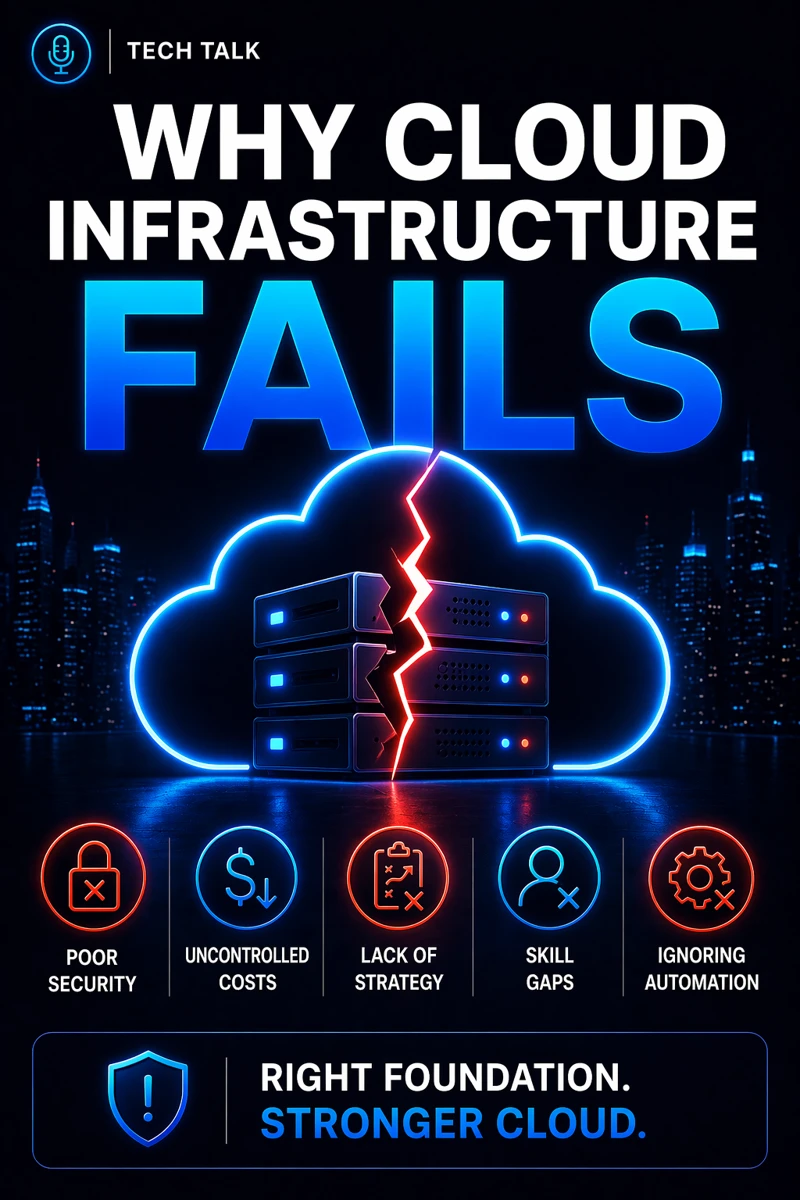
Why Cloud Infrastructure Fails
Failures are usually caused by:
- poor planning
- misconfiguration
- lack of monitoring
- weak processes
These issues are not technical limitations.
They are operational failures.
This makes failure analysis a key part of managing cloud infrastructure.
The Most Common Causes of Cloud Failure
Cloud failures typically come from several root causes.
Lack of Strategy (No Clear Direction)
Without strategy:
- systems are built inconsistently
- resources are misused
This aligns with cloud infrastructure strategy.
Misconfigurations (Incorrect Settings)
Misconfigured systems lead to:
- outages
- security vulnerabilities
This aligns with cloud misconfigurations and risk.
Lack of Monitoring (No Visibility)
Without monitoring:
- issues go unnoticed
- failures escalate
This aligns with cloud infrastructure monitoring.
Poor Resource Management
Improper resource allocation leads to:
- performance issues
- inefficiency
This aligns with right-sizing cloud resources.
Ineffective Scaling
Failure to scale properly causes:
- system overload
- downtime
This aligns with scaling cloud infrastructure.
Cloud failures are usually caused by planning, configuration, and management issues.
The Hidden Cause: Complexity
Cloud environments are:
- distributed
- dynamic
- interconnected
This complexity leads to:
- hidden dependencies
- unexpected issues
These challenges are explained in cloud infrastructure explained.
Complex systems fail when they are not properly managed.
What Breaks Cloud Infrastructure
Infrastructure breaks when:
- processes are not defined
- systems are not monitored
- configurations are inconsistent
- governance is weak
These issues are often tied to cloud infrastructure mistakes.
The Role of Architecture in Preventing Failure
Good architecture prevents failure.
This includes:
- redundancy
- scalability
- optimized design
This aligns with cloud infrastructure architecture.
Infrastructure design determines how resilient your systems are.
The Role of Reliability Planning
Reliability planning ensures uptime.
This includes:
- failover
- redundancy
- monitoring
This aligns with cloud infrastructure reliability.
The Role of Automation in Preventing Failure
Automation reduces human error.
This includes:
- consistent deployments
- automated responses
This aligns with cloud infrastructure automation.
The Role of Cost Management in Stability
Cost mismanagement can lead to:
- resource shortages
- system degradation
This aligns with cloud cost management strategies.
The Complexity of Failure
Failures often involve:
- multiple systems
- dependencies
- workflows
This creates:
- cascading issues
- difficult troubleshooting
These challenges are explained in cloud infrastructure explained.
What a Stable Cloud Environment Looks Like
A strong environment includes:
- clear strategy
- optimized architecture
- continuous monitoring
- automated processes
It must also align with cloud infrastructure strategy.
Preventing failure requires proactive management and continuous optimization.
How Failures Impact Business Operations
Cloud failures directly affect:
- uptime
- performance
- revenue
Poor infrastructure leads to:
- downtime
- lost productivity
- customer dissatisfaction
Cloud failure can disrupt operations and impact revenue.
How to Know If Your Infrastructure Is at Risk
You may have a gap if:
- systems are inconsistent
- issues occur frequently
- monitoring is limited
- costs are unpredictable
If your environment lacks visibility or consistency, failure risk is high.
How to Prevent Cloud Infrastructure Failure
Start with:
- building a clear strategy
- optimizing architecture
- implementing monitoring
- automating processes
These steps align with broader cloud infrastructure strategy.
How This Connects to Other Cloud Topics
Cloud failure connects to:
- what is cloud infrastructure
- cloud infrastructure mistakes
- cloud infrastructure reliability
- cloud infrastructure monitoring
- cloud infrastructure strategy
What This Means for Your Business
Your ability to prevent failure determines:
- system stability
- operational efficiency
- business continuity
It is not optional.
It is critical.
Cloud infrastructure fails when it is not actively managed and optimized.
Final Thoughts
Cloud infrastructure failure is common.
But it is preventable.
When managed properly:
- systems remain stable
- risks are reduced
- operations are reliable
Need help with this topic?
Make sure your backups actually work when it matters.
Most businesses discover backup failures during an outage. We help you validate recovery, reduce downtime risk, and build a system that works under pressure.
- Backup validation and testing
- Recovery time optimization
- Clear recovery documentation