What Hidden Cloud Risks Really Mean
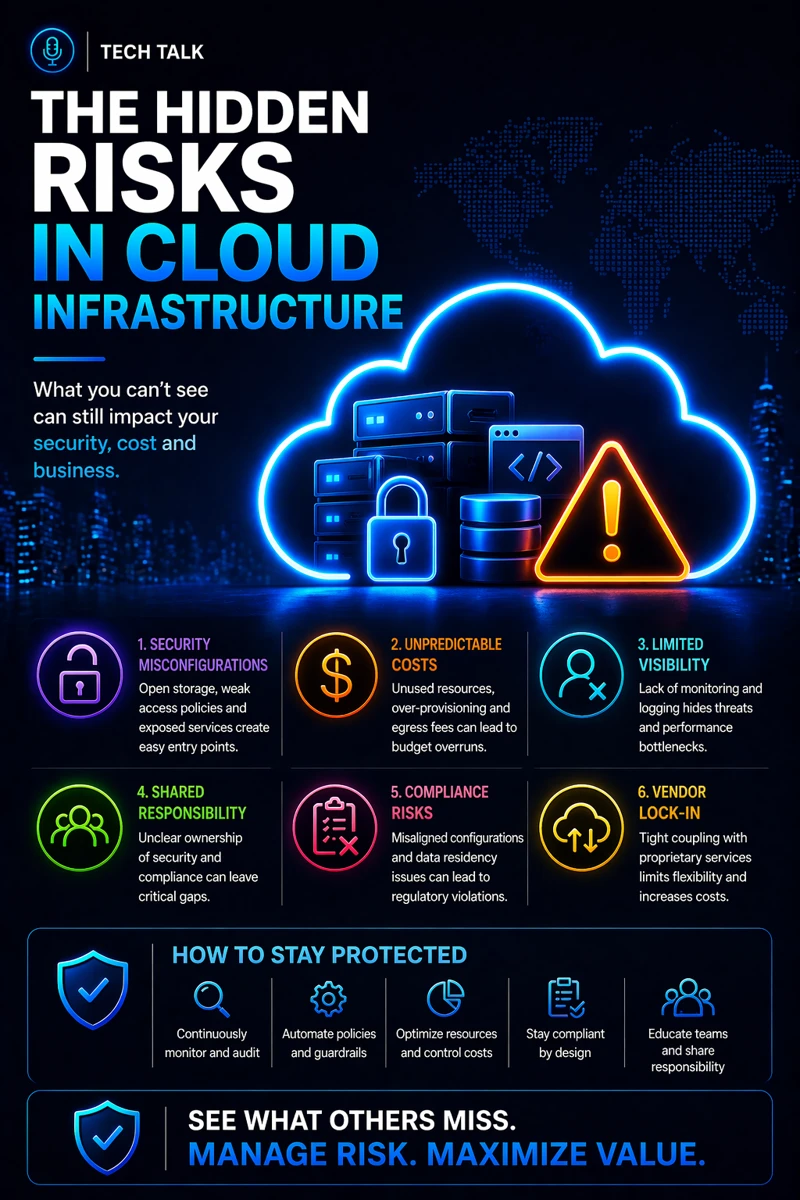
Hidden risks in cloud infrastructure are issues that are not immediately visible but can cause:
- downtime
- performance problems
- security vulnerabilities
These risks often exist quietly until they cause failure.
If you need foundational context, start with what cloud infrastructure is.
The most dangerous cloud risks are the ones you cannot see.
Why Hidden Risks Exist
Cloud environments are:
- complex
- distributed
- constantly changing
This creates:
- unseen dependencies
- configuration drift
- hidden inefficiencies
These challenges are explained in cloud infrastructure explained.
The Most Common Hidden Risks in Cloud Infrastructure
Businesses often overlook several key risks.
Misconfigurations (Invisible Vulnerabilities)
Incorrect settings can go unnoticed.
This leads to:
- security exposure
- system instability
This aligns with cloud misconfigurations and risk.
Dependency Failures (Hidden System Connections)
Cloud systems rely on:
- APIs
- services
- integrations
Failure in one area can affect others.
Lack of Visibility (No Monitoring)
Without monitoring:
- risks remain undetected
- issues escalate
This aligns with cloud infrastructure monitoring.
Configuration Drift (Slow Degradation)
Systems change over time.
This leads to:
- inconsistency
- unpredictable behavior
This aligns with cloud configuration management.
Cost Inefficiencies (Hidden Waste)
Unused or misallocated resources increase cost.
This aligns with cloud infrastructure cost optimization.
Hidden risks often involve misconfigurations, dependencies, lack of visibility, and inefficiency.
The Hidden Risk of Complexity
Cloud environments are inherently complex.
This complexity creates:
- multiple failure points
- hard-to-detect issues
This is why complexity is a major factor in why cloud infrastructure fails.
Complex systems create risks that are difficult to detect without proper tools.
What Makes Hidden Risks Dangerous
Hidden risks are dangerous because:
- they are not obvious
- they are not monitored
- they grow over time
This leads to:
- sudden failures
- unexpected downtime
These outcomes are often tied to cloud downtime causes.
The Role of Monitoring in Risk Detection
Monitoring reveals hidden risks.
This includes:
- tracking system health
- detecting anomalies
This aligns with cloud infrastructure monitoring.
Without monitoring, hidden risks remain undetected.
The Role of Automation in Reducing Risk
Automation helps maintain consistency.
This includes:
- reducing manual errors
- enforcing standards
This aligns with cloud infrastructure automation.
The Role of Architecture in Risk Prevention
Strong architecture reduces risk.
This includes:
- redundancy
- distributed systems
This aligns with cloud infrastructure architecture.
The Role of Governance in Managing Risk
Governance provides control.
This includes:
- policies
- access management
- compliance
This aligns with cloud infrastructure strategy.
The Complexity of Hidden Risks
Hidden risks often involve:
- multiple systems
- dependencies
- workflows
This creates:
- cascading failures
- difficult troubleshooting
These challenges are explained in cloud infrastructure explained.
What a Low-Risk Cloud Environment Looks Like
A strong environment includes:
- continuous monitoring
- standardized configurations
- automated processes
- clear governance
It must also align with cloud infrastructure strategy.
Hidden risks are reduced through visibility, automation, and proactive management.
How Hidden Risks Impact Business Operations
Hidden risks directly affect:
- system stability
- performance
- security
If not addressed:
- failures occur unexpectedly
- operations are disrupted
Hidden risks can cause sudden and costly disruptions.
How to Know If You Have Hidden Risks
You may have hidden risks if:
- monitoring is limited
- systems are inconsistent
- issues appear unexpectedly
- costs are unpredictable
If your environment lacks visibility, hidden risks are likely present.
How to Identify and Reduce Hidden Risks
Start with:
- implementing monitoring
- reviewing configurations
- mapping dependencies
- automating processes
These steps align with broader cloud infrastructure strategy.
How This Connects to Other Cloud Topics
Hidden risks connect to:
- what is cloud infrastructure
- cloud misconfigurations and risk
- cloud configuration management
- cloud infrastructure monitoring
- cloud infrastructure strategy
What This Means for Your Business
Your ability to identify hidden risks determines:
- system reliability
- operational stability
- risk exposure
It is not optional.
It is critical.
Hidden risks become visible only when you actively look for them.
Final Thoughts
Hidden risks are one of the biggest threats to cloud infrastructure.
But they can be managed.
When addressed properly:
- systems remain stable
- risks are reduced
- operations are predictable
Need help with this topic?
Make sure your backups actually work when it matters.
Most businesses discover backup failures during an outage. We help you validate recovery, reduce downtime risk, and build a system that works under pressure.
- Backup validation and testing
- Recovery time optimization
- Clear recovery documentation