What Cloud Deployment Models Really Mean
Cloud deployment models define how your infrastructure is built and managed.
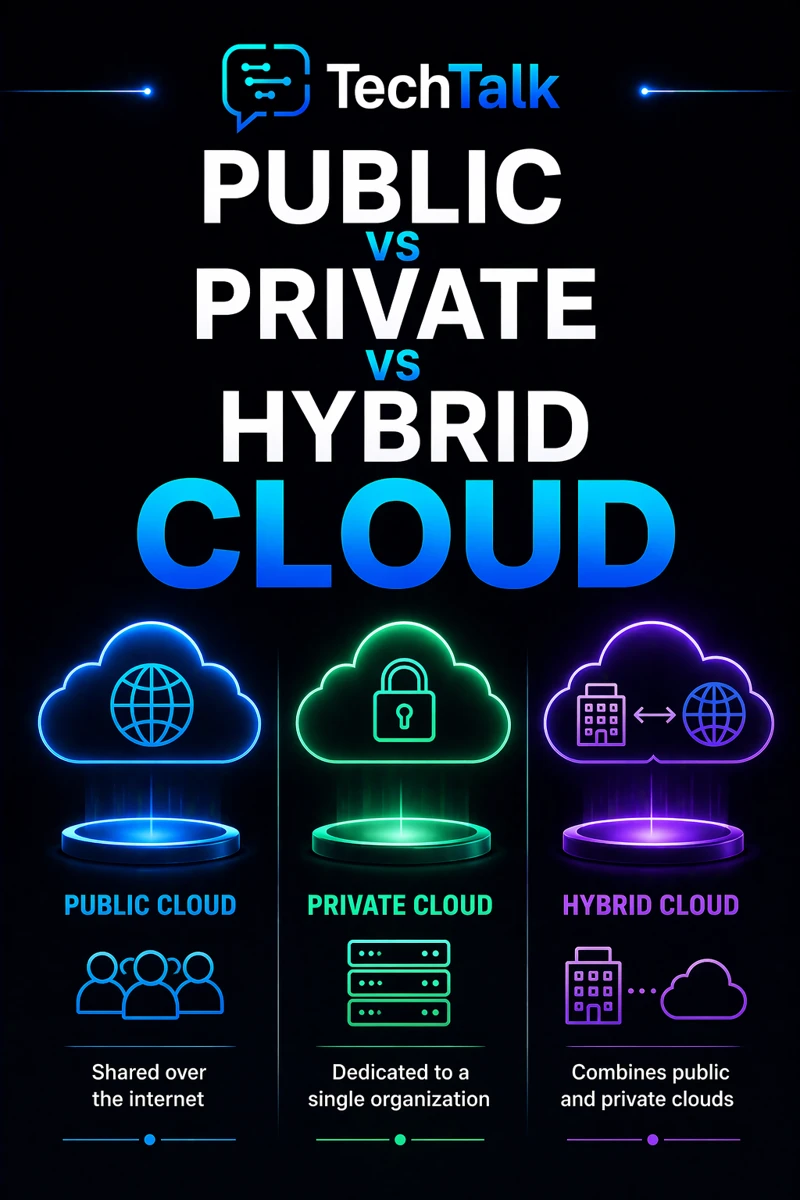
The three main types are:
- public cloud
- private cloud
- hybrid cloud
Each model offers different trade-offs in:
- cost
- control
- scalability
- security
If you need foundational context, start with what cloud infrastructure is.
Choosing the wrong cloud model can create long-term cost, performance, and security issues.
Why Choosing the Right Model Matters
Your cloud model determines:
- how systems are deployed
- how resources are managed
- how data is secured
It directly impacts:
- performance
- scalability
- cost
This decision is a key part of cloud infrastructure strategy.
Public Cloud Explained
Public cloud is infrastructure provided by third-party providers.
Examples include:
- shared infrastructure
- on-demand resources
- pay-as-you-go pricing
Benefits of Public Cloud
- highly scalable
- cost-effective
- easy to deploy
This aligns with scaling cloud infrastructure.
Risks of Public Cloud
- less control
- shared environment
- potential security concerns
These risks are addressed in cloud infrastructure security.
Public cloud is ideal for scalability and flexibility, but requires strong configuration and security.
Private Cloud Explained
Private cloud is dedicated infrastructure for a single organization.
It can be:
- hosted on-premise
- hosted by a provider
Benefits of Private Cloud
- greater control
- enhanced security
- customized environments
Risks of Private Cloud
- higher cost
- limited scalability
- increased management complexity
These challenges are explained in cloud infrastructure explained.
Private cloud provides control and security, but requires more management and investment.
Hybrid Cloud Explained
Hybrid cloud combines public and private environments.
This allows:
- sensitive workloads to remain private
- scalable workloads to run in public cloud
Benefits of Hybrid Cloud
- flexibility
- balanced cost and control
- optimized workload placement
Risks of Hybrid Cloud
- increased complexity
- integration challenges
- higher management overhead
This approach often requires strong cloud infrastructure architecture.
Hybrid cloud balances flexibility and control, but requires careful design and management.
The Hidden Risk: Choosing Based on Cost Alone
Many businesses choose a cloud model based only on:
- initial cost
This leads to:
- performance issues
- scalability limitations
- security risks
This is a common issue in environments lacking cloud infrastructure planning.
Cost alone should not determine your cloud model — long-term impact matters more.
What Breaks Cloud Model Decisions
Choosing the wrong model leads to:
- inefficient resource usage
- performance bottlenecks
- increased cost
These issues are often tied to cloud misconfigurations and risk.
The Role of Performance in Model Selection
Different models impact performance.
Public cloud:
- optimized for scalability
Private cloud:
- optimized for control
Hybrid cloud:
- optimized for flexibility
This aligns with cloud performance optimization.
The Role of Security in Model Selection
Security requirements often drive decisions.
Private cloud:
- more control over data
Public cloud:
- requires strong configuration
Hybrid cloud:
- allows separation of sensitive workloads
This aligns with securing cloud infrastructure.
Security depends on how the environment is configured — not just the model itself.
The Role of Cost in Model Selection
Cost varies by model.
Public cloud:
- lower upfront cost
- variable ongoing cost
Private cloud:
- higher upfront cost
- predictable expenses
Hybrid cloud:
- mixed cost structure
This ties into cloud infrastructure cost optimization.
What a Well-Chosen Cloud Model Looks Like
A strong decision includes:
- alignment with business needs
- clear performance requirements
- defined security needs
- controlled cost structure
It must also align with cloud infrastructure strategy.
The best cloud model aligns with your business goals, not just technical preferences.
How Cloud Models Impact Business Operations
Your model determines:
- how systems scale
- how secure your data is
- how efficiently you operate
Poor decisions lead to:
- inefficiency
- increased cost
- operational challenges
Your cloud model affects every aspect of your infrastructure.
How to Choose the Right Cloud Model
Start with:
- defining business requirements
- evaluating performance needs
- assessing security requirements
- analyzing cost structure
These steps align with broader cloud infrastructure strategy.
How This Connects to Other Cloud Topics
Cloud models are part of a complete infrastructure system.
They connect to:
- what is cloud infrastructure
- cloud infrastructure strategy
- cloud infrastructure architecture
- cloud performance optimization
- cloud infrastructure cost optimization
What This Means for Your Business
Your cloud model determines:
- how your infrastructure operates
- how scalable your systems are
- how secure your environment is
It is not optional.
It is foundational.
The right cloud model sets the foundation for everything else in your infrastructure.
Final Thoughts
There is no one-size-fits-all cloud model.
The right choice depends on:
- your business needs
- your performance requirements
- your security priorities
When chosen correctly:
- systems are efficient
- costs are controlled
- operations are optimized
Need help with this topic?
Make sure your backups actually work when it matters.
Most businesses discover backup failures during an outage. We help you validate recovery, reduce downtime risk, and build a system that works under pressure.
- Backup validation and testing
- Recovery time optimization
- Clear recovery documentation