What Cloud Migration Risks Really Mean
Cloud migration risks are the potential issues that can occur when moving systems to the cloud.
These risks affect:
- system performance
- business continuity
- data security
- cost
Migration is one of the most complex phases of cloud adoption.
If you need foundational context, start with what cloud infrastructure is.
Cloud migration introduces risk — whether you plan for it or not.
Why Migration Risk Matters
Migration directly impacts:
- uptime
- user experience
- operational continuity
Without risk management:
- downtime increases
- data issues occur
- costs rise
This makes risk awareness a key part of cloud migration strategy.
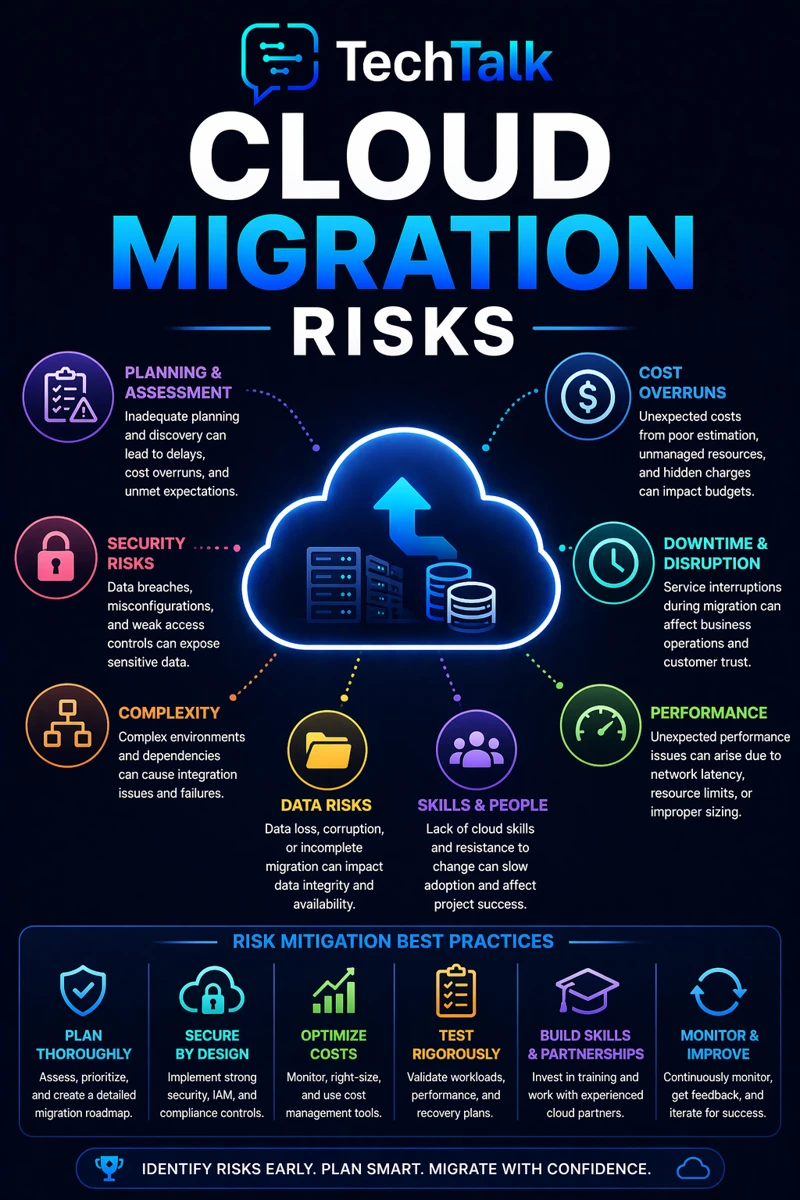
The Most Common Cloud Migration Risks
Migration introduces several types of risk.
Downtime Risk (Service Disruption)
Systems may become unavailable during migration.
Causes include:
- poor scheduling
- lack of failover planning
This aligns with cloud infrastructure and business continuity.
Data Loss Risk (Loss or Corruption)
Data may be lost or corrupted.
Causes include:
- improper transfer processes
- lack of backups
This aligns with cloud disaster recovery explained.
Performance Risk (Degraded Systems)
Systems may perform worse after migration.
Causes include:
- incorrect sizing
- poor architecture
This aligns with cloud performance optimization.
Cost Overrun Risk (Unexpected Expenses)
Costs may increase during or after migration.
Causes include:
- inefficient resource usage
- duplicate environments
This aligns with cloud cost management strategies.
Security Risk (Exposure or Misconfiguration)
Security gaps may appear.
Causes include:
- incorrect configurations
- lack of monitoring
This aligns with cloud infrastructure security.
Most migration risks are caused by poor planning, not technical limitations.
The Hidden Risk: Unknown Dependencies
Many systems have hidden dependencies.
Examples include:
- application connections
- data flows
- system integrations
If not identified:
- systems break
- performance issues occur
This is common in environments lacking cloud infrastructure planning.
Unknown dependencies are one of the most common causes of migration failure.
What Causes Migration Failures
Migration fails when:
- planning is incomplete
- testing is insufficient
- monitoring is missing
- execution is rushed
These issues are often tied to cloud misconfigurations and risk.
The Role of Testing in Risk Reduction
Testing reduces risk.
This includes:
- validating systems
- identifying issues
- simulating workloads
The Role of Monitoring During Migration
Monitoring provides visibility.
This includes:
- tracking system performance
- detecting issues early
This aligns with cloud infrastructure monitoring.
Without monitoring, migration issues are discovered too late.
The Role of Architecture in Risk Management
Proper architecture reduces risk.
This includes:
- scalable design
- optimized workloads
- redundancy
This aligns with cloud infrastructure architecture.
The Role of Backup and Recovery
Backup and recovery protect data.
This includes:
- backups before migration
- recovery plans
This aligns with cloud disaster recovery explained.
The Complexity of Migration Risk
Migration involves:
- multiple systems
- dependencies
- workflows
This creates:
- complexity
- potential failure points
These challenges are explained in cloud infrastructure explained.
What a Low-Risk Migration Looks Like
A strong migration includes:
- detailed planning
- dependency mapping
- thorough testing
- continuous monitoring
It must also align with cloud migration strategy.
Risk is reduced through planning, testing, and phased execution.
How Migration Risks Impact Business Operations
Migration risks directly affect:
- uptime
- performance
- customer experience
Poor risk management leads to:
- downtime
- data loss
- financial impact
Migration risks can disrupt operations and impact revenue.
How to Know If Your Migration Is High Risk
You may have a gap if:
- dependencies are unclear
- testing is limited
- monitoring is not in place
- migration is rushed
If your migration lacks planning or testing, risk is high.
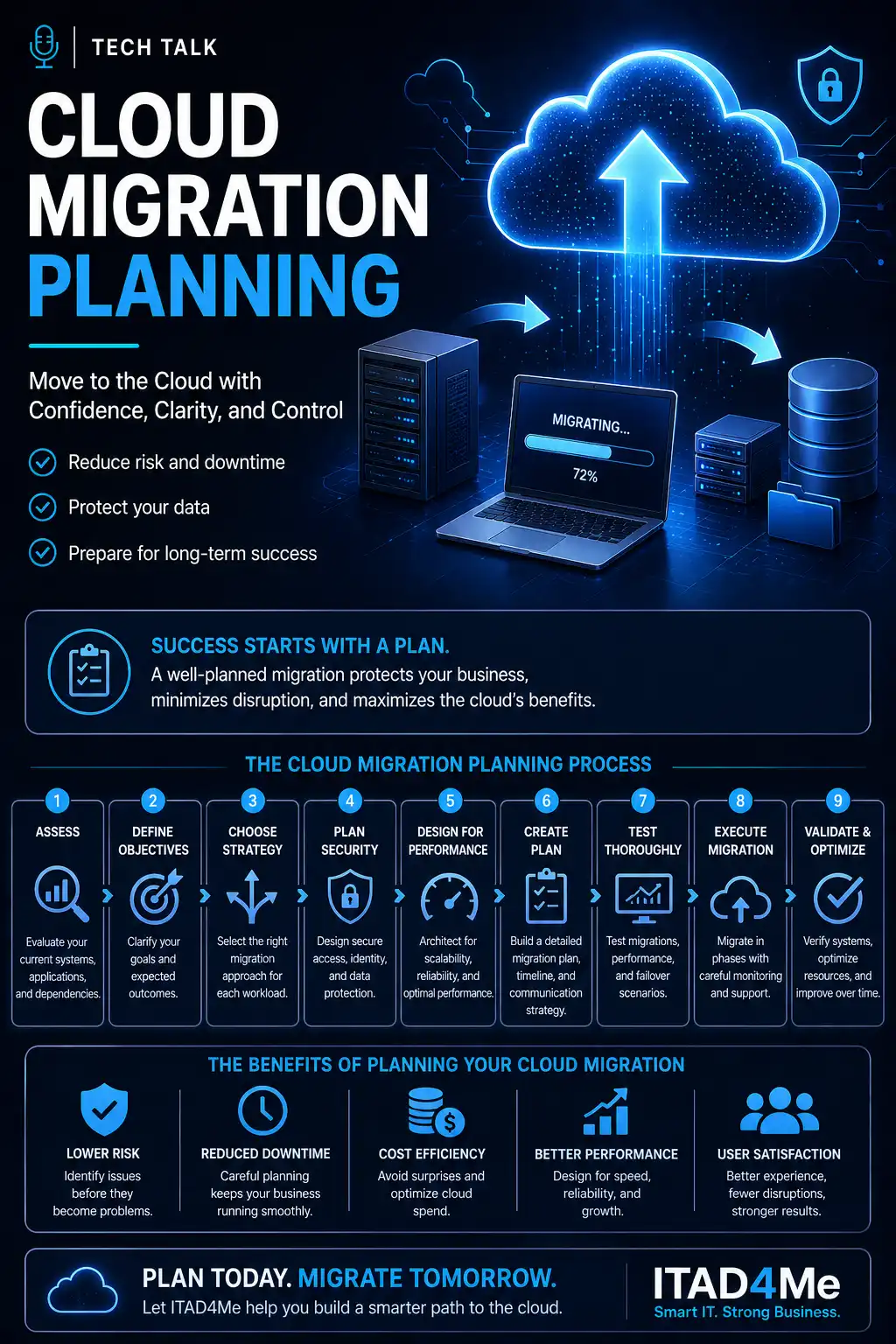
How to Reduce Cloud Migration Risks
Start with:
- mapping dependencies
- testing systems
- implementing monitoring
- planning phased execution
These steps align with broader cloud infrastructure strategy.
How This Connects to Other Cloud Topics
Migration risk is part of a complete infrastructure system.
It connects to:
- what is cloud infrastructure
- cloud migration strategy
- cloud infrastructure planning
- cloud disaster recovery explained
- cloud infrastructure strategy
What This Means for Your Business
Your migration risk determines:
- how stable your systems remain
- how smoothly you transition
- how protected your data is
It is not optional.
It is critical.
Understanding risks is the first step to avoiding them.
Final Thoughts
Cloud migration is a high-risk process.
But those risks can be controlled.
When managed properly:
- systems remain stable
- data is protected
- operations continue smoothly
Need help with this topic?
Make sure your backups actually work when it matters.
Most businesses discover backup failures during an outage. We help you validate recovery, reduce downtime risk, and build a system that works under pressure.
- Backup validation and testing
- Recovery time optimization
- Clear recovery documentation