What Hybrid Cloud Infrastructure Really Means
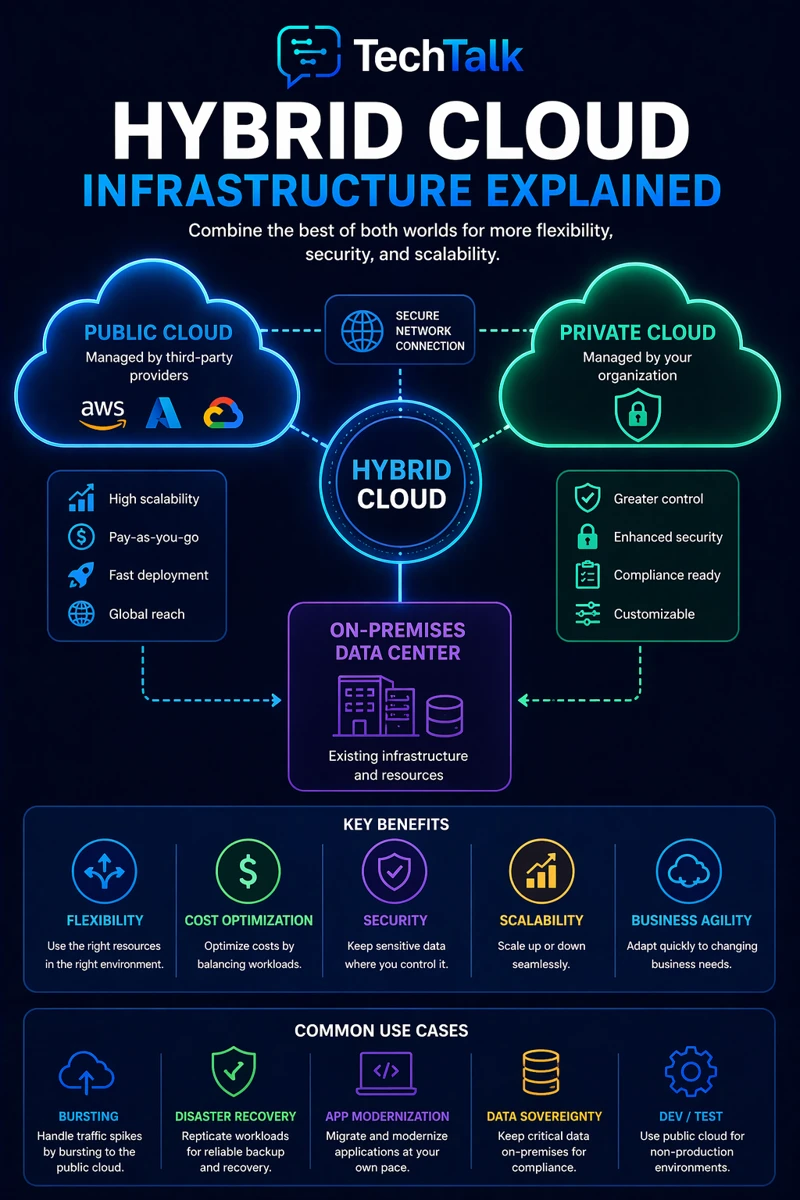
Hybrid cloud infrastructure combines multiple environments into a single system.
This typically includes:
- public cloud
- private cloud
- on-premise systems
The goal is to:
- balance flexibility and control
- optimize performance
- manage risk
If you need foundational context, start with what cloud infrastructure is.
Hybrid cloud increases flexibility — but also increases complexity.
Why Businesses Use Hybrid Cloud
Hybrid cloud allows businesses to:
- keep sensitive data in private environments
- scale applications in public cloud
- maintain existing infrastructure
This approach is increasingly common in modern environments.
It builds on concepts explained in public vs private vs hybrid cloud.
What a Real Hybrid Scenario Looks Like
A typical scenario:
- critical data remains on private infrastructure
- applications run in public cloud
- systems communicate across environments
At that point:
- flexibility increases
- scalability improves
- management becomes more complex
These environments require strong cloud infrastructure architecture.
Hybrid environments are powerful — but only when properly designed and integrated.
The Core Components of Hybrid Cloud
Hybrid cloud relies on multiple elements working together.
Integration (Connecting Environments)
Systems must communicate across environments.
This includes:
- secure connections
- data synchronization
- application integration
Workload Distribution (Placing Systems Strategically)
Workloads must be placed correctly.
Examples:
- sensitive workloads in private cloud
- scalable workloads in public cloud
This aligns with cloud infrastructure strategy.
Security (Protecting Across Environments)
Security must be consistent.
This includes:
- access control
- data protection
- monitoring
This aligns with cloud infrastructure security.
Monitoring (Maintaining Visibility)
You must monitor all environments.
This includes:
- performance tracking
- usage monitoring
- alerting
This aligns with cloud infrastructure monitoring.
Hybrid cloud success depends on integration, visibility, and consistent management.
The Hidden Risk: Fragmentation
Hybrid cloud can become fragmented.
This happens when:
- systems are not integrated
- data is not synchronized
- management is inconsistent
This leads to:
- inefficiency
- security gaps
- performance issues
This is common in environments lacking cloud infrastructure planning.
Hybrid cloud without integration creates disconnected systems.
What Breaks Hybrid Cloud Environments
Hybrid cloud fails when:
- integration is weak
- security is inconsistent
- monitoring is incomplete
- architecture is poorly designed
These issues are often tied to cloud misconfigurations and risk.
The Role of Performance in Hybrid Cloud
Hybrid systems must maintain performance across environments.
This includes:
- minimizing latency
- optimizing workloads
- balancing resources
This aligns with cloud performance optimization.
The Role of Scalability in Hybrid Cloud
Hybrid environments must scale effectively.
This includes:
- using public cloud for demand spikes
- maintaining private control for critical systems
This aligns with scaling cloud infrastructure.
Hybrid cloud must be designed to scale across multiple environments.
The Complexity of Hybrid Cloud
Hybrid environments are:
- more complex
- harder to manage
- more difficult to secure
They require:
- consistent configuration
- centralized management
- continuous monitoring
These challenges are explained in cloud infrastructure explained.
What a Strong Hybrid Cloud Environment Looks Like
A strong environment includes:
- integrated systems
- consistent security
- optimized workload distribution
- continuous monitoring
It must also align with designing cloud infrastructure.
Hybrid cloud should operate as a unified system — not separate environments.
How Hybrid Cloud Impacts Cost
Hybrid cloud affects cost in different ways.
Benefits:
- optimized workload placement
- controlled resource usage
Challenges:
- increased management cost
- integration overhead
This ties into cloud infrastructure cost optimization.
How Hybrid Cloud Impacts Business Operations
Hybrid cloud enables:
- flexibility
- scalability
- control
But poor implementation leads to:
- inefficiency
- complexity
- increased risk
Hybrid cloud can improve operations — or complicate them — depending on how it is designed.
How to Know If Hybrid Cloud Is Right for You
You may benefit from hybrid cloud if:
- you need both control and scalability
- you have sensitive data requirements
- you operate across multiple environments
If your business needs both flexibility and control, hybrid cloud may be the right approach.
How to Implement Hybrid Cloud
Start with:
- defining workload requirements
- designing architecture
- integrating systems
- implementing monitoring
These steps align with broader cloud infrastructure strategy.
How This Connects to Other Cloud Topics
Hybrid cloud is part of a complete infrastructure system.
It connects to:
- what is cloud infrastructure
- public vs private vs hybrid cloud
- cloud infrastructure architecture
- cloud performance optimization
- cloud infrastructure strategy
What This Means for Your Business
Your infrastructure model determines:
- how flexible your systems are
- how secure your data is
- how scalable your environment is
It is not optional.
It is strategic.
Hybrid cloud enables flexibility and control — when designed correctly.
Final Thoughts
Hybrid cloud infrastructure is powerful.
But it requires:
- careful design
- strong integration
- continuous management
When done correctly:
- systems are flexible
- performance is optimized
- operations are efficient
Need help with this topic?
Make sure your backups actually work when it matters.
Most businesses discover backup failures during an outage. We help you validate recovery, reduce downtime risk, and build a system that works under pressure.
- Backup validation and testing
- Recovery time optimization
- Clear recovery documentation